
%201.svg)
AI readiness is easy to reduce to a tool question: which models, assistants, or platforms should the organization buy? That view is incomplete. Even capable technology can create limited value when teams lack clear use cases, reliable data, role-specific skills, review processes, or decision ownership.
An AI readiness assessment helps an organization examine those dependencies before it expands an AI initiative. It can also help HR and L&D teams distinguish a training need from a governance, data, process, or technology need.
Quick answer: An AI readiness framework is a structured way to review whether an organization has the strategy, leadership, workforce capability, data, governance, and technology needed for its intended AI use cases. The six-pillar framework in this article is a practical planning template. It is not a certified standard, and organizations should adapt it to their risk profile, industry, jurisdictions, and existing AI governance approach.
For organizations building formal AI risk-management practices, the NIST AI Risk Management Framework provides a widely used reference for managing AI risks. The template below is narrower and is designed to help HR, L&D, business, and technology stakeholders organize readiness discussions and workforce-development priorities.
What Is an AI Readiness Framework?
An AI readiness framework is a structured assessment of the conditions required to adopt AI for defined business use cases. Depending on the organization, that assessment may cover strategy, leadership and ownership, workforce skills, data, governance, security, privacy, technology, procurement, legal review, change management, and measurement.
A useful assessment does not try to produce a single universal score for the organization. It identifies where evidence is strong, where evidence is incomplete, and which constraint could prevent a specific AI use case from being implemented safely and effectively.
Why AI Readiness Is Not Only a Technology Question
Ownership affects decision speed and consistency
When roles are unclear, different teams may make different decisions about approved tools, data use, review requirements, or training. A readiness assessment should document who owns AI strategy, who approves use cases, who manages risk, and who is responsible for workforce enablement.
Different roles face different use cases and risks
Executives, managers, HR teams, technical specialists, and frontline employees may interact with AI in very different ways. A role that evaluates vendors needs different preparation from a role that uses an AI assistant for routine drafting, and both differ from a technical team building or integrating AI systems.
Measurement should match the intended outcome
Training completion can show participation, but it does not prove improved AI readiness. Organizations may need additional evidence such as skill demonstrations, approved-use adoption, workflow quality, error or exception patterns, manager observation, or business measures tied to the intended use case.
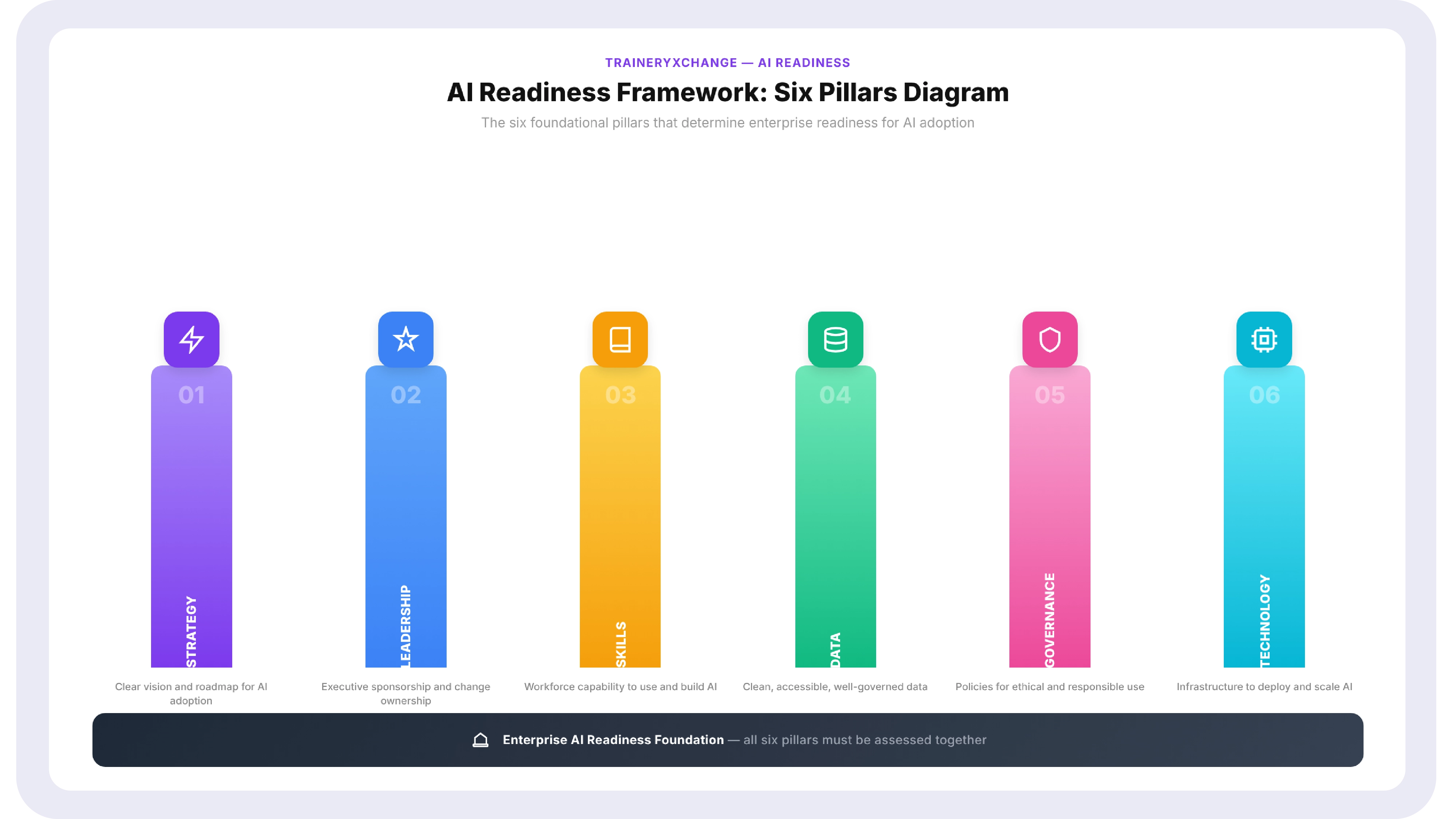
Practical AI Readiness Framework: Six Pillars
The six pillars below provide a starting structure for discussion. They should be treated as planning categories rather than a claim that every organization must use exactly six dimensions.
Pillar 1: Strategy
Review whether proposed AI initiatives are tied to defined business problems, users, outcomes, constraints, and decision owners. A strategy pillar should also distinguish experimentation from approved production use.
Questions to ask include: Which business problem is the use case intended to address? Who benefits? What is the acceptable level of human review? What would make the organization stop, revise, or expand the use case?
Pillar 2: Leadership and ownership
Review executive sponsorship, decision rights, communication, and accountability. Leadership readiness is not simply whether leaders support AI. It includes whether employees receive consistent guidance about priorities, approved use, escalation, and review responsibilities.
Pillar 3: Workforce skills
Assess the knowledge and behaviors required by role. Some employees may need basic AI literacy and policy awareness. Others may need prompt design, output evaluation, data handling, model limitations, testing, risk review, or technical implementation skills.
Do not assume course completion equals capability. Define how a learner would demonstrate the required behavior in the relevant workflow.
Pillar 4: Data
Review whether the data required for an AI use case is available, appropriate, permitted, documented, and of sufficient quality. Consider access control, data lineage, privacy, retention, classification, and whether the planned use of data is allowed under policy, contract, and applicable law.
Pillar 5: Governance and risk
Review policies, approval processes, human oversight, accountability, vendor review, security, privacy, testing, and incident response. Governance depth should reflect the consequence of the use case. A low-risk drafting assistant may not require the same controls as an AI-assisted employment, financial, safety, or customer-impacting decision.
Pillar 6: Technology
Review the tools, integrations, identity controls, environments, monitoring, and support needed for the use case. Technology readiness should include operational questions such as who configures the tool, how access is removed, how changes are tested, and what happens when a vendor or model changes.
Use the Scorecard to Find the Next Question, Not a Perfect Number
A readiness score can help stakeholders compare evidence and identify where more work is needed. It should not be treated as a certification, guarantee, or universal benchmark.
AI Readiness Scorecard: A 1-to-5 Discussion Scale
This scale can help teams structure a workshop. Before scoring, define the evidence required for each pillar and the use case being assessed. Different teams can otherwise assign the same number for very different reasons.
| Score | Practical Interpretation |
|---|---|
| 1: Undefined | No documented approach or owner has been identified for the use case in this pillar. |
| 2: Initial | Some activity exists, but it is informal, isolated, or supported by limited evidence. |
| 3: Defined | A documented approach exists, but implementation or evidence is inconsistent across the intended scope. |
| 4: Operating | The approach is in use for the intended scope, with defined ownership, evidence, and review processes. |
| 5: Reviewed and improving | The organization measures the approach, reviews exceptions or outcomes, and updates controls or capability based on evidence. |
A low score does not automatically mean that pillar is the first investment priority. Consider consequence, dependency, effort, and the intended use case. For example, a governance gap may block a high-risk deployment even when skills are also underdeveloped.
Assessment Questions for HR and L&D
- Skills: What AI-related tasks are employees actually expected to perform in each role?
- Skills: What evidence would show that an employee can perform those tasks appropriately?
- Leadership: Who owns AI workforce enablement, and who approves role-specific use?
- Leadership: Are employees receiving consistent guidance about approved tools and expected review?
- Governance: Which use cases require additional approval, human review, or specialist involvement?
- Governance: Do employees know where to escalate a concern or suspected AI-related incident?
- Measurement: Which measures will show whether the intended workflow improved without creating unacceptable risk?
Role-Based AI Skills Matrix
The matrix below is an example, not a fixed curriculum. Organizations should adapt it to actual tools, roles, policies, data access, and decision authority.
| Audience | Possible Capability Areas | Learning and Practice Focus |
|---|---|---|
| Executives | AI strategy, risk, vendor evaluation, governance, business trade-offs | Use-case evaluation, limitations, oversight, investment criteria, decision rights |
| HR and L&D | Workforce impact, learning design, skills assessment, policy-aware enablement | Role analysis, training design, human review, adoption measurement, change support |
| Managers | Team use-case selection, review of AI-assisted work, coaching, escalation | Workflow guidance, output evaluation, communication, appropriate oversight |
| IT and Data | Integration, security, data governance, testing, monitoring, administration | Technical implementation, access controls, evaluation, incident response, lifecycle management |
| Frontline employees | Approved task-specific use, limitations, data handling, human judgment | Short role-specific scenarios based on actual workflows and policy |
Role-based training can improve relevance because it connects learning to actual tasks and responsibilities. That does not mean every organization needs separate courses for every title. Roles with similar use cases and risks can often share a learning path.
Map Readiness Gaps to Role-Relevant Training
TraineryXchange can help teams review existing training content for AI literacy, management, compliance, and related workforce-development needs. Course availability, licensing, and delivery compatibility should be verified for the selected environment.
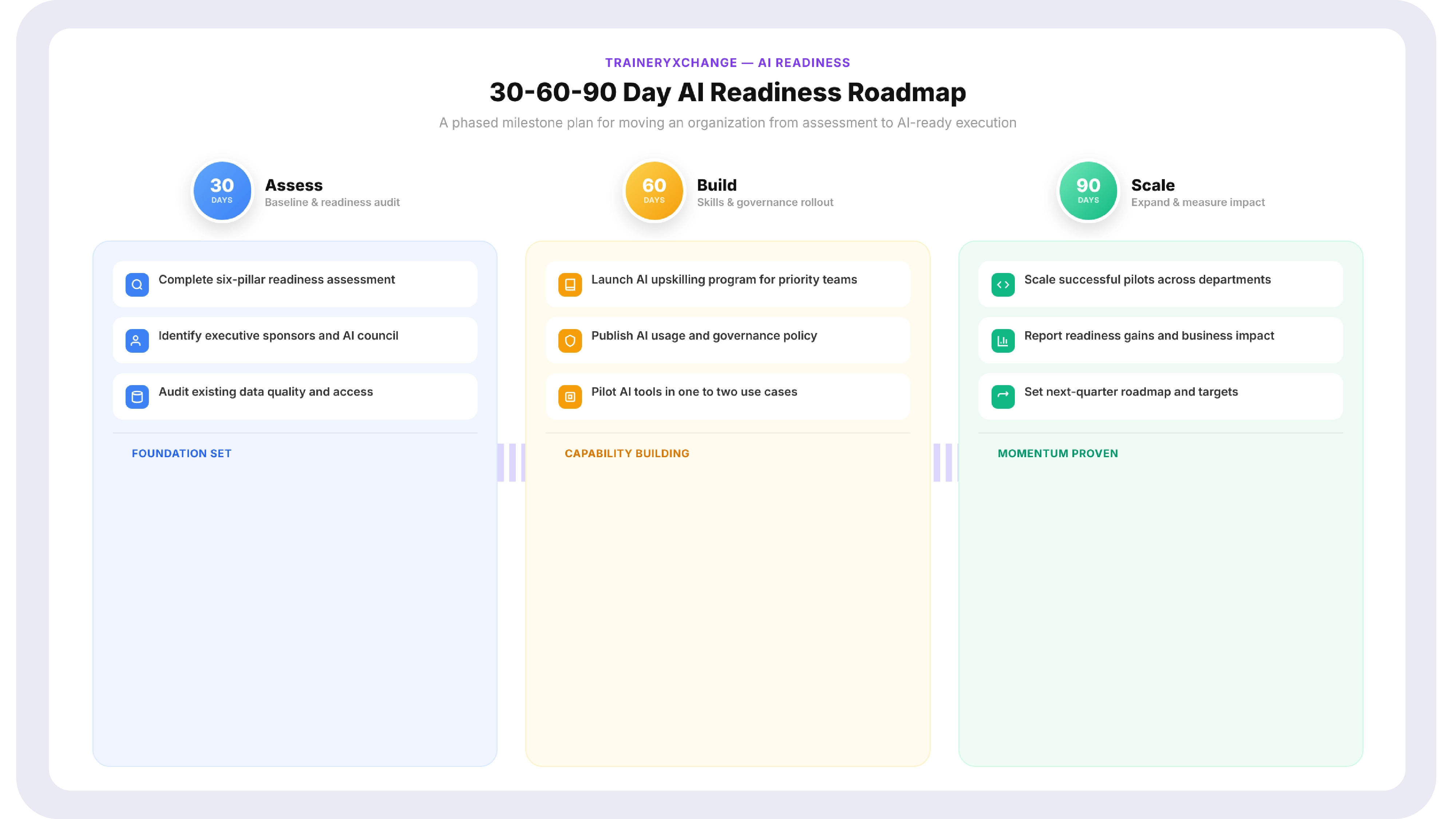
30-60-90-Day AI Readiness Roadmap Template
This is a sample planning sequence. Complex or high-risk organizations may need more time for legal review, procurement, security, data preparation, employee consultation, or technical implementation. Smaller, lower-risk pilots may move faster.
Days 1-30: Define scope and evidence
- Select one or more intended AI use cases rather than assessing AI in the abstract.
- Identify business owners, technical owners, risk stakeholders, and workforce groups affected.
- Score the six pillars using documented evidence and record areas of uncertainty.
- Define the role-specific capabilities and policy knowledge required for the pilot.
- Agree on what success, unacceptable risk, and escalation will look like.
Days 31-60: Design controls and pilot preparation
- Address the highest-priority readiness gaps that could block or materially affect the pilot.
- Create or select role-relevant training and practice activities.
- Document approval, review, data-handling, and escalation expectations.
- Configure the pilot environment and test access, identity, data flows, and support processes.
- Capture a baseline for the measures that will be reviewed later.
Days 61-90: Run, review, and decide
- Run the pilot with defined support and review responsibilities.
- Review learning evidence separately from workflow and business evidence.
- Record exceptions, incidents, user feedback, quality issues, and unexpected constraints.
- Revisit the relevant readiness pillars based on new evidence.
- Decide whether to expand, revise, pause, or stop the use case.
How a Learning Platform Can Support AI Readiness
A learning platform can support the workforce portion of an AI readiness program by organizing audiences, assigning learning, tracking participation, and providing learning records. The platform does not replace governance, data controls, technical validation, manager oversight, or business measurement.
Organize role-based learning
Teams can group learners by function, role, location, or another appropriate structure and assign different learning paths when the platform supports those workflows. Exact grouping, automation, and reporting capabilities depend on the selected LMS and configuration.
Track learning evidence
Completion, assessment scores, attempts, or other activity may provide useful evidence, depending on the content and platform. For applied AI skills, add work-based or scenario-based verification where appropriate rather than relying only on course completion.
Connect learning to the broader readiness review
Use learning data as one input into the scorecard. A change in training participation should not automatically be reported as a change in organizational AI readiness unless the scoring method explicitly defines that relationship and additional evidence supports it.
Common AI Readiness Mistakes
- Treating AI readiness as a technology purchase rather than a multi-stakeholder operating question.
- Assessing the organization without defining the AI use cases being considered.
- Using one generic course for audiences with materially different responsibilities and risks.
- Assuming a high completion rate proves improved capability or safer AI use.
- Leaving decision ownership, review requirements, or escalation paths unclear.
- Using a maturity score without documenting the evidence behind the number.
- Reusing an old readiness assessment after material changes to tools, policies, data, regulation, roles, or business use cases without reviewing whether the assumptions still hold.
Use the Framework as a Decision Aid, Not a Certification
The strongest use of an AI readiness framework is to make assumptions visible. It helps stakeholders identify what they know, what they do not know, which constraints matter for a proposed use case, and who owns the next action.
The six pillars and 1-to-5 scale in this guide are deliberately simple. They can support a workshop or planning process, but they should not replace formal risk management, legal review, security assessment, privacy analysis, regulatory obligations, or established standards that apply to the organization.
Review Role-Based AI Training Options
Discuss how TraineryXchange content and TraineryLMS options could support the workforce-development portion of an AI readiness plan. Available courses, delivery methods, reporting, and integrations depend on the selected content and configuration.
Book a Demo


%5B1%5D.svg)
