
LMS With Built-In Courses: 10 Options to Compare in 2026

Compare 10 LMS options with built-in courses and content libraries by course access, LMS functionality, integrations, delivery, licensing, reporting, administration, and content ownership.

Updated On:
February 25, 2026

Mahesh Kumar

Founder, TraineryHCM.com
LMS with built-in content comparison guide

Table of Contents

Searching for an LMS with built-in content sounds straightforward, but vendors use that phrase in different ways. One platform may include a ready-made library in the subscription. Another may sell a content library as an add-on. Another may provide a marketplace where third-party libraries can be purchased and managed. A content marketplace may also integrate with an LMS without being an LMS itself.

Quick answer: An LMS with built-in content combines learning administration with access to ready-made learning resources, but buyers should verify what “included” means. Check whether the library is part of the base plan, an optional content subscription, a marketplace, or an integration with an external provider. Also confirm whether the same system handles assignments, learner records, reporting, identity, and administration.

This guide compares ten options and alternatives that buyers may encounter when researching the category. It is not a fixed ranking. Product packaging changes, so pricing, course counts, trials, integrations, and content entitlements should be confirmed directly with the vendor before purchase.

What “Built-In Content” Can Mean

ModelHow It WorksWhat to Verify
Included libraryThe LMS plan includes access to a defined set of ready-made courses.Which courses, publishers, languages, topics, update practices, and learner limits are included?
Optional content libraryThe LMS and content library are sold separately but operate in the same platform.Separate fees, plan dependencies, licensing scope, and what happens to access if the content subscription ends.
Content marketplaceThe LMS provides access to one or more third-party providers that can be licensed through the platform.Which providers are available, whether contracts are consolidated, and how content is imported, updated, and reported.
Content integrationThe organization contracts with another provider and connects that library to the LMS.Integration method, data flow, SSO, completion reporting, content lifecycle, and support ownership.
Content-only platformThe vendor focuses on course discovery or licensing and expects the buyer to use another LMS for administration and records.How content is delivered into the LMS, which standards are supported, and who owns completion data.

10 LMS and Content Options to Compare in 2026

1. TraineryXchange and TraineryLMS

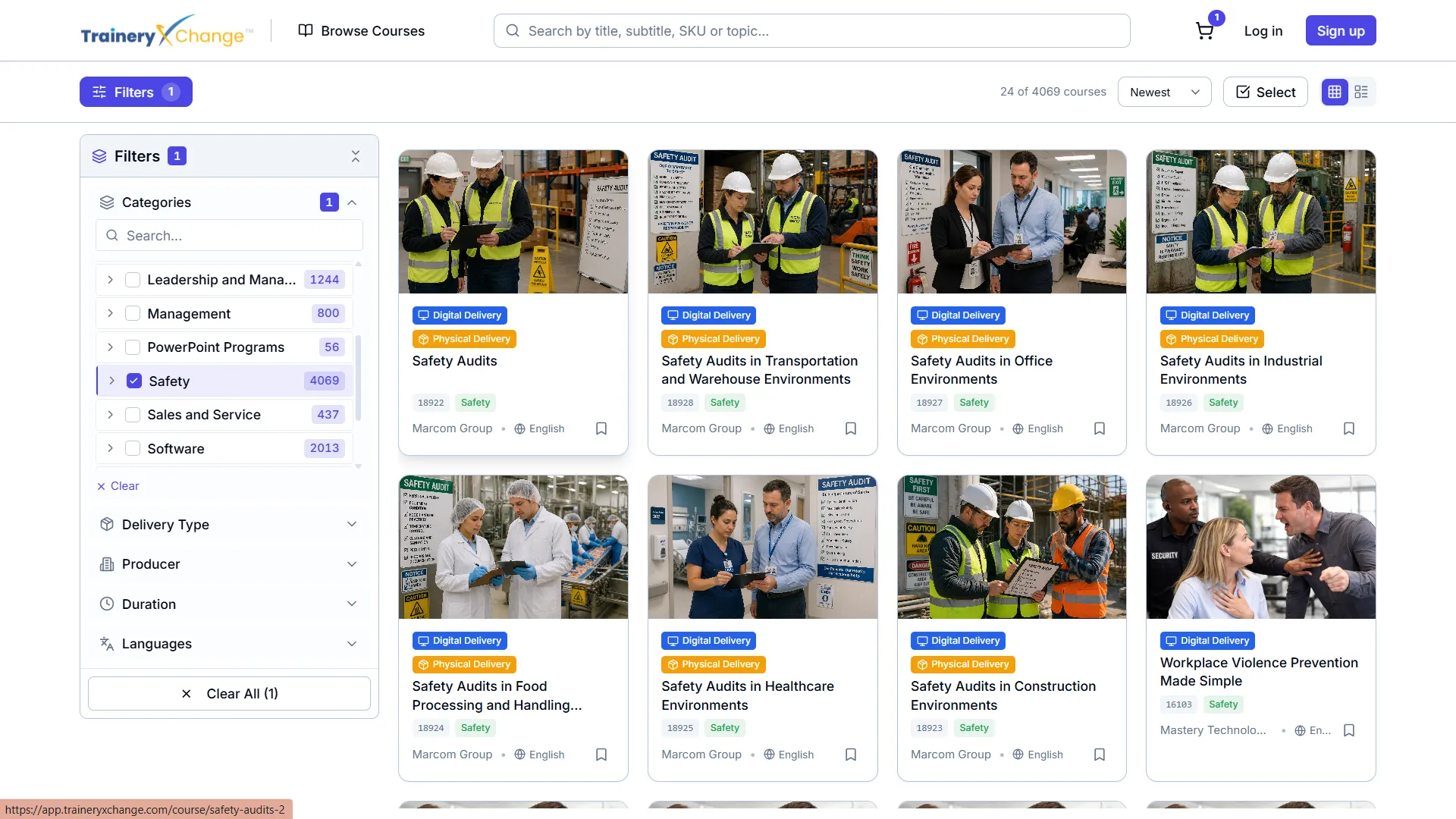
TraineryXchange combines curated training-content access with TraineryLMS options and supported delivery workflows for organizations that either need an LMS or already use one. Buyers should evaluate the actual content available for their topics, licensing model, LMS requirements, supported formats, reporting, and integration configuration.

Evaluate it when: the organization wants to compare a content marketplace and LMS option together rather than source them as completely separate projects.

Verify: current content availability, licensing, supported LMS delivery, SCORM/xAPI/AICC/LTI requirements, reporting, integrations, user administration, pricing, and trial or demo terms.

Compare Content and LMS Requirements Together

TraineryXchange can help teams review content, licensing, TraineryLMS, and supported delivery options against the learning environment they already use.

Book a Demo

2. Docebo

Docebo is an enterprise learning platform with LMS functionality and a Content Marketplace for third-party learning content. Its current product materials describe content discovery, preview, activation, assignment, reporting, and lifecycle management inside the platform.

Evaluate it when: the organization needs enterprise learning administration and wants to manage third-party content through the same environment.

Verify: which marketplace partners and content bundles are available in the required region, how content licensing is priced, which capabilities are included in the selected package, and the implementation requirements.

3. 360Learning

360Learning positions itself as a collaborative LMS and also supports off-the-shelf content, content aggregation, and third-party learning integrations. Its model can be relevant when an organization wants internal expert-created learning alongside external resources.

Evaluate it when: collaborative course creation, internal subject-matter expertise, and broader content aggregation are important.

Verify: which off-the-shelf libraries are available, whether content is included or separately licensed, administration, reporting, and the integrations required for the organization’s existing stack.

4. Absorb LMS

Absorb is an LMS platform that organizations may evaluate alongside ready-made content options. Because content packaging and partner availability can change, buyers should distinguish the LMS subscription from any content library or marketplace entitlement.

Evaluate it when: the organization is primarily selecting an LMS and wants to understand which ready-made content options can be added.

Verify: current content partners, plan structure, course delivery, reporting, APIs or integrations, and total cost for the LMS plus content.

5. Litmos

Litmos combines LMS functionality with Litmos Content Libraries. Current vendor materials describe content across compliance, safety, leadership, technical, customer, and industry-focused topics, with content governance and update processes managed by Litmos.

Evaluate it when: the organization wants an LMS and a vendor-managed ready-made content library in the same ecosystem.

Verify: which libraries are included in the selected package, jurisdiction-specific coverage, accessibility, languages, learning records, and any content-specific licensing conditions.

6. Cornerstone

Cornerstone is an enterprise learning and talent platform. Organizations researching LMS-with-content products may encounter Cornerstone because it offers learning administration and content-related products or services within a broader talent suite.

Evaluate it when: learning is part of a wider enterprise talent, skills, or workforce-technology program.

Verify: which content products are included, marketplace or library licensing, implementation scope, HR-system integrations, administration model, and whether the breadth of the suite matches the organization’s requirements.

7. TalentLMS with TalentLibrary

TalentLMS is an LMS, and TalentLibrary is an integrated ready-made content library available within the TalentLMS ecosystem. Current TalentLMS materials describe TalentLibrary as an optional library with workplace, leadership, compliance, onboarding, and other courses.

Evaluate it when: the organization wants a straightforward LMS with the option to add an integrated library rather than manage a separate content portal.

Verify: the TalentLibrary plan, current course coverage, licensing, reporting, customization limits, and whether the library can be used outside TalentLMS if that matters to the organization.

8. Go1

Go1 combines a broad learning-content aggregation model with Go1 Learn, a learning platform that can be used directly or alongside an existing LMS or HRIS. Buyers should verify which platform capabilities, content entitlements, integrations, reporting features, and delivery methods are included in their proposed configuration.

Evaluate it when: the organization wants broad third-party learning content and either plans to use Go1 Learn as its primary learning platform or deliver Go1 content through an existing LMS or HRIS.

Verify: current provider access, Go1 Learn capabilities, delivery into the target LMS or HRIS, licensing, languages, regional availability, content lifecycle, reporting, and integration requirements.

9. OpenSesame

OpenSesame is a training-content marketplace that works with many learning systems. It is better evaluated as a content layer than assumed to be the administrative LMS for every use case.

Evaluate it when: an existing LMS needs a broad external course catalog or specialized content providers.

Verify: marketplace licensing, target-LMS compatibility, content delivery, update workflow, course-level accessibility and language options, and how completion data is handled.

10. Learnerbly

Learnerbly is better understood as a learning-resource marketplace and employee-development platform than as a traditional compliance or assignment-focused LMS. It can appear in learning-platform comparisons because it gives employees access to external courses, books, and other development resources.

Evaluate it when: self-directed learning budgets and broad development-resource choice are more important than mandatory-course administration.

Verify: fulfillment times, resource access, reporting, approval workflows, integrations, and whether a separate LMS is needed for required training records.

Comparison Framework

OptionPrimary CategoryContent Model to VerifyBest Question to Ask
TraineryXchange / TraineryLMSLMS + content marketplace optionsCurated content, licensing, supported deliveryCan this cover both our content and LMS requirements in our current configuration?
DoceboEnterprise LMS / learning platformContent Marketplace and partner librariesWhich content partners and bundles are included in our proposed package?
360LearningCollaborative LMSInternal authoring, aggregation, off-the-shelf optionsHow will internal and external content be managed together?
Absorb LMSLMSContent options or partnershipsWhat is included in the LMS price versus licensed separately?
LitmosLMS + content librariesLitmos Content LibrariesWhich libraries and jurisdictions are included for our use case?
CornerstoneEnterprise learning/talent suiteContent products and servicesWhich parts of the broader suite do we actually need?
TalentLMSLMSTalentLibrary add-onDoes the integrated library cover our required topics and licensing needs?
Go1Content aggregation + learning platformGo1 content library and Go1 LearnWill we use Go1 Learn directly, or deliver Go1 content through our existing LMS or HRIS?
OpenSesameContent marketplaceMarketplace/course licensingHow do selected courses integrate with our LMS and update workflow?
LearnerblyLearning-resource marketplaceExternal resource purchasing/fulfillmentDo we need a separate LMS for mandatory assignments and records?

How to Compare LMS Content Libraries

1. Review the actual courses, not just the count

A large library does not automatically mean better fit. Ask for course-level access or previews for the exact topics your organization plans to assign. Review publisher expertise, learning objectives, target audience, recency, assessment, accessibility, languages, duration, and instructional format.

2. Separate content ownership from delivery

Clarify who owns the course license, where the course is hosted, whether the learner launches it inside the LMS or on another platform, and where completion records live. If standards such as SCORM, xAPI, AICC, or LTI are involved, confirm the actual supported configuration rather than assuming every course uses every standard.

3. Understand the update model

Ask who is responsible for monitoring changes, approving revisions, replacing retired courses, and communicating updates. Hosted, dispatched, imported, and downloaded content can have different update workflows.

4. Evaluate administration

Test how administrators search the library, preview courses, assign them, create groups, manage due dates, export records, handle course retirement, and respond to support issues. A library that is easy to license but difficult to operate can create ongoing workload.

5. Build the full cost model

Include LMS fees, content licensing, implementation, integrations, identity setup, administrator time, support, localization, data migration, and renewal terms. Avoid relying on generic pricing benchmarks because enterprise contracts vary widely.

Buyer Checklist

  • Is the LMS itself included, or is this a content-only platform?
  • Is the content library included in the base plan, sold as an add-on, or licensed through a marketplace?
  • Which publishers and course collections are available?
  • Can the organization preview representative courses before purchase?
  • Which accessibility and language requirements are supported?
  • How are content updates and retirements handled?
  • Which delivery standards and LMS configurations are supported?
  • Where do completion, score, and learner records live?
  • Can data be exported if the organization changes vendors?
  • Which integrations are included versus custom?
  • What security, privacy, retention, and identity requirements apply?
  • What are the renewal, minimum-commitment, seat, and termination terms?

Which Type of Platform Is the Better Fit?

Choose an LMS + content model when the organization needs both learning administration and a ready-made library and prefers to manage them in one ecosystem.

Choose a content marketplace or aggregator when the organization already has an LMS it plans to keep and mainly needs more external content.

Choose a learning-resource marketplace when employee-directed development and flexible resource purchasing are the primary use cases rather than formal assignment and compliance records.

Choose separate best-of-breed systems when a specialist LMS and specialist content provider together meet requirements better than one combined platform. Consolidation is useful only when it does not create capability or governance gaps.

Final Evaluation Principle

The phrase “LMS with built-in content” is useful for discovery but too broad for a buying decision. Treat it as the start of the requirements process. Define whether the organization needs an LMS, a content library, a marketplace, an integration layer, or a combination—then compare the actual workflows, contracts, data, and content that will be used.

Compare TraineryXchange Against Your LMS and Content Requirements

Review curated content, TraineryLMS, licensing, supported delivery methods, integrations, and reporting requirements before deciding whether an all-in-one or connected-system model fits your organization.

Book a Demo
Key Takeaways

  • An LMS with built-in courses can mean an included library, optional content add-on, partner marketplace, or third-party content integration. Confirm exactly what the subscription includes.
  • Some products in this category are full LMS platforms, while others are content marketplaces or learning-resource platforms designed to work alongside an LMS.
  • Do not compare platforms only by course count. Review publishers, topics, accessibility, languages, licensing, update practices, delivery, reporting, and the fit of the available corporate training content marketplace.
  • Verify current pricing, trials, integrations, content entitlements, and contract terms directly with each vendor because packaging changes frequently.
  • The best fit depends on whether the organization needs an LMS, a content layer, or both, and on the systems already in place.

Searching for an LMS with built-in content sounds straightforward, but vendors use that phrase in different ways. One platform may include a ready-made library in the subscription. Another may sell a content library as an add-on. Another may provide a marketplace where third-party libraries can be purchased and managed. A content marketplace may also integrate with an LMS without being an LMS itself.

Quick answer: An LMS with built-in content combines learning administration with access to ready-made learning resources, but buyers should verify what “included” means. Check whether the library is part of the base plan, an optional content subscription, a marketplace, or an integration with an external provider. Also confirm whether the same system handles assignments, learner records, reporting, identity, and administration.

This guide compares ten options and alternatives that buyers may encounter when researching the category. It is not a fixed ranking. Product packaging changes, so pricing, course counts, trials, integrations, and content entitlements should be confirmed directly with the vendor before purchase.

What “Built-In Content” Can Mean

ModelHow It WorksWhat to Verify
Included libraryThe LMS plan includes access to a defined set of ready-made courses.Which courses, publishers, languages, topics, update practices, and learner limits are included?
Optional content libraryThe LMS and content library are sold separately but operate in the same platform.Separate fees, plan dependencies, licensing scope, and what happens to access if the content subscription ends.
Content marketplaceThe LMS provides access to one or more third-party providers that can be licensed through the platform.Which providers are available, whether contracts are consolidated, and how content is imported, updated, and reported.
Content integrationThe organization contracts with another provider and connects that library to the LMS.Integration method, data flow, SSO, completion reporting, content lifecycle, and support ownership.
Content-only platformThe vendor focuses on course discovery or licensing and expects the buyer to use another LMS for administration and records.How content is delivered into the LMS, which standards are supported, and who owns completion data.

10 LMS and Content Options to Compare in 2026

1. TraineryXchange and TraineryLMS

TraineryXchange combines curated training-content access with TraineryLMS options and supported delivery workflows for organizations that either need an LMS or already use one. Buyers should evaluate the actual content available for their topics, licensing model, LMS requirements, supported formats, reporting, and integration configuration.

Evaluate it when: the organization wants to compare a content marketplace and LMS option together rather than source them as completely separate projects.

Verify: current content availability, licensing, supported LMS delivery, SCORM/xAPI/AICC/LTI requirements, reporting, integrations, user administration, pricing, and trial or demo terms.

Compare Content and LMS Requirements Together

TraineryXchange can help teams review content, licensing, TraineryLMS, and supported delivery options against the learning environment they already use.

Book a Demo

2. Docebo

Docebo is an enterprise learning platform with LMS functionality and a Content Marketplace for third-party learning content. Its current product materials describe content discovery, preview, activation, assignment, reporting, and lifecycle management inside the platform.

Evaluate it when: the organization needs enterprise learning administration and wants to manage third-party content through the same environment.

Verify: which marketplace partners and content bundles are available in the required region, how content licensing is priced, which capabilities are included in the selected package, and the implementation requirements.

3. 360Learning

360Learning positions itself as a collaborative LMS and also supports off-the-shelf content, content aggregation, and third-party learning integrations. Its model can be relevant when an organization wants internal expert-created learning alongside external resources.

Evaluate it when: collaborative course creation, internal subject-matter expertise, and broader content aggregation are important.

Verify: which off-the-shelf libraries are available, whether content is included or separately licensed, administration, reporting, and the integrations required for the organization’s existing stack.

4. Absorb LMS

Absorb is an LMS platform that organizations may evaluate alongside ready-made content options. Because content packaging and partner availability can change, buyers should distinguish the LMS subscription from any content library or marketplace entitlement.

Evaluate it when: the organization is primarily selecting an LMS and wants to understand which ready-made content options can be added.

Verify: current content partners, plan structure, course delivery, reporting, APIs or integrations, and total cost for the LMS plus content.

5. Litmos

Litmos combines LMS functionality with Litmos Content Libraries. Current vendor materials describe content across compliance, safety, leadership, technical, customer, and industry-focused topics, with content governance and update processes managed by Litmos.

Evaluate it when: the organization wants an LMS and a vendor-managed ready-made content library in the same ecosystem.

Verify: which libraries are included in the selected package, jurisdiction-specific coverage, accessibility, languages, learning records, and any content-specific licensing conditions.

6. Cornerstone

Cornerstone is an enterprise learning and talent platform. Organizations researching LMS-with-content products may encounter Cornerstone because it offers learning administration and content-related products or services within a broader talent suite.

Evaluate it when: learning is part of a wider enterprise talent, skills, or workforce-technology program.

Verify: which content products are included, marketplace or library licensing, implementation scope, HR-system integrations, administration model, and whether the breadth of the suite matches the organization’s requirements.

7. TalentLMS with TalentLibrary

TalentLMS is an LMS, and TalentLibrary is an integrated ready-made content library available within the TalentLMS ecosystem. Current TalentLMS materials describe TalentLibrary as an optional library with workplace, leadership, compliance, onboarding, and other courses.

Evaluate it when: the organization wants a straightforward LMS with the option to add an integrated library rather than manage a separate content portal.

Verify: the TalentLibrary plan, current course coverage, licensing, reporting, customization limits, and whether the library can be used outside TalentLMS if that matters to the organization.

8. Go1

Go1 combines a broad learning-content aggregation model with Go1 Learn, a learning platform that can be used directly or alongside an existing LMS or HRIS. Buyers should verify which platform capabilities, content entitlements, integrations, reporting features, and delivery methods are included in their proposed configuration.

Evaluate it when: the organization wants broad third-party learning content and either plans to use Go1 Learn as its primary learning platform or deliver Go1 content through an existing LMS or HRIS.

Verify: current provider access, Go1 Learn capabilities, delivery into the target LMS or HRIS, licensing, languages, regional availability, content lifecycle, reporting, and integration requirements.

9. OpenSesame

OpenSesame is a training-content marketplace that works with many learning systems. It is better evaluated as a content layer than assumed to be the administrative LMS for every use case.

Evaluate it when: an existing LMS needs a broad external course catalog or specialized content providers.

Verify: marketplace licensing, target-LMS compatibility, content delivery, update workflow, course-level accessibility and language options, and how completion data is handled.

10. Learnerbly

Learnerbly is better understood as a learning-resource marketplace and employee-development platform than as a traditional compliance or assignment-focused LMS. It can appear in learning-platform comparisons because it gives employees access to external courses, books, and other development resources.

Evaluate it when: self-directed learning budgets and broad development-resource choice are more important than mandatory-course administration.

Verify: fulfillment times, resource access, reporting, approval workflows, integrations, and whether a separate LMS is needed for required training records.

Comparison Framework

OptionPrimary CategoryContent Model to VerifyBest Question to Ask
TraineryXchange / TraineryLMSLMS + content marketplace optionsCurated content, licensing, supported deliveryCan this cover both our content and LMS requirements in our current configuration?
DoceboEnterprise LMS / learning platformContent Marketplace and partner librariesWhich content partners and bundles are included in our proposed package?
360LearningCollaborative LMSInternal authoring, aggregation, off-the-shelf optionsHow will internal and external content be managed together?
Absorb LMSLMSContent options or partnershipsWhat is included in the LMS price versus licensed separately?
LitmosLMS + content librariesLitmos Content LibrariesWhich libraries and jurisdictions are included for our use case?
CornerstoneEnterprise learning/talent suiteContent products and servicesWhich parts of the broader suite do we actually need?
TalentLMSLMSTalentLibrary add-onDoes the integrated library cover our required topics and licensing needs?
Go1Content aggregation + learning platformGo1 content library and Go1 LearnWill we use Go1 Learn directly, or deliver Go1 content through our existing LMS or HRIS?
OpenSesameContent marketplaceMarketplace/course licensingHow do selected courses integrate with our LMS and update workflow?
LearnerblyLearning-resource marketplaceExternal resource purchasing/fulfillmentDo we need a separate LMS for mandatory assignments and records?

How to Compare LMS Content Libraries

1. Review the actual courses, not just the count

A large library does not automatically mean better fit. Ask for course-level access or previews for the exact topics your organization plans to assign. Review publisher expertise, learning objectives, target audience, recency, assessment, accessibility, languages, duration, and instructional format.

2. Separate content ownership from delivery

Clarify who owns the course license, where the course is hosted, whether the learner launches it inside the LMS or on another platform, and where completion records live. If standards such as SCORM, xAPI, AICC, or LTI are involved, confirm the actual supported configuration rather than assuming every course uses every standard.

3. Understand the update model

Ask who is responsible for monitoring changes, approving revisions, replacing retired courses, and communicating updates. Hosted, dispatched, imported, and downloaded content can have different update workflows.

4. Evaluate administration

Test how administrators search the library, preview courses, assign them, create groups, manage due dates, export records, handle course retirement, and respond to support issues. A library that is easy to license but difficult to operate can create ongoing workload.

5. Build the full cost model

Include LMS fees, content licensing, implementation, integrations, identity setup, administrator time, support, localization, data migration, and renewal terms. Avoid relying on generic pricing benchmarks because enterprise contracts vary widely.

Buyer Checklist

  • Is the LMS itself included, or is this a content-only platform?
  • Is the content library included in the base plan, sold as an add-on, or licensed through a marketplace?
  • Which publishers and course collections are available?
  • Can the organization preview representative courses before purchase?
  • Which accessibility and language requirements are supported?
  • How are content updates and retirements handled?
  • Which delivery standards and LMS configurations are supported?
  • Where do completion, score, and learner records live?
  • Can data be exported if the organization changes vendors?
  • Which integrations are included versus custom?
  • What security, privacy, retention, and identity requirements apply?
  • What are the renewal, minimum-commitment, seat, and termination terms?

Which Type of Platform Is the Better Fit?

Choose an LMS + content model when the organization needs both learning administration and a ready-made library and prefers to manage them in one ecosystem.

Choose a content marketplace or aggregator when the organization already has an LMS it plans to keep and mainly needs more external content.

Choose a learning-resource marketplace when employee-directed development and flexible resource purchasing are the primary use cases rather than formal assignment and compliance records.

Choose separate best-of-breed systems when a specialist LMS and specialist content provider together meet requirements better than one combined platform. Consolidation is useful only when it does not create capability or governance gaps.

Final Evaluation Principle

The phrase “LMS with built-in content” is useful for discovery but too broad for a buying decision. Treat it as the start of the requirements process. Define whether the organization needs an LMS, a content library, a marketplace, an integration layer, or a combination—then compare the actual workflows, contracts, data, and content that will be used.

Compare TraineryXchange Against Your LMS and Content Requirements

Review curated content, TraineryLMS, licensing, supported delivery methods, integrations, and reporting requirements before deciding whether an all-in-one or connected-system model fits your organization.

Book a Demo
Frequently Asked Questions

How should mid-market companies compare Docebo and TraineryXchange?
What compliance training content is included in TraineryXchange?
Can I use TraineryXchange with my existing LMS?
How much does an LMS with built-in content cost?
What should a small business look for in an LMS with built-in content?
Do I still need a separate LMS if I use a content marketplace like GO1 or OpenSesame?
What does 'LMS with built-in content' actually mean?