
%201.svg)
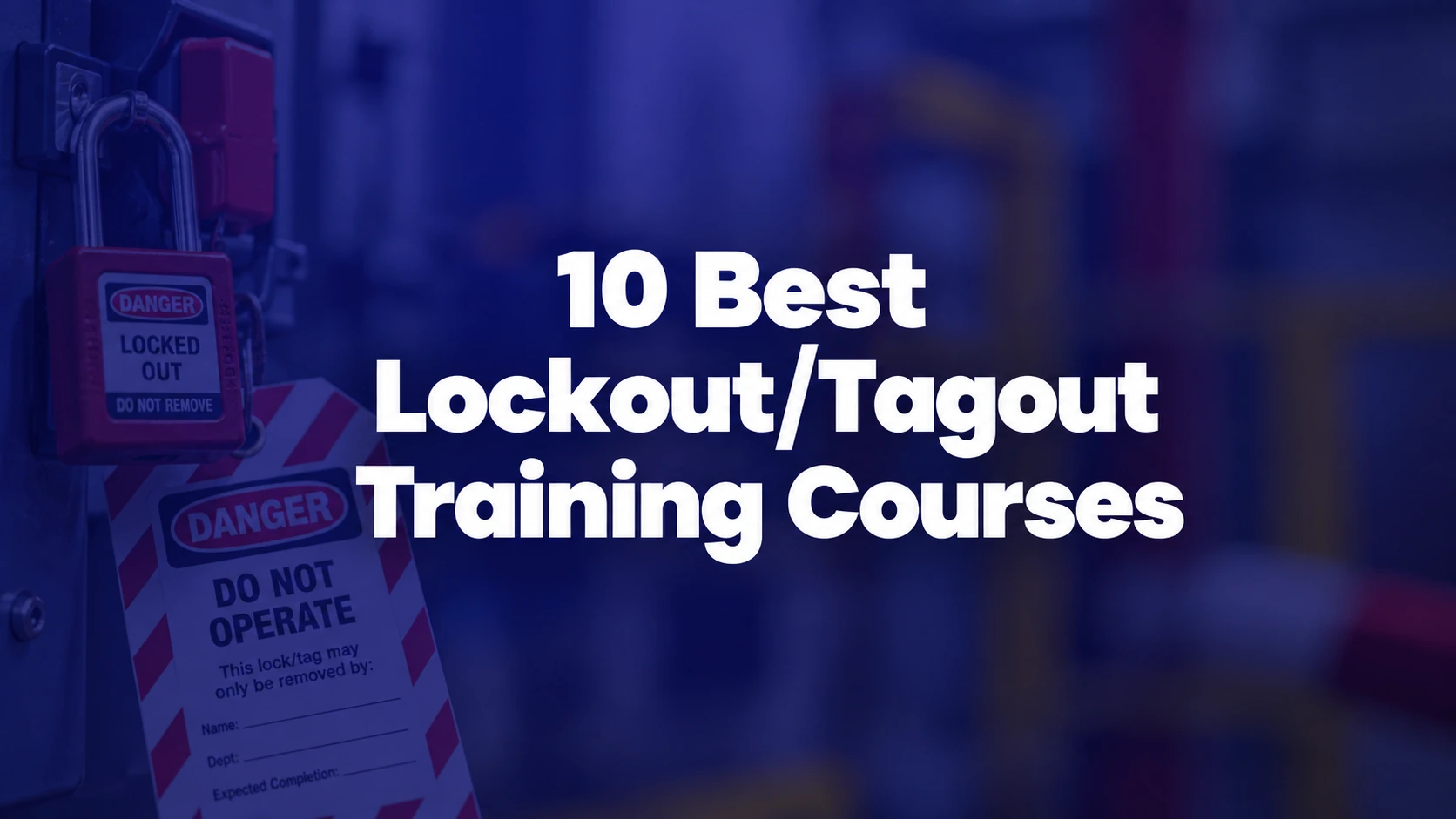
Choosing lockout/tagout training is not simply a matter of finding a course that mentions OSHA 1910.147. The employee's role determines the depth required. An authorized employee who applies locks or tags and services equipment needs different knowledge and skills from an affected employee who operates equipment or works around a LOTO procedure. Other employees in the area also need instruction appropriate to their exposure.
This 2026 buyer's guide compares ten current online options for manufacturing, maintenance, facilities, utilities, construction, oil and gas, and other workplace teams. We evaluated role fit, hazardous-energy coverage, published runtime, language options, regulatory references, delivery format, and the workplace-specific work that still remains after an online course is completed.
How We Evaluated Lockout/Tagout Training Courses
We ranked these options around the decisions an EHS, operations, HR, L&D, or procurement team must make before rollout.
- Role fit: Is the course intended for authorized employees, affected employees, other employees, or a mixed workforce?
- Hazard depth: Does it address electrical, mechanical, hydraulic, pneumatic, thermal, gravity, stored, or other hazardous energy as appropriate?
- Procedure coverage: Does the published scope address preparation, shutdown, isolation, lock/tag application, stored-energy control, verification, release, and return to service?
- Current evidence: Can runtime, language, course format, and regulatory references be verified on a current official provider page or current catalog record?
- Deployment fit: Can the content support team enrollment, multilingual workforces, LMS delivery, certificates, or broader safety-program administration?
- Compliance clarity: Does the provider avoid treating a generic online certificate as a substitute for the employer's actual energy-control program?
For broader program governance, use TraineryXchange's compliance training evidence checklist and compliance content update guide. Manufacturing teams can also review the manufacturing safety training guide, the broader compliance training program, and the corporate training content marketplace.
10 Best Lockout/Tagout Training Courses Online in 2026
| Rank | Course or Option | Published Runtime | Best Fit | Main Trade-Off to Verify |
|---|---|---|---|---|
| 1 | TraineryXchange Lockout/Tagout Course Options | Varies by publisher and course | Teams comparing multiple options before licensing | Check the selected publisher, version, scope, language, delivery and role fit |
| 2 | 360training OSHA Lockout Tagout (LOTO) Online Training | 1.5 hours | Employees and supervisors needing a deeper OSHA-aligned hazardous-energy course | Employer still owns machine-specific procedures, role-based instruction and workplace application |
| 3 | HSI Lockout Tagout for Authorized Workers | 26 minutes | Authorized employees who perform energy-control procedures | Employer still needs machine-specific procedures and role/site-specific training |
| 4 | Vector Solutions Lockout Tagout for Authorized Employees | 0.42 hours, about 25 minutes | Authorized employees needing multilingual 1910.147-focused instruction | Confirm how the course maps to the employer's equipment and energy-control procedures |
| 5 | OSHA.com Lockout/Tagout Safety in the Workplace | 1 hour | Teams wanting a longer general online LOTO foundation | OSHA.com is a private provider, not OSHA.gov; role depth and site-specific needs remain |
| 6 | 360training Lockout Tagout Training | 0.5 hour | Employees needing concise awareness-level LOTO principles | Provider describes it as awareness level; authorized employees need role-appropriate depth |
| 7 | HSI Lockout Tagout Overview | 7 minutes | Affected workers needing concise recognition and safe-behavior instruction | Not designed as authorized-worker procedural training |
| 8 | Vector Solutions Lockout Tagout for Affected Employees | 0.30 hours, about 18 minutes | Affected employees in multilingual workforces | Awareness focus; do not use for employees who actually perform lockout |
| 9 | Mastery Lockout Tagout for Affected Workers | 13–21 minutes | Manufacturing teams training affected employees in English or Spanish | Online completion may not satisfy every workplace-specific requirement |
| 10 | HSI Lockout/Tagout for Construction | 22 minutes | Construction employees who perform or work around LOTO | Construction has additional electrical and task-specific requirements; verify applicability |
1. TraineryXchange Lockout/Tagout Course Options
Start with TraineryXchange when the goal is to compare several lockout/tagout options before committing to one publisher. The live TraineryXchange catalog search gives HR, L&D, EHS, and procurement teams a single sourcing workflow for reviewing available courses and delivery choices.
TraineryXchange is the marketplace layer, not one fixed proprietary course. The publisher, runtime, version, language, certification or skills requirements, and delivery format depend on the course selected, so the final choice should still be checked against the same criteria used for the providers below.
2. 360training OSHA Lockout Tagout (LOTO) Online Training
360training's OSHA Lockout Tagout (LOTO) Online Training is currently published at 1.5 hours. The provider describes it as a more comprehensive OSHA-aligned course covering hazardous-energy control, accident prevention, energy-control procedures, lockout/tagout equipment and employee protection.
Best for: Employees and supervisors who need more depth than a short awareness module and whose program can pair online instruction with the employer's actual equipment, energy-control procedures and role-specific responsibilities.
Trade-off: A longer online course still does not replace the employer's energy-control program, machine-specific procedures or the knowledge and skills authorized employees need to safely apply, use and remove energy controls in their workplace.
Organizations sourcing LOTO alongside other workplace-safety topics can compare broader course categories and use TraineryXchange's content sourcing workflow for buyers to organize the evaluation process.
3. HSI Lockout Tagout for Authorized Workers
HSI Lockout Tagout for Authorized Workers is a 26-minute online interactive course with a broad published language set. It addresses hazardous-energy sources, employee roles, employer responsibilities, locks and tags, procedural steps, group LOTO, and special considerations. HSI references 29 CFR 1910.147.
Best for: Authorized employees who need a focused online foundation before applying the employer's machine-specific procedures.
Trade-off: OSHA requires authorized employees to understand the actual hazardous-energy sources, type and magnitude of energy, and methods necessary for isolation and control. A generic module should therefore be connected to the equipment and procedures the employee will use.
4. Vector Solutions Lockout Tagout for Authorized Employees
Vector Solutions Lockout Tagout for Authorized Employees is listed at 0.42 hours and intermediate level. Its published scope includes hazardous-energy sources, authorized versus affected employees, preparation, shutdown, isolation, lockout, stored-energy checks, verification, restart procedures, hardware, and Energy Control Program administration. Vector lists a broad set of languages and identifies 29 CFR 1910.147 as the course basis.
Best for: Multilingual workforces needing authorized-employee training with clear procedural sequencing.
Trade-off: Course coverage is still generic. Employers need to connect it to their written program, equipment-specific isolation points, verification methods, group procedures, and local work practices.
5. OSHA.com Lockout/Tagout Safety in the Workplace
OSHA.com Lockout/Tagout Safety in the Workplace is a one-hour, self-paced online course. The current provider page covers the OSHA Control of Hazardous Energy standard, energy-control programs, application of locks and tags, hazardous-energy types, and a certificate of completion.
Best for: Teams wanting more time on the topic than a short awareness module.
Trade-off: OSHA.com is a private training provider and is not the U.S. Occupational Safety and Health Administration at OSHA.gov. Employers should verify role fit and complete the workplace-specific parts of their LOTO training process.
6. 360training Lockout Tagout Training
360training Lockout Tagout Training is a 30-minute English online course. The provider describes it as awareness-level training covering LOTO program principles, device types, authorized-employee responsibilities, and OSHA requirements.
Best for: Affected or other employees who need concise foundational knowledge, or as introductory material within a broader program.
Trade-off: Because the provider identifies the course as awareness level, employers should not assume it provides the depth OSHA expects for an authorized employee who performs energy isolation.
Compare LOTO Courses by Employee Role
Separate authorized, affected, and awareness-only training needs before you compare course length, language, or delivery format.
7. HSI Lockout Tagout Overview
HSI Lockout Tagout Overview is a seven-minute online interactive course with a broad published language set. It focuses on affected workers: why LOTO is used, employee roles, locks and tags, recognizing when a procedure is underway, and the behavior expected around locked or tagged equipment.
Best for: Affected employees and short reinforcement campaigns.
Trade-off: It is intentionally concise and does not provide the procedural depth expected for an authorized employee who applies energy controls.
8. Vector Solutions Lockout Tagout for Affected Employees
Vector Solutions Lockout Tagout for Affected Employees is listed at 0.30 hours. It covers LOTO definitions, hazardous-energy sources, authorized versus affected roles, the overall process, and restarting equipment. Vector publishes a wide language set and identifies 29 CFR 1910.147 as its basis.
Best for: Distributed or multilingual workforces where machine operators and nearby employees need role-appropriate awareness.
Trade-off: The course is explicitly for affected employees. Employees who perform servicing and apply locks or tags require authorized-employee training.
9. Mastery Lockout Tagout for Affected Workers
Mastery Training Services Lockout Tagout for Affected Workers is a video-on-demand course listed at 13–21 minutes, with English and Spanish options. Published chapters cover worker types, affected versus authorized responsibilities, the written energy-control plan, communication, and locks and tags. The provider also warns that online completion may not fulfill every compliance requirement.
Best for: Manufacturing teams that want affected-worker content with bilingual availability.
Trade-off: It should be mapped to the employer's actual energy-control procedures and cannot substitute for authorized-worker training where employees perform LOTO.
10. HSI Lockout/Tagout for Construction
HSI Lockout/Tagout for Construction is a 22-minute English and Spanish online interactive course. It covers lock and tag requirements, employee roles, proper procedures, and authorized-employee tasks, and references 29 CFR 1926.417 and 1910.147.
Best for: Construction teams that want content framed around their work environment rather than a purely general-industry course.
Trade-off: Construction hazardous-energy controls can intersect with electrical, equipment, and task-specific standards. Verify the course against the exact work and applicable provisions rather than assuming 1910.147 is the only rule that matters.
What OSHA Requires for Lockout/Tagout Training
For general industry, 29 CFR 1910.147 requires an energy-control program that includes procedures, employee training, and periodic inspections. The training must ensure employees understand the purpose and function of the program and acquire the knowledge and skills required for the safe application, use, and removal of energy controls.
Authorized employees
Each authorized employee must be trained to recognize applicable hazardous-energy sources, understand the type and magnitude of energy available in the workplace, and know the methods and means necessary for energy isolation and control. This is why a generic awareness course is not enough for an employee who will actually lock out equipment.
Affected and other employees
Affected employees must be instructed in the purpose and use of the energy-control procedure. Other employees whose work is or may be in an area where energy-control procedures are used must be instructed about the procedure and the prohibition against restarting or reenergizing locked or tagged equipment.
Tagout requires additional instruction
When tagout systems are used, OSHA requires additional training on the limitations of tags. Tags are warning devices rather than physical restraints, must remain legible and secure, and cannot be bypassed, ignored, or removed without authorization.
Authorized vs Affected vs Other Employee Training
| Employee Role | Typical Responsibility | Training Focus | Buyer Check |
|---|---|---|---|
| Authorized employee | Performs servicing or maintenance and applies/removes energy controls | Energy sources, type and magnitude, isolation/control methods, procedures, verification, special situations | Choose role-specific depth and connect training to actual equipment and written procedures |
| Affected employee | Operates/uses equipment being serviced or works in the affected area | Purpose and use of the energy-control procedure, recognition of LOTO, prohibited actions | Do not overtrain with irrelevant procedural detail or undertrain employees who also perform servicing |
| Other employee | May work in an area where LOTO is used | Procedure awareness and prohibition against restarting/reenergizing equipment | Confirm who may enter affected areas and how awareness is documented |
| Tagout-system employee | Works where tags are used as part of energy control | Role training plus limitations and proper treatment of tags | Verify additional tagout instruction is included |
Can Lockout/Tagout Training Be Completed Online?
Lockout/tagout training online can efficiently standardize foundational knowledge: hazardous-energy types, employee roles, lock and tag devices, the purpose of energy-control procedures, procedural sequencing, stored-energy hazards, verification concepts, and return-to-service principles. It can also help organizations deliver consistent multilingual instruction and maintain completion records.
But online completion is only one part of an effective program. OSHA's standard ties authorized-employee training to the hazardous energy actually present in the workplace and the methods necessary for isolation and control. Employers need documented energy-control procedures and must ensure employees can apply them safely. Equipment-specific isolation points, stored-energy conditions, group LOTO, shift changes, outside contractors, testing, and exceptional lock removal may require workplace instruction beyond a generic module.
Organizations deploying third-party content should review training content licensing and content curation before assuming every course supports the same LMS or administrative model. Teams deciding between hosted delivery and an existing system can also compare the LMS delivery options and TraineryLMS.
How to Choose the Right LOTO Course
1. Classify employees before assigning training
Start by identifying authorized, affected, and other employees. Job titles alone are unreliable: an operator can become an authorized employee when servicing duties bring that employee under the standard. For larger programs, document those role assignments through a repeatable training operations workflow rather than relying on one generic assignment list. The broader learning and development workflow can help keep role ownership, assignment logic and evidence aligned across the program.
2. Inventory hazardous energy and equipment
Map electrical, mechanical, hydraulic, pneumatic, chemical, thermal, gravity, and stored-energy hazards. The course should prepare employees for the categories they encounter, while machine-specific procedures handle the exact isolation sequence. If you are comparing several safety topics at once, training content curation can help organize role-specific collections without treating one course as universal.
3. Verify the governing standard and jurisdiction
Federal general industry commonly centers on 1910.147, but construction, electrical generation, maritime work, and state-plan jurisdictions can involve different or additional requirements. A Cal/OSHA title should not automatically be assigned nationally.
4. Check special procedures
If your operations use group LOTO, shift turnover, contractors, temporary energization for testing, tagout, or employer-directed removal of another employee's device, confirm that training and written procedures address those scenarios.
5. Verify current version, language, and accessibility
Check the exact course's review status, regulatory references, language, captions, accessibility, device support, and LMS compatibility. TraineryXchange's multilingual training guide provides additional procurement questions for diverse workforces. If the course will run in an existing LMS, verify the actual package and reporting behavior through the marketplace LTI/SCORM delivery workflow and the broader integration process.
6. Build retraining around triggers, not an invented calendar
Federal OSHA LOTO retraining is trigger-based. Track job changes, equipment/process changes, procedure changes, inspection findings, near misses, and observed knowledge or performance gaps. Your company or jurisdiction may set a more frequent internal cycle, but distinguish that policy from the federal rule.
Final Recommendation
There is no single best OSHA lockout tagout training course for every employee because OSHA itself distinguishes training by role. For authorized employees, HSI and Vector Solutions provide clearly role-specific options with procedural depth. OSHA.com's one-hour course is useful for teams wanting a longer general foundation. 360training currently offers both a 1.5-hour OSHA-aligned LOTO course and a separate 30-minute awareness-level option, so buyers should choose the version that matches the employee role and program design.
For affected employees, HSI's seven-minute overview, Vector's affected-employee course, and Mastery's bilingual affected-worker course are more appropriately scoped than an authorized-worker program. Construction teams can consider HSI's construction-specific course, while power-generation electrical workers have a more specialized HSI hazardous-energy option.
TraineryXchange is useful when the buying problem is broader than a single LOTO course and the organization needs to source multiple safety topics through one marketplace. Use the live LOTO catalog search to identify current options, then verify the exact publisher, version, jurisdiction, language, runtime and role fit before licensing. Multi-site buyers can also review the enterprise training use case and Why TraineryXchange before deciding how to standardize sourcing.
The strongest procurement decision starts with employee role, equipment, hazardous-energy sources, jurisdiction, and the employer's written procedures. Then compare course depth, language, version, delivery, records, and the practical or workplace-specific instruction still required. That produces a safer and more defensible training program than choosing by runtime or certificate alone.
Build LOTO Training Around Employee Roles and Equipment
Compare safety content by authorized or affected role, hazardous-energy coverage, language, course version, and delivery model before rollout.
Sources Reviewed
OSHA: 29 CFR 1910.147 Control of Hazardous Energy
OSHA: LOTO Training and Retraining
OSHA: Employee Retraining Tutorial
HSI: Lockout Tagout for Authorized Workers
Vector Solutions: Lockout Tagout for Authorized Employees
OSHA.com: Lockout/Tagout Safety in the Workplace
360training: OSHA Lockout Tagout (LOTO) Online Training
360training: Lockout Tagout Training
Vector Solutions: Lockout Tagout for Affected Employees
Mastery: Lockout Tagout for Affected Workers
HSI: Lockout/Tagout for Construction
HSI: Hazardous Energy Control Procedures
Official provider pages, OSHA standards, and the TraineryXchange live catalog search were reviewed in September 2026. Verify current details before purchase or assignment.





%5B1%5D.svg)
