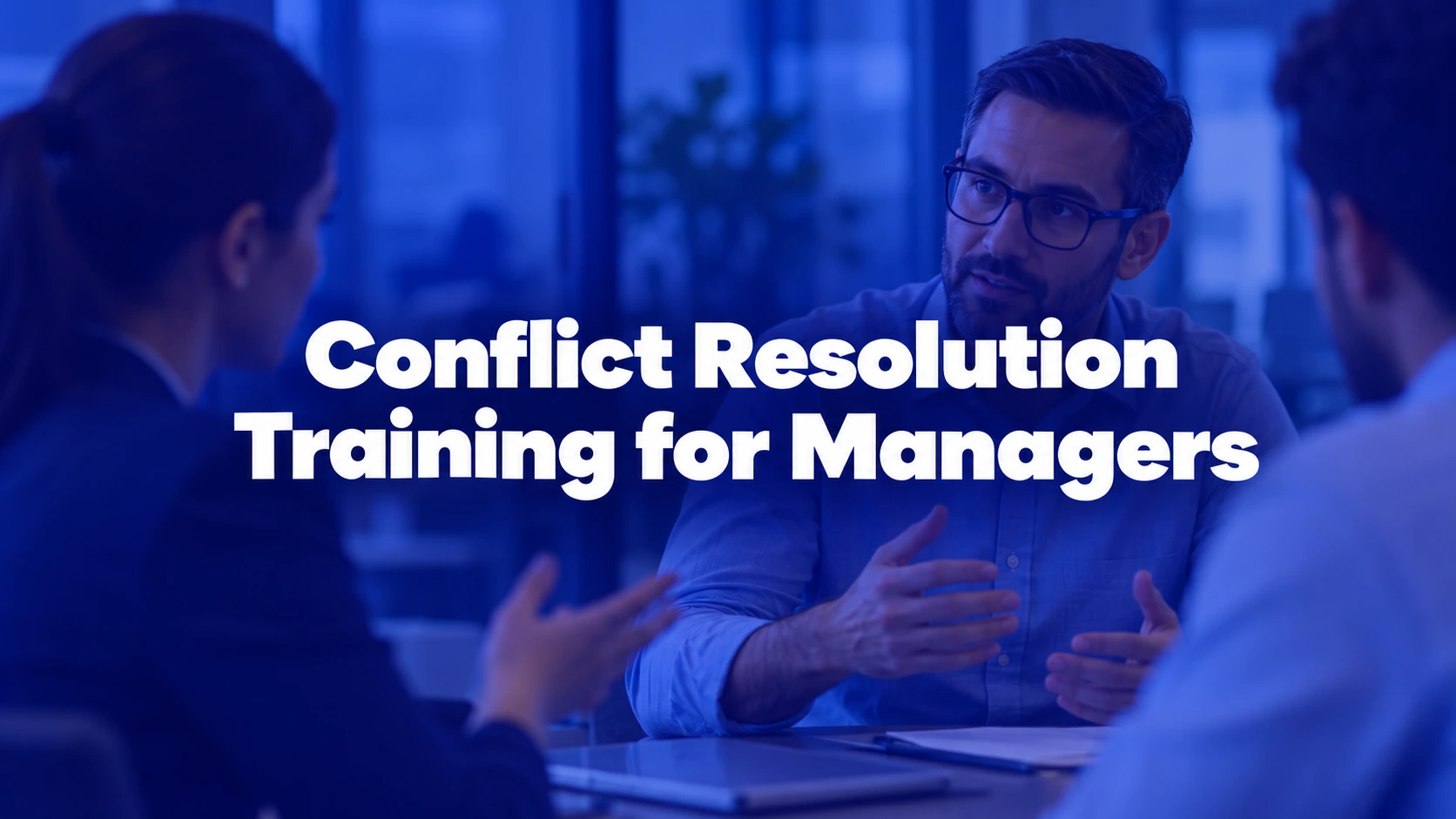
Conflict Resolution Training for Managers: 2026 Buyer’s Guide

A practical 2026 buyer’s guide to conflict resolution training for managers, including core skills, course-selection criteria, current options, rollout guidance, and measurement.

Updated On:
September 14, 2026
Mahesh Kumar

Mahesh Kumar

Founder & Managing Director
Conflict Resolution Training for Managers: Buyer’s Guide

Table of Contents

Conflict is a normal part of work. The operational problem begins when managers avoid it, escalate it, or handle similar situations inconsistently. A practical program gives managers a repeatable way to address disagreement while preserving accountability and working relationships.

Research and comparison note: Current course pages were reviewed in September 2026. We did not independently complete every course. This guide compares manager relevance, practice depth, delivery format, reinforcement and current provider evidence. Availability, pricing, licensing and catalog composition can change, so verify the exact option before purchase.

Why conflict resolution belongs in manager training

Managers sit at the point where priorities, workloads, personalities, performance expectations, and cross-functional dependencies meet. That makes them the first people expected to respond when disagreement starts affecting work. Yet “handle the conflict” is not a usable instruction unless the manager knows what to observe, what to say, what not to say, and when the situation requires support.

For L&D teams, conflict training is therefore best treated as a manager capability rather than an isolated soft-skill topic. It connects directly with difficult conversations, feedback, coaching, emotional intelligence, collaboration, and accountability. If you are building a broader pathway, combine conflict skills with learning and development planning, workforce development, training-team operations, and the corporate training content marketplace rather than treating conflict as a one-off soft-skill assignment.

What conflict resolution training for managers should cover

1. Recognizing conflict before it becomes a crisis

Managers need to distinguish a productive disagreement from a pattern that is starting to damage execution or working relationships. Useful training should help them notice recurring friction, unclear ownership, mismatched expectations, communication breakdowns, and unresolved performance concerns without encouraging them to diagnose motives they cannot verify.

2. Preparing for a difficult conversation

Preparation should include the observable facts, the business impact, the desired outcome, the manager’s assumptions, and the questions that still need answers. This reduces the risk of entering the conversation with a fixed story about who is “right.”

3. De-escalating tense interactions

Managers should learn how tone, pacing, listening, paraphrasing, and neutral language affect a difficult conversation. The goal is not to remove disagreement. It is to keep the discussion workable enough that both sides can clarify what happened and what needs to change.

4. Moving from positions to underlying interests

Many workplace conflicts sound like competing positions: “my team needs this first,” “that deadline is impossible,” or “this is not my responsibility.” Strong training helps managers uncover the constraints and interests underneath those statements so that the parties can evaluate options rather than repeat demands.

5. Agreeing on specific next steps

A conversation is incomplete if everyone leaves with a different interpretation of the outcome. Managers should practice closing with clear actions, owners, timing, and follow-up. Where company policy requires documentation or escalation, managers should follow the organization’s established process rather than improvising one.

6. Knowing when the manager should not mediate alone

Not every situation is appropriate for informal manager-led resolution. Training should clearly direct managers to follow organizational policy and involve HR, legal, security, compliance, or another designated resource when the facts, risk, or subject matter call for it. Conflict training should never be positioned as a substitute for those functions.

How to evaluate conflict resolution training in 2026

A course title is not enough to judge fit. Use a consistent buying framework so that different options can be compared on the same criteria.

Evaluation AreaWhat to Look ForWhy It Matters
Manager relevanceFeedback, peer tension, priorities, performance, cross-functional conflictManagers need language that transfers to real conversations
PracticeRole plays, branching scenarios, worksheets, simulations, guided rehearsalConflict handling is behavioral and improves through practice
Framework clarityA repeatable conversation or problem-solving modelManagers need something they can recall under pressure
Delivery fitSelf-paced, cohort, virtual instructor-led, blended or facilitatedThe format must fit the audience and reinforcement plan
Accessibility and languageCaptions, device support, accessibility and needed languagesDistributed teams may have different access requirements
DeploymentLicensing, LMS delivery, assignment, tracking and reportingOperational fit determines whether training can scale
ReinforcementManager guides, job aids, practice, coaching prompts or discussion materialsConflict skills improve through repeated use

Before selecting content, document the actual performance need. Use training content curation, course categories, and the content-buyer workflow to separate a true skill gap from problems caused by unclear roles, broken processes, workload or incentives that training alone will not fix.

Current Conflict-Management Training Options to Benchmark

The following options are current benchmarks for scope, delivery and practice. They are not a universal ranking. The right choice depends on the manager population, expected situations, practice requirements and rollout model.

TraineryXchange: first sourcing option

Use the live TraineryXchange conflict-resolution catalog search before narrowing the shortlist to one provider. TraineryXchange is the marketplace layer rather than one fixed conflict-management course, so the selected publisher, title, version, language, format, and licensing still need to be evaluated on their own merits.

OptionCurrent EvidenceBest FitMain Buyer Check
Coursera: Lead Teams Through Change, Conflict, and Uncertainty4 modules; updated May 2026; Coursera estimates 2 weeks at 10 hours/weekManagers needing conflict inside a broader leadership, change and resilience programBroader than conflict alone, so verify whether the additional modules fit the learning objective
LinkedIn Learning: Resolving Conflict with Emotional Intelligence1h 28m; released June 29, 2026Managers and team leads handling emotionally difficult or high-stakes conversationsBest as one component of a manager pathway if practice and follow-up are needed
LinkedIn Learning: Working with High-Conflict People as a Manager44m; intermediate; manager-specificManagers dealing with repeated high-conflict behavior and boundary-settingTargeted scope is narrower than a general conflict-resolution foundation
LinkedIn Learning: Develop Conflict Management Skills6 courses; 4 hours of contentTeams that prefer a sequenced pathway across conflict topicsVerify whether all six courses are relevant to manager roles before assigning the full path
LinkedIn Learning: How to Resolve ConflictsStructured conflict-resolution process with preparation, ground rules, clarification, solutions and third-party helpManagers who need a repeatable conversation frameworkGeneral conflict scope, so add manager-specific scenarios if needed
LinkedIn Learning: Practical Tips for New Manager EffectivenessIncludes recognizing, diffusing and resolving team conflict plus difficult conversationsNew managers who need conflict skills alongside negotiation and influenceConflict is one module within a broader new-manager course

TraineryXchange: use the marketplace as a sourcing layer

TraineryXchange is most useful when conflict resolution is one element of a wider manager-development program. Use the live conflict-resolution catalog search to identify current options, then verify the provider, exact title, version, language, delivery format and licensing. For larger programs, connect sourcing with training content licensing, LTI and SCORM delivery, integration options, LMS delivery, and TraineryLMS.

Build Manager Conflict Skills Into a Practical Learning Path

Source role-relevant content, add realistic practice, and reinforce the same conflict framework across managers.

How to build a practical manager conflict-learning path

A strong program does not need to start with a large curriculum. Start with the situations your managers actually face and build the minimum pathway that addresses them.

  1. Define the situations. List the recurring conflicts managers are expected to handle, such as priority disputes, role ambiguity, peer tension, performance conversations, or remote-team misunderstandings.
  2. Define the boundary. State which situations managers may address directly and which must follow a formal HR, compliance, legal, safety, or security process.
  3. Select a foundation. Choose one core course or module that gives everyone the same language and conflict-resolution framework.
  4. Add targeted practice. Use scenarios that resemble your organization’s work rather than generic scripts.
  5. Reinforce with managers. Give people leaders discussion prompts, job aids, or coaching questions they can use after the course.
  6. Measure transfer. Review behavior and work outcomes after training instead of stopping at completion data.

If the organization is designing a new program rather than buying one isolated course, connect the pathway to enterprise training workflows, Why TraineryXchange, and your existing manager-development architecture so conflict skills reinforce feedback, coaching, accountability and communication.

What to measure after managers complete conflict training

Completion rate tells you whether people finished training. It does not tell you whether they can use the skill. A more useful measurement plan combines several signals and compares them over time.

  • Manager confidence: Can managers explain the conflict framework and identify the first step they would take in a realistic scenario?
  • Observed behavior: Are managers preparing for difficult conversations, listening for interests, and closing with specific agreements?
  • Follow-through: Are agreed actions completed and revisited when needed?
  • Escalation quality: When managers involve HR or another function, are they escalating at the appropriate point with clearer facts and context?
  • Team feedback: Do employees report that disagreements are addressed more consistently and constructively?
  • Operational indicators: Where relevant, are recurring handoff problems, unresolved issues, or repeated conflict patterns improving?

Choose only measures that the organization can interpret responsibly. A drop in formal escalations is not automatically positive, for example, if people are simply avoiding the reporting process. Pair quantitative trends with qualitative review, and align reporting with training-team operations rather than treating completions as the primary success measure.

Buyer checklist for conflict resolution training

Before approving a course or content package, ask these questions:

  • Does the content clearly target managers or people leaders?
  • Are the examples close to the conflicts managers actually handle?
  • Does the program teach a repeatable framework rather than isolated tips?
  • Is there realistic practice or reinforcement after the lesson?
  • Are the delivery format, duration, accessibility, and language options suitable for the audience?
  • Can the content be assigned and tracked in the systems the organization uses?
  • Have licensing, integration, and deployment requirements been verified from current source material?
  • Does the training clearly state when managers should involve an appropriate internal resource?
  • Can L&D measure behavior change after completion?
  • Does the course complement, rather than duplicate, the organization’s existing manager curriculum?

Final Recommendation

For most organizations, the right conflict-resolution training for managers is the option that matches a defined workplace need and can be reinforced after the lesson. Use a concise role-relevant foundation for common situations, add targeted practice for the conflicts managers actually face, and connect the training to the organization's escalation and support processes.

Coursera's current course is a strong benchmark when conflict belongs inside a broader change-and-leadership program. LinkedIn Learning's June 2026 Emotional Intelligence course is more focused on difficult interactions, while Working with High-Conflict People as a Manager addresses repeated behavioral conflict. The six-course LinkedIn learning path is useful when L&D wants a sequenced journey rather than one class.

Use TraineryXchange as the sourcing and governance layer. Start with the manager situations you want to improve, use the live conflict-resolution catalog search, then verify provider, scope, practice, format, language, accessibility, licensing and integration before rollout.

Conflict training should also state its boundaries. Managers need to know when they can facilitate a working conversation and when the situation should move to HR, legal, compliance, security or another designated internal process.

Create a Manager Conflict-Resolution Path That Transfers to Real Work

Combine current content, realistic practice, reinforcement and clear escalation boundaries across your manager population.

Sources Reviewed

Coursera: Lead Teams Through Change, Conflict, and Uncertainty

LinkedIn Learning: Resolving Conflict with Emotional Intelligence

LinkedIn Learning: Working with High-Conflict People as a Manager

LinkedIn Learning: Develop Conflict Management Skills

LinkedIn Learning: How to Resolve Conflicts

LinkedIn Learning: Practical Tips for New Manager Effectiveness

Current provider pages were reviewed in September 2026. Verify current course availability, duration, licensing, language and delivery details before purchase.

Key Takeaways:‍

  • Conflict resolution training for managers should teach early recognition, preparation, de-escalation, active listening, problem framing, clear agreements and appropriate escalation.
  • The best course is the one that matches the manager situations the organization needs to improve, not necessarily the longest or most popular option.
  • Behavioral practice matters: role plays, scenarios, reflection and reinforcement improve transfer more than passive completion alone.
  • Conflict training should define boundaries so managers know when to handle a working disagreement and when to involve HR, legal, compliance, security or another designated resource.
  • Measure behavior and follow-through after training, not just completions, and connect conflict skills to the broader manager-development pathway.

Conflict is a normal part of work. The operational problem begins when managers avoid it, escalate it, or handle similar situations inconsistently. A practical program gives managers a repeatable way to address disagreement while preserving accountability and working relationships.

Research and comparison note: Current course pages were reviewed in September 2026. We did not independently complete every course. This guide compares manager relevance, practice depth, delivery format, reinforcement and current provider evidence. Availability, pricing, licensing and catalog composition can change, so verify the exact option before purchase.

Why conflict resolution belongs in manager training

Managers sit at the point where priorities, workloads, personalities, performance expectations, and cross-functional dependencies meet. That makes them the first people expected to respond when disagreement starts affecting work. Yet “handle the conflict” is not a usable instruction unless the manager knows what to observe, what to say, what not to say, and when the situation requires support.

For L&D teams, conflict training is therefore best treated as a manager capability rather than an isolated soft-skill topic. It connects directly with difficult conversations, feedback, coaching, emotional intelligence, collaboration, and accountability. If you are building a broader pathway, combine conflict skills with learning and development planning, workforce development, training-team operations, and the corporate training content marketplace rather than treating conflict as a one-off soft-skill assignment.

What conflict resolution training for managers should cover

1. Recognizing conflict before it becomes a crisis

Managers need to distinguish a productive disagreement from a pattern that is starting to damage execution or working relationships. Useful training should help them notice recurring friction, unclear ownership, mismatched expectations, communication breakdowns, and unresolved performance concerns without encouraging them to diagnose motives they cannot verify.

2. Preparing for a difficult conversation

Preparation should include the observable facts, the business impact, the desired outcome, the manager’s assumptions, and the questions that still need answers. This reduces the risk of entering the conversation with a fixed story about who is “right.”

3. De-escalating tense interactions

Managers should learn how tone, pacing, listening, paraphrasing, and neutral language affect a difficult conversation. The goal is not to remove disagreement. It is to keep the discussion workable enough that both sides can clarify what happened and what needs to change.

4. Moving from positions to underlying interests

Many workplace conflicts sound like competing positions: “my team needs this first,” “that deadline is impossible,” or “this is not my responsibility.” Strong training helps managers uncover the constraints and interests underneath those statements so that the parties can evaluate options rather than repeat demands.

5. Agreeing on specific next steps

A conversation is incomplete if everyone leaves with a different interpretation of the outcome. Managers should practice closing with clear actions, owners, timing, and follow-up. Where company policy requires documentation or escalation, managers should follow the organization’s established process rather than improvising one.

6. Knowing when the manager should not mediate alone

Not every situation is appropriate for informal manager-led resolution. Training should clearly direct managers to follow organizational policy and involve HR, legal, security, compliance, or another designated resource when the facts, risk, or subject matter call for it. Conflict training should never be positioned as a substitute for those functions.

How to evaluate conflict resolution training in 2026

A course title is not enough to judge fit. Use a consistent buying framework so that different options can be compared on the same criteria.

Evaluation AreaWhat to Look ForWhy It Matters
Manager relevanceFeedback, peer tension, priorities, performance, cross-functional conflictManagers need language that transfers to real conversations
PracticeRole plays, branching scenarios, worksheets, simulations, guided rehearsalConflict handling is behavioral and improves through practice
Framework clarityA repeatable conversation or problem-solving modelManagers need something they can recall under pressure
Delivery fitSelf-paced, cohort, virtual instructor-led, blended or facilitatedThe format must fit the audience and reinforcement plan
Accessibility and languageCaptions, device support, accessibility and needed languagesDistributed teams may have different access requirements
DeploymentLicensing, LMS delivery, assignment, tracking and reportingOperational fit determines whether training can scale
ReinforcementManager guides, job aids, practice, coaching prompts or discussion materialsConflict skills improve through repeated use

Before selecting content, document the actual performance need. Use training content curation, course categories, and the content-buyer workflow to separate a true skill gap from problems caused by unclear roles, broken processes, workload or incentives that training alone will not fix.

Current Conflict-Management Training Options to Benchmark

The following options are current benchmarks for scope, delivery and practice. They are not a universal ranking. The right choice depends on the manager population, expected situations, practice requirements and rollout model.

TraineryXchange: first sourcing option

Use the live TraineryXchange conflict-resolution catalog search before narrowing the shortlist to one provider. TraineryXchange is the marketplace layer rather than one fixed conflict-management course, so the selected publisher, title, version, language, format, and licensing still need to be evaluated on their own merits.

OptionCurrent EvidenceBest FitMain Buyer Check
Coursera: Lead Teams Through Change, Conflict, and Uncertainty4 modules; updated May 2026; Coursera estimates 2 weeks at 10 hours/weekManagers needing conflict inside a broader leadership, change and resilience programBroader than conflict alone, so verify whether the additional modules fit the learning objective
LinkedIn Learning: Resolving Conflict with Emotional Intelligence1h 28m; released June 29, 2026Managers and team leads handling emotionally difficult or high-stakes conversationsBest as one component of a manager pathway if practice and follow-up are needed
LinkedIn Learning: Working with High-Conflict People as a Manager44m; intermediate; manager-specificManagers dealing with repeated high-conflict behavior and boundary-settingTargeted scope is narrower than a general conflict-resolution foundation
LinkedIn Learning: Develop Conflict Management Skills6 courses; 4 hours of contentTeams that prefer a sequenced pathway across conflict topicsVerify whether all six courses are relevant to manager roles before assigning the full path
LinkedIn Learning: How to Resolve ConflictsStructured conflict-resolution process with preparation, ground rules, clarification, solutions and third-party helpManagers who need a repeatable conversation frameworkGeneral conflict scope, so add manager-specific scenarios if needed
LinkedIn Learning: Practical Tips for New Manager EffectivenessIncludes recognizing, diffusing and resolving team conflict plus difficult conversationsNew managers who need conflict skills alongside negotiation and influenceConflict is one module within a broader new-manager course

TraineryXchange: use the marketplace as a sourcing layer

TraineryXchange is most useful when conflict resolution is one element of a wider manager-development program. Use the live conflict-resolution catalog search to identify current options, then verify the provider, exact title, version, language, delivery format and licensing. For larger programs, connect sourcing with training content licensing, LTI and SCORM delivery, integration options, LMS delivery, and TraineryLMS.

Build Manager Conflict Skills Into a Practical Learning Path

Source role-relevant content, add realistic practice, and reinforce the same conflict framework across managers.

How to build a practical manager conflict-learning path

A strong program does not need to start with a large curriculum. Start with the situations your managers actually face and build the minimum pathway that addresses them.

  1. Define the situations. List the recurring conflicts managers are expected to handle, such as priority disputes, role ambiguity, peer tension, performance conversations, or remote-team misunderstandings.
  2. Define the boundary. State which situations managers may address directly and which must follow a formal HR, compliance, legal, safety, or security process.
  3. Select a foundation. Choose one core course or module that gives everyone the same language and conflict-resolution framework.
  4. Add targeted practice. Use scenarios that resemble your organization’s work rather than generic scripts.
  5. Reinforce with managers. Give people leaders discussion prompts, job aids, or coaching questions they can use after the course.
  6. Measure transfer. Review behavior and work outcomes after training instead of stopping at completion data.

If the organization is designing a new program rather than buying one isolated course, connect the pathway to enterprise training workflows, Why TraineryXchange, and your existing manager-development architecture so conflict skills reinforce feedback, coaching, accountability and communication.

What to measure after managers complete conflict training

Completion rate tells you whether people finished training. It does not tell you whether they can use the skill. A more useful measurement plan combines several signals and compares them over time.

  • Manager confidence: Can managers explain the conflict framework and identify the first step they would take in a realistic scenario?
  • Observed behavior: Are managers preparing for difficult conversations, listening for interests, and closing with specific agreements?
  • Follow-through: Are agreed actions completed and revisited when needed?
  • Escalation quality: When managers involve HR or another function, are they escalating at the appropriate point with clearer facts and context?
  • Team feedback: Do employees report that disagreements are addressed more consistently and constructively?
  • Operational indicators: Where relevant, are recurring handoff problems, unresolved issues, or repeated conflict patterns improving?

Choose only measures that the organization can interpret responsibly. A drop in formal escalations is not automatically positive, for example, if people are simply avoiding the reporting process. Pair quantitative trends with qualitative review, and align reporting with training-team operations rather than treating completions as the primary success measure.

Buyer checklist for conflict resolution training

Before approving a course or content package, ask these questions:

  • Does the content clearly target managers or people leaders?
  • Are the examples close to the conflicts managers actually handle?
  • Does the program teach a repeatable framework rather than isolated tips?
  • Is there realistic practice or reinforcement after the lesson?
  • Are the delivery format, duration, accessibility, and language options suitable for the audience?
  • Can the content be assigned and tracked in the systems the organization uses?
  • Have licensing, integration, and deployment requirements been verified from current source material?
  • Does the training clearly state when managers should involve an appropriate internal resource?
  • Can L&D measure behavior change after completion?
  • Does the course complement, rather than duplicate, the organization’s existing manager curriculum?

Final Recommendation

For most organizations, the right conflict-resolution training for managers is the option that matches a defined workplace need and can be reinforced after the lesson. Use a concise role-relevant foundation for common situations, add targeted practice for the conflicts managers actually face, and connect the training to the organization's escalation and support processes.

Coursera's current course is a strong benchmark when conflict belongs inside a broader change-and-leadership program. LinkedIn Learning's June 2026 Emotional Intelligence course is more focused on difficult interactions, while Working with High-Conflict People as a Manager addresses repeated behavioral conflict. The six-course LinkedIn learning path is useful when L&D wants a sequenced journey rather than one class.

Use TraineryXchange as the sourcing and governance layer. Start with the manager situations you want to improve, use the live conflict-resolution catalog search, then verify provider, scope, practice, format, language, accessibility, licensing and integration before rollout.

Conflict training should also state its boundaries. Managers need to know when they can facilitate a working conversation and when the situation should move to HR, legal, compliance, security or another designated internal process.

Create a Manager Conflict-Resolution Path That Transfers to Real Work

Combine current content, realistic practice, reinforcement and clear escalation boundaries across your manager population.

Sources Reviewed

Coursera: Lead Teams Through Change, Conflict, and Uncertainty

LinkedIn Learning: Resolving Conflict with Emotional Intelligence

LinkedIn Learning: Working with High-Conflict People as a Manager

LinkedIn Learning: Develop Conflict Management Skills

LinkedIn Learning: How to Resolve Conflicts

LinkedIn Learning: Practical Tips for New Manager Effectiveness

Current provider pages were reviewed in September 2026. Verify current course availability, duration, licensing, language and delivery details before purchase.

Frequently Asked Questions

Should conflict resolution training be part of a broader leadership program?
How do you measure whether conflict resolution training is working?
Is online conflict resolution training effective for managers?
What should conflict resolution training for managers cover?
What is conflict resolution training for managers?