
%201.svg)
How to Design Role-Based Compliance Learning Paths
Compliance learning paths can help organizations organize training by role, responsibility, location, and risk rather than relying on one identical course sequence for every employee.
The objective is not to promise behavior change. Training is one part of a broader compliance system that can also include policies, supervision, controls, reporting channels, investigations, and enforcement. A well-designed learning path should make required information more relevant and easier to apply in real work situations.
Start With the Requirement, Not the Course Catalog
Before selecting content, identify the governing requirement. This may come from a law, regulation, contract, policy, customer requirement, or internal control.
For each topic, document:
- Who must receive the training.
- What knowledge, policy, or procedure the training should cover.
- When training is required or should be refreshed.
- What records or evidence must be retained.
- Whether role, location, or responsibility changes affect the assignment.
This prevents the learning path from becoming a collection of courses without a clear compliance purpose.
Step 1: Segment the Audience by Relevant Risk
Different roles can face different compliance situations. A sales employee may need anti-bribery and contracting scenarios, while an IT administrator may need deeper security and access-control training.
Example risk-mapping structure
| Role | Relevant Risk Example | Training Focus |
|---|---|---|
| Sales Representative | Gifts, representations, and customer-contract decisions. | Anti-bribery, ethical sales practices, and applicable company policy. |
| HR Manager | Receiving or escalating employee complaints. | Reporting procedures, anti-retaliation expectations, and manager responsibilities. |
| IT Administrator | Credential handling and privileged access. | Security policy, access control, and incident-response responsibilities. |
When employee data is reliable, an LMS and HRIS integration may support role-based assignment workflows. Exact automation, sync timing, fields, and deactivation behavior depend on the systems and configuration. See the LMS and HRIS integration guide.
Step 2: Use Scenarios to Practice Application
Scenario-based learning can help employees practice applying a policy in situations that contain competing priorities or incomplete information.
For example, a sales scenario might ask an employee how to respond when a customer requests a gift or benefit that could conflict with company policy. The scenario should point the learner toward the actual policy, approval process, or escalation path rather than presenting a dramatic legal consequence as inevitable.
Branching scenarios can be useful when they reflect realistic choices and provide clear feedback. They should not imply that completing a simulation proves future compliant behavior.
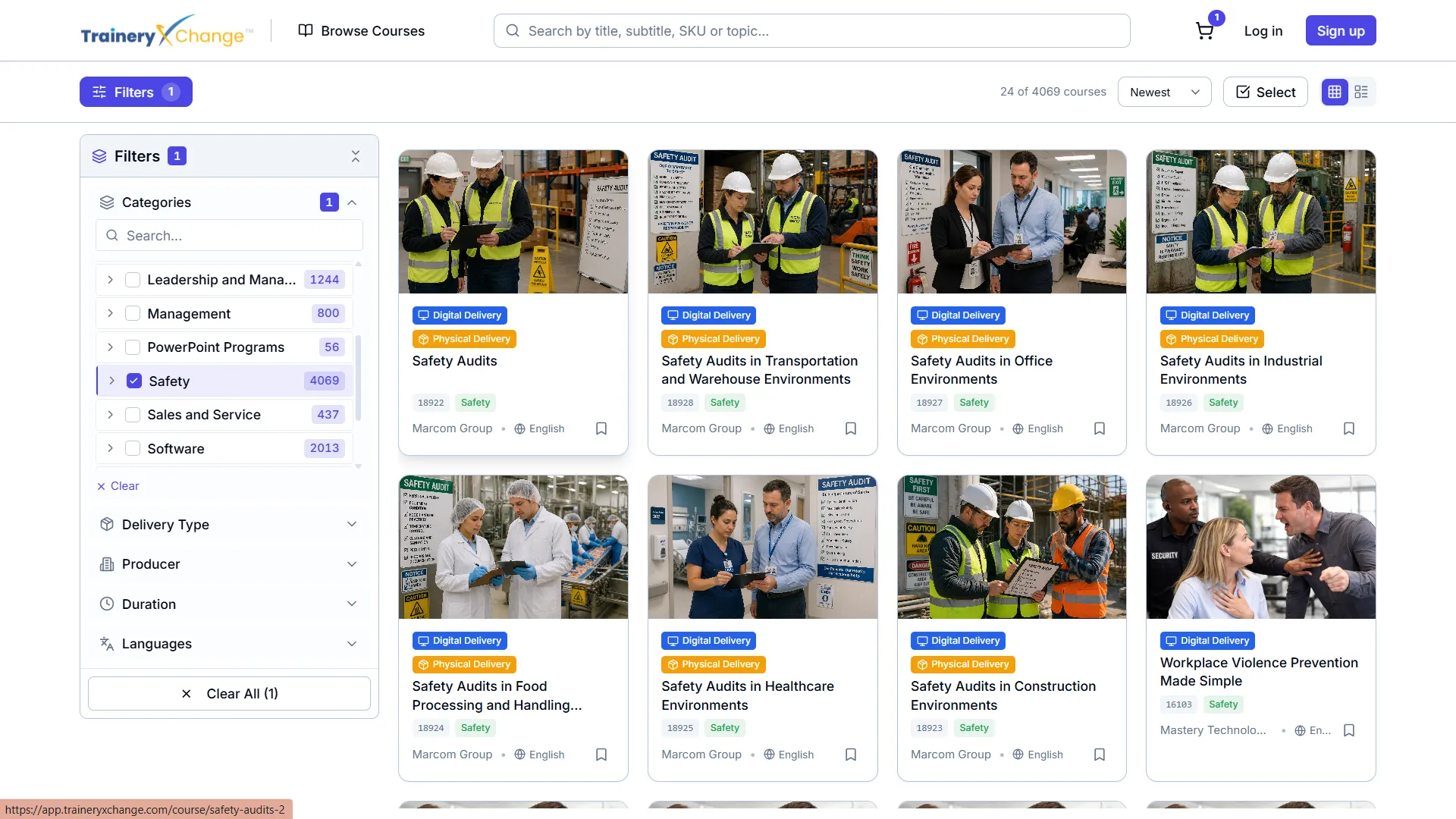
Organizations can review available scenario-based content in the TraineryXchange content marketplace. Available formats and interactivity vary by course and provider.
Step 3: Plan Reinforcement Around Real Requirements
Some programs benefit from reinforcement between formal training events. Reinforcement can include short refreshers, manager discussion prompts, policy reminders, or targeted knowledge checks.
A practical sequence might include
- Foundation training: Initial instruction on the requirement, policy, and employee responsibilities.
- Targeted reinforcement: Short reminders or examples tied to common risks.
- Follow-up assessment: A knowledge check or scenario review where appropriate.
- Retraining: Additional instruction after a policy change, role change, identified gap, or another trigger required by the program.
A fixed quarterly or annual cadence should not be assumed for every topic. The appropriate schedule depends on the requirement, risk, policy, and workforce context.
Step 4: Use Assessments Carefully
Assessments can show whether a learner can answer questions or apply a scenario at the time of testing. They are useful evidence, but they do not automatically prove legal compliance or lasting behavior change.
Pre-assessments or test-out options should only be used when the organization has confirmed they are appropriate for the specific training requirement. Some programs may require full instruction regardless of prior knowledge.
Step 5: Measure Learning and Operational Signals Separately
Useful training metrics can include assignment coverage, completion, overdue status, assessment results, repeat attempts, and policy acknowledgments where supported.
Operational indicators may include phishing-test results, safety observations, hotline usage, audit findings, or incident data. These measures can provide context, but correlation does not prove that training alone caused the result.
For example, an increase in hotline reports may reflect stronger awareness, greater trust in reporting channels, a change in workforce conditions, or a real increase in incidents. It should not automatically be labeled proof that training worked.
Step 6: Define the Delivery Workflow
Organizations should decide how assignments, reminders, reporting, and content updates will be handled before launch.
TraineryXchange supports training content, TraineryLMS, and supported delivery into compatible LMS environments. Available learning-path, reminder, reporting, integration, and content-delivery capabilities depend on the selected product, course, LMS, and configuration.
Review the LMS delivery options and compliance training pages when planning the delivery model.
Conclusion
A strong compliance learning path starts with the requirement, maps training to the right audience, uses realistic practice where useful, reinforces important topics appropriately, and separates training evidence from broader operational outcomes.
Role-based design can improve relevance and administration, but no learning path should be presented as a guarantee of compliance, behavior change, or reduced legal exposure.
Book a demo to review current content and delivery options for a role-based compliance training program.



%5B1%5D.svg)
