Enterprise Skills Taxonomy Explained: How to Build One and Connect It to Learning

Updated On:
June 7, 2026

Mahesh Kumar

Founder, TraineryHCM.com
Enterprise Skills Taxonomy Explained

Table of Contents

Ask three people in your organization to define project management, and you will likely get three different answers. One means scheduling and Gantt charts. Another means of stakeholder negotiation. A third means whatever their last PMP course covered. None of them is wrong. They are simply using the same two words to describe different capabilities, and that gap is exactly where workforce planning, internal mobility, and learning investment go wrong.

This is the problem a skills taxonomy is built to solve. It gives every system in your organization, your HRIS, your LMS, your talent marketplace, a shared definition of what a skill is and how it relates to the roles, courses, and career paths built around it. Without that shared definition, a skills gap analysis is guesswork, a personalized learning path is a coin flip, and a learning and development budget gets spent on whatever sounds urgent rather than what the data actually shows is missing.

The business impact is not abstract. Research cited by Deloitte found that only 10 percent of HR executives say they effectively classify skills into a taxonomy, and the organizations that do this well are significantly more likely to place talent effectively and retain high performers. The other side of that statistic is a lot of training budget spent without a clear line back to a defined capability gap.

Why this matters now: skill half-lives are shrinking, AI is changing what “proficient” means in dozens of roles simultaneously, and most organizations are still trying to answer “what skills do we actually have” with a spreadsheet last updated by someone who left the company. This guide explains what an enterprise skills taxonomy is, how it differs from the adjacent terms vendors use interchangeably, how to build one that survives past its launch date, and how to connect it to a learning platform so the framework actually changes what your people are trained to do.

What Is an Enterprise Skills Taxonomy?

An enterprise skills taxonomy is a structured, hierarchical classification of the skills relevant to an organization's roles and business goals. It typically organizes individual skills, such as data analysis or stakeholder management, into clusters, and clusters into broader domains, creating a shared vocabulary that HR, learning and development, and talent management systems can all reference consistently. A well-built taxonomy is curated rather than exhaustive: most enterprises that get this right work with 25 to 30 core skills plus 5 to 10 specialist skills per business area, not tens of thousands of generic entries. Its purpose is to make workforce capability visible and actionable, powering skills gap analysis, internal mobility, role design, and targeted learning investment from one consistent source of truth.

Skills Taxonomy vs. Skills Ontology vs. Skills Inventory vs. Competency Framework

These four terms get used interchangeably across vendor websites, and that interchangeability is where most taxonomy projects go wrong before they even start. Each one answers a different question. Confusing them means building the wrong tool, or trying to build all four at once and ending up with something too sprawling to govern.

Term What It Answers What It Looks Like
Skills Taxonomy What skills matter to the organization, and how are they grouped? A structured hierarchy of domains, categories, clusters, and individual skills.
Skills Ontology How do these skills relate to one another? A network that maps relationships, prerequisites, dependencies, and progression paths between skills.
Skills Inventory Who has which skills, and at what proficiency level? A live record of employee capabilities mapped directly to the organization's skills taxonomy.
Competency Framework What behaviors, knowledge, and standards define success in a role? Skills combined with knowledge, behaviors, and performance expectations to define job success.

A practical way to hold these apart: the taxonomy is the map, the ontology is the set of roads connecting the points on that map, the inventory is the live data showing where your people currently are on it, and the competency framework is the rulebook for what “good performance” looks like at each destination. Most organizations need a taxonomy and an inventory immediately. The ontology and the competency framework can follow once the foundation is in place.
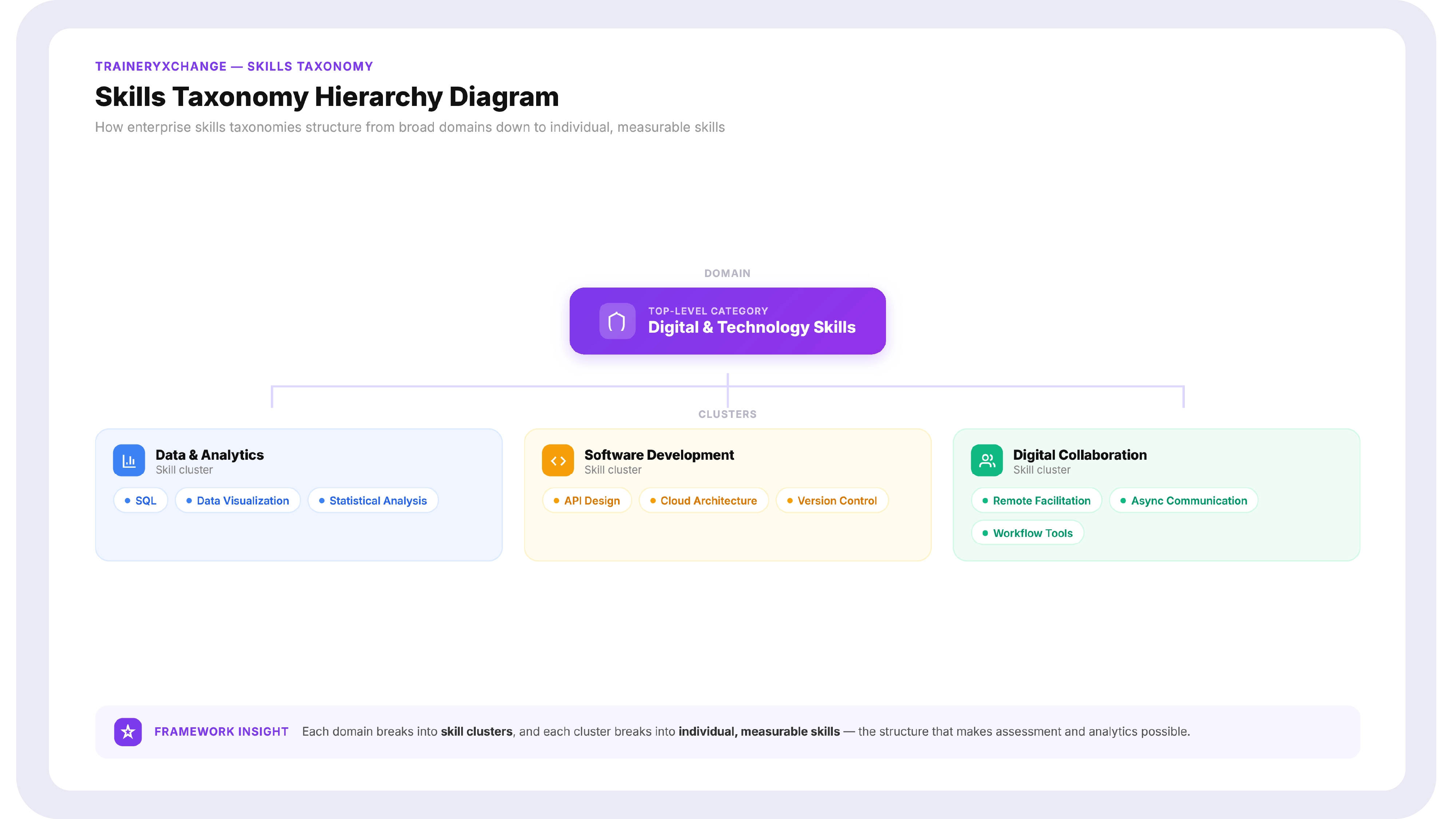
Diagram showing enterprise skills taxonomy hierarchy from domains to clusters to individual skills

Before you build from scratch

Most enterprise learning teams underestimate how much of this work has already been solved by a curated content library mapped to standard skill domains. If your taxonomy effort is stalling because nobody has time to define every skill from a blank page, it's worth seeing what a pre-built mapping looks like before committing a team to months of workshops. See how a course library maps to a skills framework

Book a Demo

Why an Enterprise Skills Taxonomy Matters Now

Three forces are converging that make this a 2026 priority rather than a someday project.

Skill half-lives are shrinking faster than training cycles

The technical skills your engineering team relies on today have a meaningfully shorter shelf life than they did five years ago. Annual refresh cycles, the standard cadence for most legacy taxonomy projects, are no longer fast enough to keep the framework aligned with the actual work being done.

AI is changing what proficiency means, role by role

When generative AI tools change how a job gets done, the skill that used to define competence in that role often shifts from execution to judgment and oversight. Organizations without a taxonomy have no structured way to detect that shift happening, let alone retrain against it.

Skills-based decisions are replacing job-title-based decisions.

Internal mobility, succession planning, and reskilling investment are all moving toward “who has the capability” rather than “who has the title.” That shift is structurally impossible without a taxonomy defining what the capabilities are in the first place.

How a Skills Taxonomy Works in Practice

A taxonomy operates on three structural layers, and understanding them separately is what prevents a project from collapsing into an unmanageable single list.

  • Domains: The broadest grouping, such as Technical Proficiency, Leadership, or Customer Engagement. Most enterprise taxonomies use somewhere between 15 and 25 domains.
  • Clusters: Groupings within a domain, such as Cloud Infrastructure or Data Governance, sitting inside a Technical Proficiency domain.
  • Individual skills: The specific, assessable capability, such as “AWS infrastructure provisioning” or “stakeholder negotiation in cross-functional settings.”

Each skill should carry a proficiency scale, typically four to five levels running from foundational to expert, with concrete behavioral descriptors at each level rather than vague labels. A skill description that says “advanced communication” produces inconsistent self-assessment data. A description that specifies “able to lead client-facing workshops and present technical findings to non-technical stakeholders” produces data that people can actually rate themselves against consistently.

How to Build an Enterprise Skills Taxonomy: A Five-Step Framework

Step 1: Define the decisions the taxonomy needs to support

Before listing a single skill, get explicit agreement on what the taxonomy will be used for. Workforce planning, internal mobility, compliance reporting, and L&D investment all shape the structure differently. A taxonomy built primarily to support training content mapping will emphasize different groupings than one built primarily for succession planning.

Step 2: Scope two or three domains, not the whole organization

The most common reason taxonomy projects stall is scope. Attempting to map every skill across every function in one initiative exhausts stakeholder patience long before the framework is usable. Start with a function under known pressure, such as a department facing a documented capability gap, and expand once that first domain is delivering value.

Step 3: Write precise, behavior-based skill descriptions

This is the step most projects rush, and it is the one that determines whether the resulting data is trustworthy. Each skill needs a description specific enough that two different people, rating themselves independently, would land on similar proficiency scores.

Step 4: Validate with a mix of self-assessment and evidence

Not every skill needs the same rigor of validation. Skills tied to compliance or safety should be backed by certifications or a manager's sign-off. Skills tied to general professional development can rely more heavily on self-assessment. Forcing the same validation standard across both categories is a common source of project fatigue.

Step 5: Connect the taxonomy to a system that can act on it

A taxonomy that lives in a spreadsheet, disconnected from the systems that deliver training or track development, stays a reference document. The value compounds when the taxonomy is wired into the systems your people actually touch: the LMS that assigns courses, the talent marketplace that surfaces internal candidates, and the reporting layer that shows leadership where the gaps are closing.

How a Skills Taxonomy Powers an Enterprise Learning Platform

This is the step most published guides on skills taxonomy stop short of, and it is where the framework either pays for itself or becomes shelfware. A taxonomy that identifies a gap but has no mechanism for closing it is a diagnostic tool with no treatment attached.

From skill gap to assigned course in days, not quarters

Once a skill gap is identified against the taxonomy, the natural next step is matching that specific skill to training content that addresses it. Building custom content against every gap a taxonomy surfaces is slow and expensive. Pulling from an existing library of ready-to-deploy courses mapped to standard skill domains means a gap identified this week can have an assigned learning path by the end of the same week, not after a content development cycle measured in months.

Building personalized learning paths from taxonomy data

A taxonomy with proficiency levels makes personalization straightforward in a way that generic course catalogs cannot. An employee assessed at a foundational level in a cluster gets routed to introductory content. Someone already at an intermediate level skips straight to advanced material. Without the taxonomy's proficiency structure, that routing logic does not exist, and every employee gets the same one-size-fits-all course list regardless of where they actually stand.

Using an LMS with a content library to close gaps at scale

For most mid-sized and enterprise teams, the realistic choice is not “build a taxonomy or buy training content,” it is whether the learning platform connecting the two is one your L&D team can move fast inside. A learning management system paired with a deep, ready-made content library lets a team translate taxonomy findings into assigned, trackable training without a multi-month content production cycle standing between the data and the action.

Common mistake: building the taxonomy and stopping there

The single most common failure pattern is treating the taxonomy as the deliverable rather than the starting point. Teams invest months defining domains and clusters, present the framework at a leadership offsite, and then never connect it to an actual training assignment workflow. Eighteen months later, the taxonomy lives in a shared drive that three people remember how to find, and the organization is back to making training decisions on instinct.
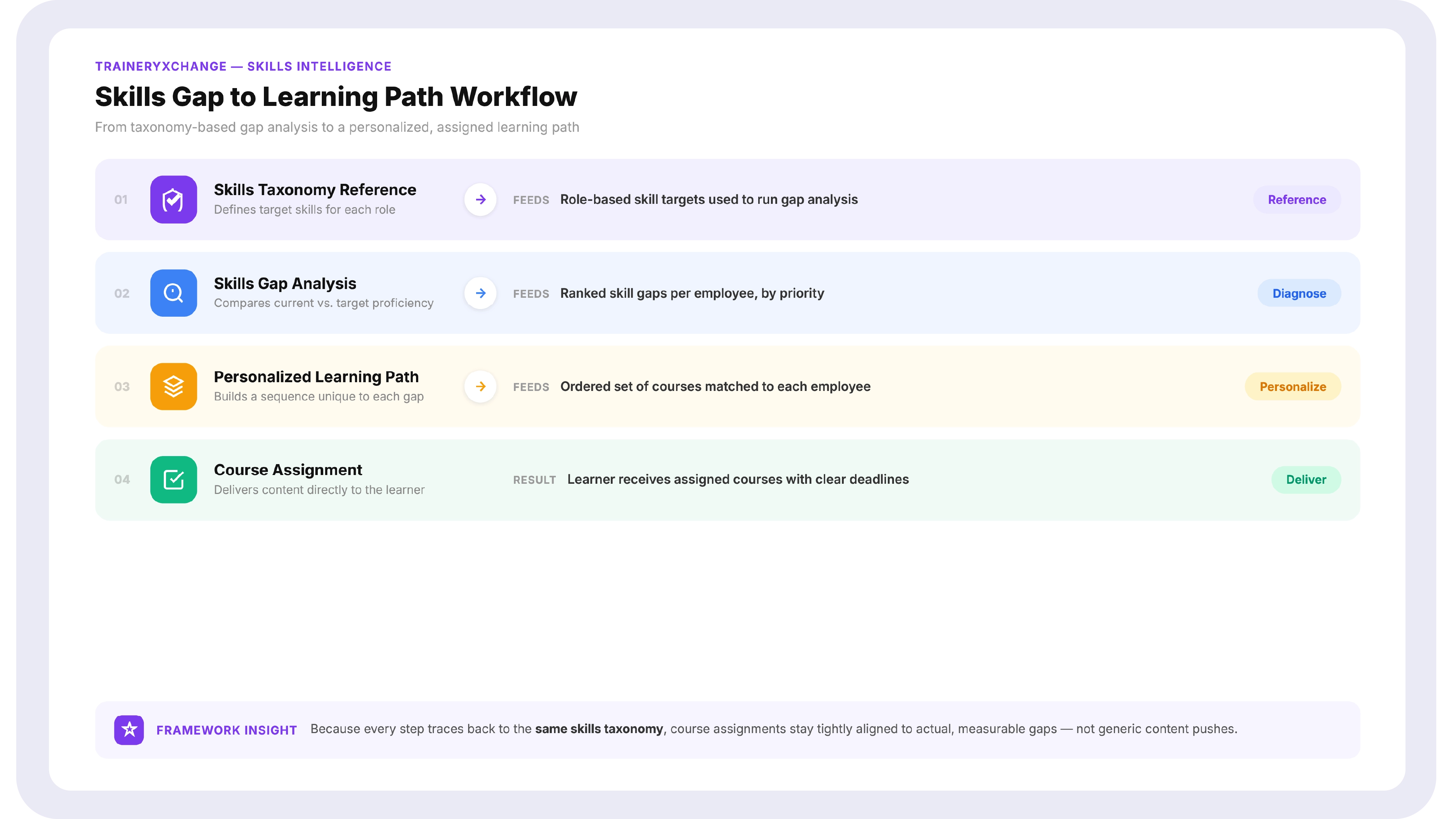
Workflow diagram showing skills taxonomy gap analysis connecting to personalized learning paths and course assignment

See your taxonomy connected to real training.

If you already have a skills taxonomy, or you are building one now, the fastest way to prove its value is by showing leadership a closed loop: gap identified, course assigned, completion tracked, capability improved. TraineryXchange's library of 10,000-plus courses deploys directly into your existing LMS or ours, so taxonomy-identified gaps turn into assigned training the same day, not the same quarter. Book a demo to see the taxonomy-to-training workflow in action

Book a Demo

Common Mistakes That Kill Taxonomy Projects

  • Building by department instead of by stable skill domain, so the taxonomy breaks the moment the org chart changes.
  • Starting with every function at once instead of two or three priority areas, which exhausts stakeholder energy before the framework ships.
  • Treating the taxonomy and the skills inventory as the same artifact, producing data that is neither definitionally clean nor operationally useful.
  • Applying the same validation rigor to compliance-critical skills and general development skills is slowing the whole project down unnecessarily.
  • Mapping current skills only, with no view of emerging skills the business will need within 12 to 24 months.
  • Finishing the taxonomy and stopping, with no connection to a learning system that can act on what the data shows.

Best Practices for Keeping a Taxonomy Alive

  • Assign a named owner per domain. A taxonomy with no owner drifts. Domain owners review and refine on a set cadence rather than waiting for an annual overhaul.
  • Review on a cycle that matches your industry's pace of change. Fast-moving technical functions need a six-month review; slower-moving operational functions can run on an annual cycle.
  • Connect proficiency data to the actual training assignment. If a gap shows up in the data, there should be a default next step, not a manual process someone has to remember to initiate.
  • Keep the taxonomy lean. More skills are not better. A curated, governed set of 25 to 30 core skills plus specialist additions per business area is more useful than an exhaustive list nobody trusts.

Where Enterprise Skills Taxonomies Are Headed

Three shifts are shaping how taxonomies will be built and used over the next few years. First, AI-assisted inference is replacing manual workshops as the primary data source, pulling skill signals from job descriptions, project assignments, and training completions rather than relying solely on self-reports. Second, taxonomies are increasingly being treated as living infrastructure with continuous update mechanisms, rather than static documents refreshed annually. Third, and most relevant for learning teams, the expectation is shifting from “we have a taxonomy” to “our taxonomy automatically routes people to the training that closes their specific gap.” Organizations that build the connective layer between taxonomy and learning content now will have a structural advantage over those still treating the two as separate projects.

An enterprise skills taxonomy is not an HR filing exercise. Done well, it is the shared language that makes every downstream workforce decision, who gets promoted, what training gets funded, and where the next hire should come from, grounded in actual capability data instead of guesswork and job titles.

The practical lessons are straightforward. Keep the taxonomy distinct from the ontology, the inventory, and the competency framework, since each solves a different problem. Start narrow with two or three priority domains rather than attempting the whole organization at once. Write skill descriptions specific enough to produce trustworthy data. And most importantly, build the bridge from taxonomy to training before the framework ages out of relevance. A gap identified but never closed is data with no return on investment.

The business outcome that follows is measurable: faster time-to-competency for new hires, more accurate internal mobility matching, and training budgets spent against documented gaps rather than whatever initiative is loudest that quarter.

Skills Mapping & Capabilities

Ready to See What Your Enterprise Training Library Should Look Like?

TraineryXchange gives your L&D team the missing link between a skills framework and actual workforce capability: a library of 10,000-plus ready-to-deploy courses that map to standard skill domains, deployable to your existing LMS or ours, with zero setup bottlenecks. Whatever stage your taxonomy is at, the next step is making it actionable. Start your free trial or book a demo today

Book a Demo

Key Takeaways

  • A skills taxonomy is only useful if it stays current. Most fail not at launch but eighteen months later, when the org chart, the tech stack, and the roles have all moved on.
  • Taxonomy, ontology, skills inventory, and competency framework are four different tools that solve four different problems. Treating them as interchangeable is the single biggest cause of failed projects.
  • Start with two or three high-priority skill domains, not the entire organization. Breadth without governance is how taxonomy projects stall before they ship.
  • A taxonomy with no connection to training content is a filing system. The return on investment shows up when a skill gap can be closed with a course within the same week it was identified.
  • Off-the-shelf course libraries let L&D teams act on taxonomy data immediately, instead of waiting months for custom content to be built against a framework that may have already changed.

Ask three people in your organization to define project management, and you will likely get three different answers. One means scheduling and Gantt charts. Another means of stakeholder negotiation. A third means whatever their last PMP course covered. None of them is wrong. They are simply using the same two words to describe different capabilities, and that gap is exactly where workforce planning, internal mobility, and learning investment go wrong.

This is the problem a skills taxonomy is built to solve. It gives every system in your organization, your HRIS, your LMS, your talent marketplace, a shared definition of what a skill is and how it relates to the roles, courses, and career paths built around it. Without that shared definition, a skills gap analysis is guesswork, a personalized learning path is a coin flip, and a learning and development budget gets spent on whatever sounds urgent rather than what the data actually shows is missing.

The business impact is not abstract. Research cited by Deloitte found that only 10 percent of HR executives say they effectively classify skills into a taxonomy, and the organizations that do this well are significantly more likely to place talent effectively and retain high performers. The other side of that statistic is a lot of training budget spent without a clear line back to a defined capability gap.

Why this matters now: skill half-lives are shrinking, AI is changing what “proficient” means in dozens of roles simultaneously, and most organizations are still trying to answer “what skills do we actually have” with a spreadsheet last updated by someone who left the company. This guide explains what an enterprise skills taxonomy is, how it differs from the adjacent terms vendors use interchangeably, how to build one that survives past its launch date, and how to connect it to a learning platform so the framework actually changes what your people are trained to do.

What Is an Enterprise Skills Taxonomy?

An enterprise skills taxonomy is a structured, hierarchical classification of the skills relevant to an organization's roles and business goals. It typically organizes individual skills, such as data analysis or stakeholder management, into clusters, and clusters into broader domains, creating a shared vocabulary that HR, learning and development, and talent management systems can all reference consistently. A well-built taxonomy is curated rather than exhaustive: most enterprises that get this right work with 25 to 30 core skills plus 5 to 10 specialist skills per business area, not tens of thousands of generic entries. Its purpose is to make workforce capability visible and actionable, powering skills gap analysis, internal mobility, role design, and targeted learning investment from one consistent source of truth.

Skills Taxonomy vs. Skills Ontology vs. Skills Inventory vs. Competency Framework

These four terms get used interchangeably across vendor websites, and that interchangeability is where most taxonomy projects go wrong before they even start. Each one answers a different question. Confusing them means building the wrong tool, or trying to build all four at once and ending up with something too sprawling to govern.

Term What It Answers What It Looks Like
Skills Taxonomy What skills matter to the organization, and how are they grouped? A structured hierarchy of domains, categories, clusters, and individual skills.
Skills Ontology How do these skills relate to one another? A network that maps relationships, prerequisites, dependencies, and progression paths between skills.
Skills Inventory Who has which skills, and at what proficiency level? A live record of employee capabilities mapped directly to the organization's skills taxonomy.
Competency Framework What behaviors, knowledge, and standards define success in a role? Skills combined with knowledge, behaviors, and performance expectations to define job success.

A practical way to hold these apart: the taxonomy is the map, the ontology is the set of roads connecting the points on that map, the inventory is the live data showing where your people currently are on it, and the competency framework is the rulebook for what “good performance” looks like at each destination. Most organizations need a taxonomy and an inventory immediately. The ontology and the competency framework can follow once the foundation is in place.

Diagram showing enterprise skills taxonomy hierarchy from domains to clusters to individual skills

Before you build from scratch

Most enterprise learning teams underestimate how much of this work has already been solved by a curated content library mapped to standard skill domains. If your taxonomy effort is stalling because nobody has time to define every skill from a blank page, it's worth seeing what a pre-built mapping looks like before committing a team to months of workshops. See how a course library maps to a skills framework

Book a Demo

Why an Enterprise Skills Taxonomy Matters Now

Three forces are converging that make this a 2026 priority rather than a someday project.

Skill half-lives are shrinking faster than training cycles

The technical skills your engineering team relies on today have a meaningfully shorter shelf life than they did five years ago. Annual refresh cycles, the standard cadence for most legacy taxonomy projects, are no longer fast enough to keep the framework aligned with the actual work being done.

AI is changing what proficiency means, role by role

When generative AI tools change how a job gets done, the skill that used to define competence in that role often shifts from execution to judgment and oversight. Organizations without a taxonomy have no structured way to detect that shift happening, let alone retrain against it.

Skills-based decisions are replacing job-title-based decisions.

Internal mobility, succession planning, and reskilling investment are all moving toward “who has the capability” rather than “who has the title.” That shift is structurally impossible without a taxonomy defining what the capabilities are in the first place.

How a Skills Taxonomy Works in Practice

A taxonomy operates on three structural layers, and understanding them separately is what prevents a project from collapsing into an unmanageable single list.

  • Domains: The broadest grouping, such as Technical Proficiency, Leadership, or Customer Engagement. Most enterprise taxonomies use somewhere between 15 and 25 domains.
  • Clusters: Groupings within a domain, such as Cloud Infrastructure or Data Governance, sitting inside a Technical Proficiency domain.
  • Individual skills: The specific, assessable capability, such as “AWS infrastructure provisioning” or “stakeholder negotiation in cross-functional settings.”

Each skill should carry a proficiency scale, typically four to five levels running from foundational to expert, with concrete behavioral descriptors at each level rather than vague labels. A skill description that says “advanced communication” produces inconsistent self-assessment data. A description that specifies “able to lead client-facing workshops and present technical findings to non-technical stakeholders” produces data that people can actually rate themselves against consistently.

How to Build an Enterprise Skills Taxonomy: A Five-Step Framework

Step 1: Define the decisions the taxonomy needs to support

Before listing a single skill, get explicit agreement on what the taxonomy will be used for. Workforce planning, internal mobility, compliance reporting, and L&D investment all shape the structure differently. A taxonomy built primarily to support training content mapping will emphasize different groupings than one built primarily for succession planning.

Step 2: Scope two or three domains, not the whole organization

The most common reason taxonomy projects stall is scope. Attempting to map every skill across every function in one initiative exhausts stakeholder patience long before the framework is usable. Start with a function under known pressure, such as a department facing a documented capability gap, and expand once that first domain is delivering value.

Step 3: Write precise, behavior-based skill descriptions

This is the step most projects rush, and it is the one that determines whether the resulting data is trustworthy. Each skill needs a description specific enough that two different people, rating themselves independently, would land on similar proficiency scores.

Step 4: Validate with a mix of self-assessment and evidence

Not every skill needs the same rigor of validation. Skills tied to compliance or safety should be backed by certifications or a manager's sign-off. Skills tied to general professional development can rely more heavily on self-assessment. Forcing the same validation standard across both categories is a common source of project fatigue.

Step 5: Connect the taxonomy to a system that can act on it

A taxonomy that lives in a spreadsheet, disconnected from the systems that deliver training or track development, stays a reference document. The value compounds when the taxonomy is wired into the systems your people actually touch: the LMS that assigns courses, the talent marketplace that surfaces internal candidates, and the reporting layer that shows leadership where the gaps are closing.

How a Skills Taxonomy Powers an Enterprise Learning Platform

This is the step most published guides on skills taxonomy stop short of, and it is where the framework either pays for itself or becomes shelfware. A taxonomy that identifies a gap but has no mechanism for closing it is a diagnostic tool with no treatment attached.

From skill gap to assigned course in days, not quarters

Once a skill gap is identified against the taxonomy, the natural next step is matching that specific skill to training content that addresses it. Building custom content against every gap a taxonomy surfaces is slow and expensive. Pulling from an existing library of ready-to-deploy courses mapped to standard skill domains means a gap identified this week can have an assigned learning path by the end of the same week, not after a content development cycle measured in months.

Building personalized learning paths from taxonomy data

A taxonomy with proficiency levels makes personalization straightforward in a way that generic course catalogs cannot. An employee assessed at a foundational level in a cluster gets routed to introductory content. Someone already at an intermediate level skips straight to advanced material. Without the taxonomy's proficiency structure, that routing logic does not exist, and every employee gets the same one-size-fits-all course list regardless of where they actually stand.

Using an LMS with a content library to close gaps at scale

For most mid-sized and enterprise teams, the realistic choice is not “build a taxonomy or buy training content,” it is whether the learning platform connecting the two is one your L&D team can move fast inside. A learning management system paired with a deep, ready-made content library lets a team translate taxonomy findings into assigned, trackable training without a multi-month content production cycle standing between the data and the action.

Common mistake: building the taxonomy and stopping there

The single most common failure pattern is treating the taxonomy as the deliverable rather than the starting point. Teams invest months defining domains and clusters, present the framework at a leadership offsite, and then never connect it to an actual training assignment workflow. Eighteen months later, the taxonomy lives in a shared drive that three people remember how to find, and the organization is back to making training decisions on instinct.

Workflow diagram showing skills taxonomy gap analysis connecting to personalized learning paths and course assignment

See your taxonomy connected to real training.

If you already have a skills taxonomy, or you are building one now, the fastest way to prove its value is by showing leadership a closed loop: gap identified, course assigned, completion tracked, capability improved. TraineryXchange's library of 10,000-plus courses deploys directly into your existing LMS or ours, so taxonomy-identified gaps turn into assigned training the same day, not the same quarter. Book a demo to see the taxonomy-to-training workflow in action

Book a Demo

Common Mistakes That Kill Taxonomy Projects

  • Building by department instead of by stable skill domain, so the taxonomy breaks the moment the org chart changes.
  • Starting with every function at once instead of two or three priority areas, which exhausts stakeholder energy before the framework ships.
  • Treating the taxonomy and the skills inventory as the same artifact, producing data that is neither definitionally clean nor operationally useful.
  • Applying the same validation rigor to compliance-critical skills and general development skills is slowing the whole project down unnecessarily.
  • Mapping current skills only, with no view of emerging skills the business will need within 12 to 24 months.
  • Finishing the taxonomy and stopping, with no connection to a learning system that can act on what the data shows.

Best Practices for Keeping a Taxonomy Alive

  • Assign a named owner per domain. A taxonomy with no owner drifts. Domain owners review and refine on a set cadence rather than waiting for an annual overhaul.
  • Review on a cycle that matches your industry's pace of change. Fast-moving technical functions need a six-month review; slower-moving operational functions can run on an annual cycle.
  • Connect proficiency data to the actual training assignment. If a gap shows up in the data, there should be a default next step, not a manual process someone has to remember to initiate.
  • Keep the taxonomy lean. More skills are not better. A curated, governed set of 25 to 30 core skills plus specialist additions per business area is more useful than an exhaustive list nobody trusts.

Where Enterprise Skills Taxonomies Are Headed

Three shifts are shaping how taxonomies will be built and used over the next few years. First, AI-assisted inference is replacing manual workshops as the primary data source, pulling skill signals from job descriptions, project assignments, and training completions rather than relying solely on self-reports. Second, taxonomies are increasingly being treated as living infrastructure with continuous update mechanisms, rather than static documents refreshed annually. Third, and most relevant for learning teams, the expectation is shifting from “we have a taxonomy” to “our taxonomy automatically routes people to the training that closes their specific gap.” Organizations that build the connective layer between taxonomy and learning content now will have a structural advantage over those still treating the two as separate projects.

An enterprise skills taxonomy is not an HR filing exercise. Done well, it is the shared language that makes every downstream workforce decision, who gets promoted, what training gets funded, and where the next hire should come from, grounded in actual capability data instead of guesswork and job titles.

The practical lessons are straightforward. Keep the taxonomy distinct from the ontology, the inventory, and the competency framework, since each solves a different problem. Start narrow with two or three priority domains rather than attempting the whole organization at once. Write skill descriptions specific enough to produce trustworthy data. And most importantly, build the bridge from taxonomy to training before the framework ages out of relevance. A gap identified but never closed is data with no return on investment.

The business outcome that follows is measurable: faster time-to-competency for new hires, more accurate internal mobility matching, and training budgets spent against documented gaps rather than whatever initiative is loudest that quarter.

Skills Mapping & Capabilities

Ready to See What Your Enterprise Training Library Should Look Like?

TraineryXchange gives your L&D team the missing link between a skills framework and actual workforce capability: a library of 10,000-plus ready-to-deploy courses that map to standard skill domains, deployable to your existing LMS or ours, with zero setup bottlenecks. Whatever stage your taxonomy is at, the next step is making it actionable. Start your free trial or book a demo today

Book a Demo

Frequently Asked Questions

How often should an enterprise skills taxonomy be updated once it is built?
What is the fastest way to turn a finished taxonomy into actual training assignments?
Can a skills taxonomy be built without an enterprise software platform?
How many skills should an enterprise taxonomy actually include?
Do we need a skills ontology before we can build a taxonomy?
How is an enterprise skills taxonomy different from the skills list inside our LMS?