
%201.svg)
The Biggest L&D Training Challenges in 2026 (and How to Overcome Each One)
Why L&D Teams Are Under More Pressure Than Ever in 2026
L&D teams in 2026 are navigating a uniquely difficult environment. Regulatory requirements are expanding — more states are mandating specific training, GDPR enforcement is intensifying, and OSHA is actively updating standards. Learner expectations have shifted — employees shaped by on-demand digital content are increasingly resistant to long mandatory training modules. And budget pressure is real — L&D is consistently one of the first budgets reviewed when organizations cut costs.
The organizations that are navigating this successfully share a common approach: they have stopped trying to solve content problems with more internal resources and have shifted to curated marketplace content for the majority of their training needs. This guide documents the seven most common L&D challenges and the specific approach that resolves each one.
The 7 Biggest L&D Challenges in 2026: Overview
Challenge by Challenge: The Problem, the Data, and the Fix
Challenge 1: Finding Quality Training Content Quickly
The Problem: Most L&D teams spend 4 to 12 weeks searching for, evaluating, and procuring training content before a single employee starts learning. The search process involves multiple vendor conversations, content demos, procurement approvals, and LMS upload testing. By the time content is live, the urgency that created the need has often passed, or the compliance exposure has been live for months.
The Data: Average time from training need identification to first learner: 8 to 14 weeks for organizations building internally. 1 to 2 days for organizations using a curated marketplace (Towards Maturity, 2025).
The Fix: Use a curated training marketplace as your first stop for any new content need. A quality marketplace has already done the sourcing, evaluation, and quality review. You browse, license, and assign, same day. Reserve your search time for the 20 percent of topics that genuinely are not covered by any marketplace.
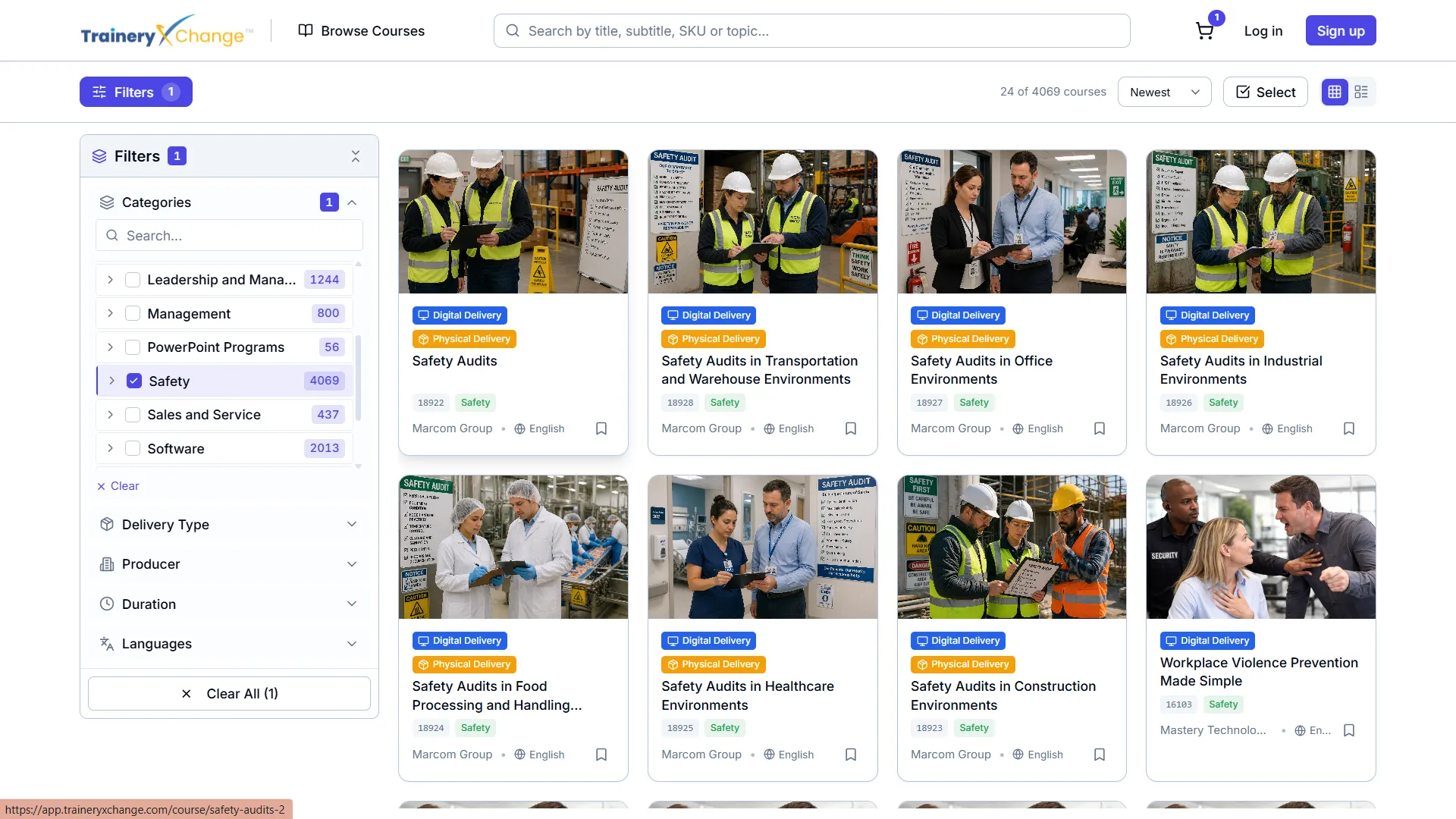
How TraineryXchange Solves This: TraineryXchange's curated library of 10,000+ courses covers compliance, onboarding, professional skills, leadership, DEI, and cybersecurity. Browse by topic, filter by format, preview content quality with a free trial. From first search to first learner: typically under 24 hours.
Challenge 2: Keeping Compliance Content Current
The Problem: Compliance training is the highest-stakes content in any L&D program, and the most likely to become outdated. State harassment training laws change. OSHA updates standards. GDPR enforcement guidance evolves. Data privacy legislation proliferates. Every change potentially invalidates training content that was accurate six months ago. For organizations with internally-built compliance courses, each change triggers a rebuild cycle: update the script, revise the course, get legal sign-off, re-export SCORM, re-upload to LMS.
The Data: Organizations experienced 2.4 times more relevant regulatory changes in 2024 to 2025 than in 2019 to 2020 (NAVEX Global, 2025 Ethics & Compliance Report). At that rate, organizations with 10+ compliance course titles face multiple rebuild cycles per year.
The Fix: Source compliance content from providers who maintain it as part of the service. With SCORM Dispatch delivery, compliance content updates centrally, your learners automatically receive the updated version without any action from your team. Establish a quarterly compliance content audit to verify all active courses reflect current standards.
How TraineryXchange Solves This: TraineryXchange delivers compliance content via SCORM Dispatch by default. When a regulation changes, OSHA heat standard, California SB 1343, state data privacy law, TraineryXchange updates the content centrally. Your learners see the current version the next time they launch. Zero rebuild overhead.
Challenge 3: Low Learner Completion Rates
The Problem: Mandatory training with low completion rates is not just an engagement problem, it is a compliance problem. If 40 percent of your employees have not completed harassment training, your Faragher-Ellerth legal defense is compromised. If 30 percent have not completed OSHA safety training, you have a documented compliance gap that any inspector will find. Low completion is often attributed to learner motivation, but the data consistently points to content format as the primary driver.
The Data: Average completion rate for long-form eLearning modules (30 to 60 min): 17 to 25%. Average completion rate for microlearning modules (under 5 min): 60 to 82%. (Towards Maturity, 2025). Format is the variable, not learner motivation.
The Fix: Audit your completion rates by course format. If long-form mandatory modules have low completion rates, break them into shorter modules or switch to microlearning-format curated content. For compliance training specifically, shorter interactive modules consistently outperform long-form on completion and knowledge retention. Set automated reminders at 14 days and 7 days before compliance deadlines.
How TraineryXchange Solves This: TraineryXchange's content library emphasizes microlearning formats for compliance and professional skills, shorter, focused modules that consistently outperform long-form on completion metrics. Enrollment automation and deadline reminders are built into the platform.
Challenge 4: Proving Training ROI to Leadership
The Problem: L&D teams consistently struggle to connect training activity to business outcomes in a way that resonates with finance and leadership. Completion reports show that training happened. They do not show what changed as a result. Without a clear ROI story, training budgets are vulnerable to cuts, especially when organizations are under cost pressure.
The Data: Only 8% of L&D leaders report being able to demonstrate business impact from training in financial terms (LinkedIn Learning 2026 Workplace Learning Report). 72% report being asked to justify L&D spend more rigorously than in previous years.
The Fix: Frame training investment as risk mitigation, not a people development cost. For compliance training, the ROI calculation is straightforward: cost of training vs cost of violations. A single OSHA serious violation costs $15,625 minimum. A harassment settlement costs $40,000 to $300,000+. A full compliance training library costs $3,000 to $8,000 per year for a 50-person team. Present these numbers side by side in your budget conversation.
How TraineryXchange Solves This: TraineryXchange's exportable completion reports, compliance tracking, and certificate generation provide the documentation layer that makes ROI conversations concrete. You can show: who trained, what they completed, when, and what compliance coverage you now have, in audit-ready format.
Challenge 5: Budget Constraints and Justifying Training Spend
The Problem: L&D budgets are under scrutiny across organizations of all sizes. When budget is tight, training is often framed as discretionary, something that can be deferred. This framing is particularly damaging for compliance training, where deferral is not a neutral decision, it is active exposure to regulatory risk.
The Data: Organizations that cut compliance training budgets face average remediation costs 3.4 times higher than the cost of the training program they eliminated (Ponemon Institute / Globalscape, 2025).
The Fix: Reframe training from a cost center to a risk mitigation function. Use the cost-of-non-compliance analysis to calculate your specific exposure (fine risk + legal fees + reputational cost) and present training as a fraction of that exposure. For compliance training specifically, the budget conversation changes entirely when leadership understands that deferral is not saving money, it is increasing uninsured risk.
How TraineryXchange Solves This: At $3,000 to $8,000 per year for a 50-person team covering OSHA, harassment, GDPR, DEI, and cybersecurity, TraineryXchange makes the ROI calculation easy. One prevented OSHA violation ($15,625 minimum) pays for the full annual subscription twice over.
Challenge 6: Scaling Training as the Organization Grows
The Problem: Training programs that work for 50 employees frequently break at 200. The content that was manageable to build and maintain internally becomes a backlog. New topics require new build projects. New geographies bring new compliance requirements. New roles need new onboarding content. Each new training need competes for the same limited L&D bandwidth.
The Data: Organizations that rely primarily on internally-built content report 60% higher L&D staff-to-employee ratios than organizations that supplement with marketplace content (Brandon Hall Group, 2025).
The Fix: Design your content strategy for scale from the start. Use marketplace content for the 80 percent of topics that do not require customization, this frees internal L&D capacity to grow the 20 percent that genuinely needs custom development. When a new compliance requirement or training topic emerges, your first question should be: does a quality marketplace cover this? In most cases, the answer is yes.
How TraineryXchange Solves This: Adding new content topics in TraineryXchange takes minutes, not months. Browse, license, assign. There is no build project, no authoring tool, no SME availability dependency. As your organization grows, the platform scales with it without adding L&D headcount.
Challenge 7: Maintaining Compliance Coverage Across Multiple Regulations
The Problem: Organizations operating across multiple US states face a compliance training matrix that becomes increasingly complex to manage. California harassment training requirements differ from New York's. Some states require annual training; others require it every two years. OSHA, GDPR, HIPAA, SOX, and DEI requirements each have their own standards, update cycles, and documentation requirements. Tracking this manually, and ensuring the right employees complete the right version at the right time, is a significant operational burden.
The Data: Organizations with employees in three or more states report spending an average of 12 hours per month on compliance training administration alone (NAVEX Global, 2025). For SMBs without a dedicated compliance function, this represents meaningful opportunity cost.
The Fix: Centralize your compliance content sourcing in a single marketplace that offers state-specific versions of regulated content and maintains those versions as laws change. Build a compliance calendar that maps each regulatory requirement to its applicable employee population and renewal frequency. Automate renewal reminders. Use a platform that generates completion records automatically.
How TraineryXchange Solves This: TraineryXchange's compliance library includes state-specific harassment training for California, New York, Illinois, Connecticut, and others, updated when mandates change. OSHA, GDPR, DEI, and cybersecurity content is included in the base subscription. Completion certificates and bulk reporting handle the documentation layer automatically.
See How TraineryXchange Solves Your L&D Challenges
TraineryXchange gives L&D teams a curated content library, native LMS, automatic compliance content updates, and audit-ready reporting in one platform all at a fraction of the cost of building internally. Book a demo to see the platform in action, or start with a free trial.


%5B1%5D.svg)
