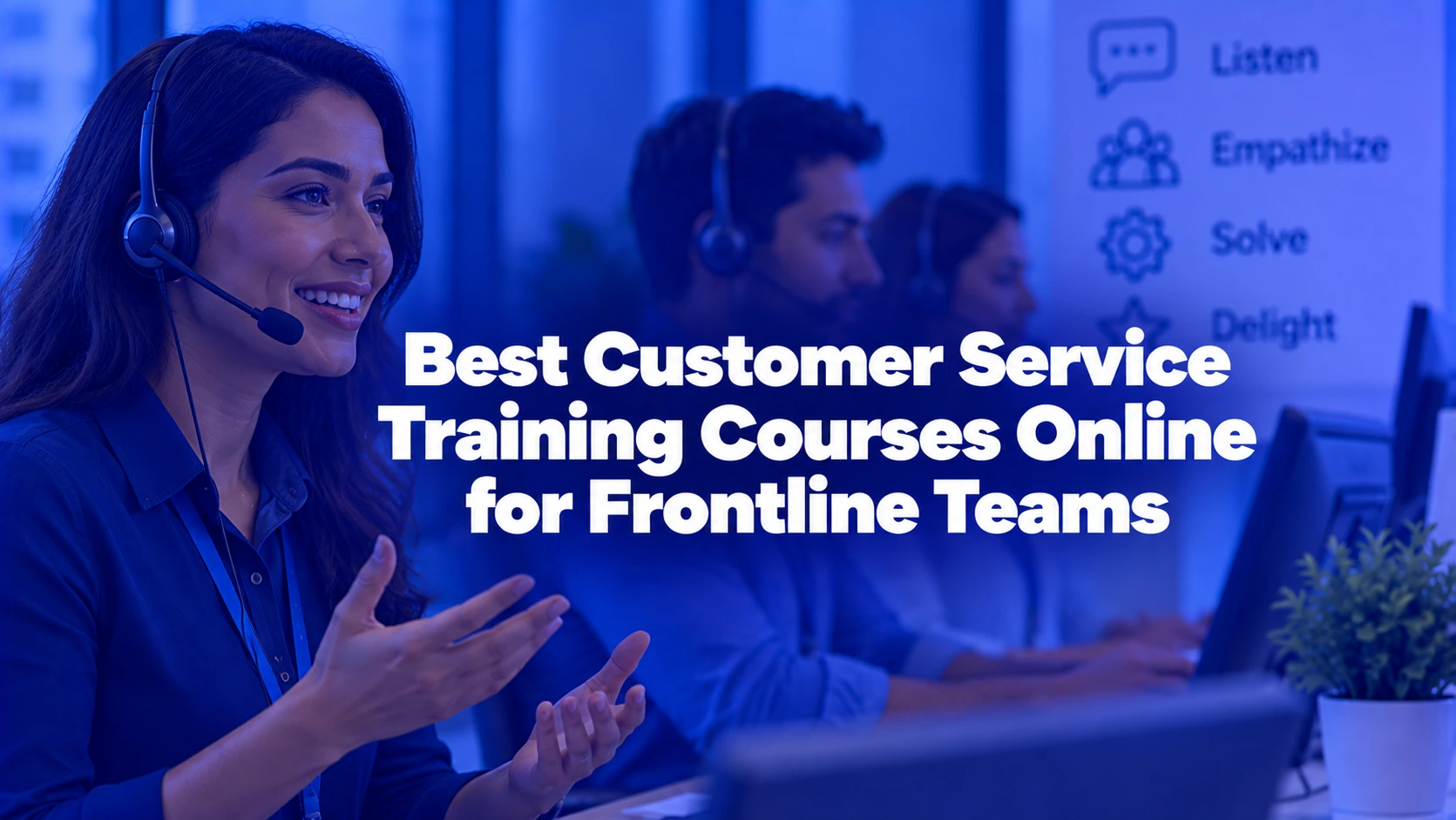
Best Customer Service Training Courses Online for Frontline Teams

Compare online customer service training courses for frontline and call-center teams, including TraineryXchange, LinkedIn Learning, Dale Carnegie, Coursera, and Alison.

Updated On:
September 30, 2026
Mahesh Kumar

Mahesh Kumar

Founder & Managing Director

Table of Contents

The best customer service training for frontline teams matches the actual interaction: retail, call center, hospitality, healthcare front desk, field service, chat, or omnichannel support. Strong programs teach communication, listening, problem solving, complaint handling, and de-escalation, then give employees realistic practice and a clear way to apply those skills on shift.

Research and comparison note: Current official provider pages were reviewed in September 2026. We did not independently complete every course. This guide compares audience fit, published scope, practice, delivery, accessibility, and workplace transfer. Course availability, pricing, licensing, language, and enterprise administration can change, so verify the exact option before purchase.

What Frontline Customer Service Training Should Cover

Frontline employees often work under time pressure, on rotating shifts, with shared devices and multiple service channels. A useful foundation can include greeting and rapport, active listening, effective questions, empathy, expectation setting, problem solving, complaint resolution, de-escalation, documentation, service recovery, and escalation rules.

Call-center teams may also need voice-only communication, note taking, CRM or ticket handling, data accuracy, troubleshooting, and privacy procedures. Map those needs with deskless and shift-based training guidance, role-based training, and a training needs analysis before choosing content.

How We Evaluated Customer Service Training Options

We compared current options on role relevance, scenario practice, channel fit, published duration, accessibility, flexible delivery, reinforcement, and evidence an employer can verify. A certificate or course-completion badge is not treated as proof that service behavior changed.

For broader procurement, use the corporate training content marketplace, course categories, content sourcing for buyers, and training content curation to compare multiple providers against the same requirements.

Customer Service Training Options to Benchmark in 2026

OptionCurrent Published ScopeBest FitMain Buyer Check
LinkedIn Learning: Getting Started as a Customer Support Specialist7 courses, 5 hours; updated Sep 15, 2026New customer support staffCurate the path to the actual role and channel
LinkedIn Learning: Zendesk Customer Service Professional Certificate6 courses, 5 hours; updated Aug 3, 2026Support teams needing customer-service and troubleshooting skillsVerify fit if the team does not use Zendesk workflows
CVS Health Call Center Customer Service Professional Certificate4-course beginner series; about 2 months at 10 hours/weekCall-center teams and career startersHealthcare examples may not transfer equally to every industry
CVS Health Retail Customer Service Professional Certificate4-course beginner series; about 2 months at 10 hours/weekRetail and in-person service rolesLonger pathway than short onboarding microlearning
Madecraft Customer Service Professional Skills4-course specialization; about 23 hoursService professionals and team leadersDepth may exceed what every hourly frontline role needs
Microsoft Customer Service with AI Professional Certificate7-course series; about 4 weeks at 10 hours/week; updated June 2026Modern service operations using CRM, analytics, and AITechnology-heavy scope may be excessive for basic frontline roles

1. TraineryXchange Customer Service Course Options

Start with TraineryXchange when the goal is to compare several customer service options before committing to one publisher. The live TraineryXchange catalog search gives HR, L&D, EHS, and procurement teams a single sourcing workflow for reviewing available courses and delivery choices.

TraineryXchange is the marketplace layer, not one fixed proprietary course. The publisher, runtime, version, language, certification or skills requirements, and delivery format depend on the course selected, so the final choice should still be checked against the same criteria used for the providers below.

2. LinkedIn Learning: Getting Started as a Customer Support Specialist

Getting Started as a Customer Support Specialist is currently a seven-course, five-hour path updated September 15, 2026. It includes Customer Service Foundations and related support skills in a sequenced pathway.

Best for: New support specialists who need a compact baseline. Trade-off: Employers should still add organization-specific products, systems, escalation rules, and customer scenarios.

3. LinkedIn Learning: Zendesk Customer Service Professional Certificate

Zendesk Customer Service Professional Certificate is currently a six-course, five-hour path updated August 3, 2026. Current components include Customer Service Foundations, problem solving and troubleshooting, and rapport-building skills.

Best for: Customer support teams that need a structured short pathway. Trade-off: Verify whether the workflow and tool context match teams that do not use Zendesk.

4. CVS Health Call Center Customer Service Professional Certificate

CVS Health Call Center Customer Service Professional Certificate is a four-course beginner series currently estimated at about two months at 10 hours per week. It covers positive customer interactions, de-escalation, problem solving, and call-center responsibilities.

Best for: Call-center teams and new support employees. Trade-off: The pathway is longer than a standard onboarding module and uses healthcare-company context that buyers should evaluate for transfer to their own industry.

Compare Customer Service Training by Frontline Role

Match retail, call-center, service-recovery, and digital-support skills to the interactions employees actually handle.

5. CVS Health Retail Customer Service Professional Certificate

CVS Health Retail Customer Service Professional Certificate is a four-course beginner series currently estimated at about two months at 10 hours per week. It teaches positive interactions, de-escalation, and retail transaction skills.

Best for: Retail associates and new in-person service employees. Trade-off: Buyers should determine whether a multi-course certificate is practical for shift schedules and whether the examples fit their own transactions and policies.

6. Madecraft Customer Service Professional Skills

Customer Service Professional Skills is a four-course Coursera specialization updated September 2026. Coursera lists approximately 23 hours of content, including de-escalation, resilience, service strategy, and customer-centric decision making.

Best for: Experienced service professionals, team leads, and employees who need more than onboarding basics. Trade-off: The strategic and resilience content may be broader than every frontline role requires.

7. Microsoft Customer Service with AI Professional Certificate

Microsoft Customer Service with AI Professional Certificate is currently a seven-course beginner series updated June 2026 and estimated at about four weeks at 10 hours per week. It covers customer data, CRM, root-cause analysis, service-level management, dashboards, and AI-assisted engagement.

Best for: Service teams moving toward CRM, analytics, and AI-assisted operations. Trade-off: The technology emphasis may be unnecessary for entry-level retail or hospitality roles.

TraineryXchange as the Sourcing Layer

TraineryXchange is most useful when the organization needs to combine customer service with adjacent content such as communication, de-escalation, supervisor development, compliance, or role-specific onboarding. Use the live customer-service catalog search to identify current options, then verify provider, version, runtime, language, accessibility, practice format, and licensing before assignment.

For larger rollouts, review content licensing, LTI and SCORM delivery, integration requirements, LMS delivery, TraineryLMS, training-team workflows, and enterprise training needs.

Match the Course to the Frontline Environment

Retail employees need practice with returns, queues, transaction expectations, product questions, and upset customers. Hospitality and food-service teams need service-recovery conversations and role-play. Call-center agents need voice-only communication, troubleshooting, documentation, and escalation. Healthcare front-desk staff may need patient communication layered with organization-specific privacy and safety procedures.

Do not assume one generic customer-service course fits every environment. Use a training gap analysis to distinguish missing skills from inconsistent application, and use training-needs questions with frontline supervisors before selecting content.

Frontline Practice Should Match the Customer Channel

The same communication principles can apply across channels, but practice should resemble the environment employees actually work in. A phone agent, retail associate, live-chat specialist and field-service employee face different constraints even when they share the same service standards.

Frontline EnvironmentPriority SkillsUseful Practice Evidence
Call center / phoneListening without visual cues, call control, troubleshooting, de-escalation, documentationRecorded role-play, QA scorecard, case notes, escalation decision
Retail / in personGreeting, product questions, queues, returns, service recovery, policy explanationScenario observation, transaction explanation, recovery conversation
Chat / messagingWritten clarity, tone, speed, concise troubleshooting, handoffsTranscript review, response quality, resolution path, documentation accuracy
Email supportStructure, expectation setting, ownership, complete answers, follow-throughSample response, reopen rate review, manager rubric
Field / onsite serviceExpectation management, professionalism, technical explanation, boundaries, escalationObserved interaction, customer handoff, service notes

Use the same frontline scenario before and after training when possible. That gives managers a clearer behavioral comparison than completion data alone.

What to Check Before You License a Course

Buyer CheckWhat to VerifyWhy It Matters
Role fitRetail, call center, hospitality, healthcare, field, or digital-support scenariosEmployees need practice that resembles real interactions
PracticeRole-play, branching scenarios, transcripts, exercises, or coached feedbackBehavior improves through rehearsal and feedback
DeliveryMobile, shared-device, desktop, live, self-paced, or blended accessFrontline schedules and device constraints affect rollout
Language and accessibilityCaptions, translations, screen-reader support, and mobile usabilityAccess needs vary across distributed workforces
AdministrationAssignments, reminders, completion records, and reportingL&D needs operational visibility at scale
LicensingPer-seat, course, bundle, term, reassignment, and exit termsHigh-turnover roles can make the wrong commercial model expensive

Use the training marketplace buyer checklist and training content license agreement guide before procurement. For multilingual teams, add the multilingual learning checklist. Confirm current language coverage and licensing terms at the course level instead of assuming every provider offers the same configuration.

Turn Course Content Into a Frontline Program

A course license alone rarely changes service behavior. Pair foundational lessons with supervisor coaching, short reinforcement, realistic customer scenarios, and a clear quality rubric. Supervisors should know what good behavior looks like and reinforce it consistently on shift.

Use learning effectiveness measurement and a training KPI dashboard to separate completions from outcomes. Useful measures can include scenario performance, quality-review scores, first-contact resolution where appropriate, escalation quality, documentation accuracy, and customer feedback. Do not attribute every customer metric change to training alone.

For longer-term development, connect frontline customer service skills with supervisor and manager training content, learning and development planning, and workforce development so strong frontline performers have a clear pathway into broader responsibilities.

Final Recommendation

For a compact foundational pathway, LinkedIn Learning's updated customer-support paths are practical benchmarks. CVS Health offers longer role-specific call-center and retail certificate paths. Madecraft provides a deeper service and resilience specialization, while Microsoft's June 2026 certificate fits teams that need CRM, analytics, Power BI and AI-assisted service capabilities. LinkedIn Learning's July 2026 Customer Service Communication Skills course is also a useful short reinforcement option at 40 minutes, particularly for active listening, expectation setting and de-escalation practice.

Use TraineryXchange as the sourcing and governance layer, not as a single ranked customer-service course. Start with the frontline role and interaction channel, use the live customer-service catalog search, then verify the exact course, practice format, language, accessibility, licensing, and delivery before assignment.

Build Customer Service Training Around Real Frontline Interactions

Source current content by role, channel, and skill, then reinforce it with supervisor coaching and measurable workplace practice.

Sources Reviewed

LinkedIn Learning: Getting Started as a Customer Support Specialist

LinkedIn Learning: Zendesk Customer Service Professional Certificate

LinkedIn Learning: Customer Service Foundations

LinkedIn Learning: Customer Service Communication Skills

LinkedIn Learning lists Customer Service Communication Skills at 40 minutes, released July 28, 2026, with AI-powered role-play for customer conversations.

LinkedIn Learning: Customer Service Problem-Solving and Troubleshooting

Coursera: CVS Health Call Center Customer Service Professional Certificate

Coursera: CVS Health Retail Customer Service Professional Certificate

Coursera: Customer Service Professional Skills by Madecraft

Coursera: Microsoft Customer Service with AI Professional Certificate

Zendesk: Customer Service Training Guide, updated February 6, 2026

Current official provider pages were reviewed in September 2026. Verify course availability, runtime, language, licensing, enterprise administration, and delivery details before purchase.
Key Takeaways:‍

  • Choose customer service training by frontline role and interaction channel rather than assigning one generic service course to every employee.
  • Strong programs teach communication, listening, problem solving, complaint handling, and de-escalation, then reinforce those skills with realistic practice.
  • Retail, call-center, hospitality, healthcare, and digital-support teams need different scenarios, workflows, and operational expectations.
  • Before licensing a course, verify practice format, mobile and shared-device access, accessibility, language options, reporting, licensing, and LMS delivery.
  • Measure workplace application through scenario performance, quality review, and supervisor observation instead of treating completion as proof of better customer service.

The best customer service training for frontline teams matches the actual interaction: retail, call center, hospitality, healthcare front desk, field service, chat, or omnichannel support. Strong programs teach communication, listening, problem solving, complaint handling, and de-escalation, then give employees realistic practice and a clear way to apply those skills on shift.

Research and comparison note: Current official provider pages were reviewed in September 2026. We did not independently complete every course. This guide compares audience fit, published scope, practice, delivery, accessibility, and workplace transfer. Course availability, pricing, licensing, language, and enterprise administration can change, so verify the exact option before purchase.

What Frontline Customer Service Training Should Cover

Frontline employees often work under time pressure, on rotating shifts, with shared devices and multiple service channels. A useful foundation can include greeting and rapport, active listening, effective questions, empathy, expectation setting, problem solving, complaint resolution, de-escalation, documentation, service recovery, and escalation rules.

Call-center teams may also need voice-only communication, note taking, CRM or ticket handling, data accuracy, troubleshooting, and privacy procedures. Map those needs with deskless and shift-based training guidance, role-based training, and a training needs analysis before choosing content.

How We Evaluated Customer Service Training Options

We compared current options on role relevance, scenario practice, channel fit, published duration, accessibility, flexible delivery, reinforcement, and evidence an employer can verify. A certificate or course-completion badge is not treated as proof that service behavior changed.

For broader procurement, use the corporate training content marketplace, course categories, content sourcing for buyers, and training content curation to compare multiple providers against the same requirements.

Customer Service Training Options to Benchmark in 2026

OptionCurrent Published ScopeBest FitMain Buyer Check
LinkedIn Learning: Getting Started as a Customer Support Specialist7 courses, 5 hours; updated Sep 15, 2026New customer support staffCurate the path to the actual role and channel
LinkedIn Learning: Zendesk Customer Service Professional Certificate6 courses, 5 hours; updated Aug 3, 2026Support teams needing customer-service and troubleshooting skillsVerify fit if the team does not use Zendesk workflows
CVS Health Call Center Customer Service Professional Certificate4-course beginner series; about 2 months at 10 hours/weekCall-center teams and career startersHealthcare examples may not transfer equally to every industry
CVS Health Retail Customer Service Professional Certificate4-course beginner series; about 2 months at 10 hours/weekRetail and in-person service rolesLonger pathway than short onboarding microlearning
Madecraft Customer Service Professional Skills4-course specialization; about 23 hoursService professionals and team leadersDepth may exceed what every hourly frontline role needs
Microsoft Customer Service with AI Professional Certificate7-course series; about 4 weeks at 10 hours/week; updated June 2026Modern service operations using CRM, analytics, and AITechnology-heavy scope may be excessive for basic frontline roles

1. TraineryXchange Customer Service Course Options

Start with TraineryXchange when the goal is to compare several customer service options before committing to one publisher. The live TraineryXchange catalog search gives HR, L&D, EHS, and procurement teams a single sourcing workflow for reviewing available courses and delivery choices.

TraineryXchange is the marketplace layer, not one fixed proprietary course. The publisher, runtime, version, language, certification or skills requirements, and delivery format depend on the course selected, so the final choice should still be checked against the same criteria used for the providers below.

2. LinkedIn Learning: Getting Started as a Customer Support Specialist

Getting Started as a Customer Support Specialist is currently a seven-course, five-hour path updated September 15, 2026. It includes Customer Service Foundations and related support skills in a sequenced pathway.

Best for: New support specialists who need a compact baseline. Trade-off: Employers should still add organization-specific products, systems, escalation rules, and customer scenarios.

3. LinkedIn Learning: Zendesk Customer Service Professional Certificate

Zendesk Customer Service Professional Certificate is currently a six-course, five-hour path updated August 3, 2026. Current components include Customer Service Foundations, problem solving and troubleshooting, and rapport-building skills.

Best for: Customer support teams that need a structured short pathway. Trade-off: Verify whether the workflow and tool context match teams that do not use Zendesk.

4. CVS Health Call Center Customer Service Professional Certificate

CVS Health Call Center Customer Service Professional Certificate is a four-course beginner series currently estimated at about two months at 10 hours per week. It covers positive customer interactions, de-escalation, problem solving, and call-center responsibilities.

Best for: Call-center teams and new support employees. Trade-off: The pathway is longer than a standard onboarding module and uses healthcare-company context that buyers should evaluate for transfer to their own industry.

Compare Customer Service Training by Frontline Role

Match retail, call-center, service-recovery, and digital-support skills to the interactions employees actually handle.

5. CVS Health Retail Customer Service Professional Certificate

CVS Health Retail Customer Service Professional Certificate is a four-course beginner series currently estimated at about two months at 10 hours per week. It teaches positive interactions, de-escalation, and retail transaction skills.

Best for: Retail associates and new in-person service employees. Trade-off: Buyers should determine whether a multi-course certificate is practical for shift schedules and whether the examples fit their own transactions and policies.

6. Madecraft Customer Service Professional Skills

Customer Service Professional Skills is a four-course Coursera specialization updated September 2026. Coursera lists approximately 23 hours of content, including de-escalation, resilience, service strategy, and customer-centric decision making.

Best for: Experienced service professionals, team leads, and employees who need more than onboarding basics. Trade-off: The strategic and resilience content may be broader than every frontline role requires.

7. Microsoft Customer Service with AI Professional Certificate

Microsoft Customer Service with AI Professional Certificate is currently a seven-course beginner series updated June 2026 and estimated at about four weeks at 10 hours per week. It covers customer data, CRM, root-cause analysis, service-level management, dashboards, and AI-assisted engagement.

Best for: Service teams moving toward CRM, analytics, and AI-assisted operations. Trade-off: The technology emphasis may be unnecessary for entry-level retail or hospitality roles.

TraineryXchange as the Sourcing Layer

TraineryXchange is most useful when the organization needs to combine customer service with adjacent content such as communication, de-escalation, supervisor development, compliance, or role-specific onboarding. Use the live customer-service catalog search to identify current options, then verify provider, version, runtime, language, accessibility, practice format, and licensing before assignment.

For larger rollouts, review content licensing, LTI and SCORM delivery, integration requirements, LMS delivery, TraineryLMS, training-team workflows, and enterprise training needs.

Match the Course to the Frontline Environment

Retail employees need practice with returns, queues, transaction expectations, product questions, and upset customers. Hospitality and food-service teams need service-recovery conversations and role-play. Call-center agents need voice-only communication, troubleshooting, documentation, and escalation. Healthcare front-desk staff may need patient communication layered with organization-specific privacy and safety procedures.

Do not assume one generic customer-service course fits every environment. Use a training gap analysis to distinguish missing skills from inconsistent application, and use training-needs questions with frontline supervisors before selecting content.

Frontline Practice Should Match the Customer Channel

The same communication principles can apply across channels, but practice should resemble the environment employees actually work in. A phone agent, retail associate, live-chat specialist and field-service employee face different constraints even when they share the same service standards.

Frontline EnvironmentPriority SkillsUseful Practice Evidence
Call center / phoneListening without visual cues, call control, troubleshooting, de-escalation, documentationRecorded role-play, QA scorecard, case notes, escalation decision
Retail / in personGreeting, product questions, queues, returns, service recovery, policy explanationScenario observation, transaction explanation, recovery conversation
Chat / messagingWritten clarity, tone, speed, concise troubleshooting, handoffsTranscript review, response quality, resolution path, documentation accuracy
Email supportStructure, expectation setting, ownership, complete answers, follow-throughSample response, reopen rate review, manager rubric
Field / onsite serviceExpectation management, professionalism, technical explanation, boundaries, escalationObserved interaction, customer handoff, service notes

Use the same frontline scenario before and after training when possible. That gives managers a clearer behavioral comparison than completion data alone.

What to Check Before You License a Course

Buyer CheckWhat to VerifyWhy It Matters
Role fitRetail, call center, hospitality, healthcare, field, or digital-support scenariosEmployees need practice that resembles real interactions
PracticeRole-play, branching scenarios, transcripts, exercises, or coached feedbackBehavior improves through rehearsal and feedback
DeliveryMobile, shared-device, desktop, live, self-paced, or blended accessFrontline schedules and device constraints affect rollout
Language and accessibilityCaptions, translations, screen-reader support, and mobile usabilityAccess needs vary across distributed workforces
AdministrationAssignments, reminders, completion records, and reportingL&D needs operational visibility at scale
LicensingPer-seat, course, bundle, term, reassignment, and exit termsHigh-turnover roles can make the wrong commercial model expensive

Use the training marketplace buyer checklist and training content license agreement guide before procurement. For multilingual teams, add the multilingual learning checklist. Confirm current language coverage and licensing terms at the course level instead of assuming every provider offers the same configuration.

Turn Course Content Into a Frontline Program

A course license alone rarely changes service behavior. Pair foundational lessons with supervisor coaching, short reinforcement, realistic customer scenarios, and a clear quality rubric. Supervisors should know what good behavior looks like and reinforce it consistently on shift.

Use learning effectiveness measurement and a training KPI dashboard to separate completions from outcomes. Useful measures can include scenario performance, quality-review scores, first-contact resolution where appropriate, escalation quality, documentation accuracy, and customer feedback. Do not attribute every customer metric change to training alone.

For longer-term development, connect frontline customer service skills with supervisor and manager training content, learning and development planning, and workforce development so strong frontline performers have a clear pathway into broader responsibilities.

Final Recommendation

For a compact foundational pathway, LinkedIn Learning's updated customer-support paths are practical benchmarks. CVS Health offers longer role-specific call-center and retail certificate paths. Madecraft provides a deeper service and resilience specialization, while Microsoft's June 2026 certificate fits teams that need CRM, analytics, Power BI and AI-assisted service capabilities. LinkedIn Learning's July 2026 Customer Service Communication Skills course is also a useful short reinforcement option at 40 minutes, particularly for active listening, expectation setting and de-escalation practice.

Use TraineryXchange as the sourcing and governance layer, not as a single ranked customer-service course. Start with the frontline role and interaction channel, use the live customer-service catalog search, then verify the exact course, practice format, language, accessibility, licensing, and delivery before assignment.

Build Customer Service Training Around Real Frontline Interactions

Source current content by role, channel, and skill, then reinforce it with supervisor coaching and measurable workplace practice.

Sources Reviewed

LinkedIn Learning: Getting Started as a Customer Support Specialist

LinkedIn Learning: Zendesk Customer Service Professional Certificate

LinkedIn Learning: Customer Service Foundations

LinkedIn Learning: Customer Service Communication Skills

LinkedIn Learning lists Customer Service Communication Skills at 40 minutes, released July 28, 2026, with AI-powered role-play for customer conversations.

LinkedIn Learning: Customer Service Problem-Solving and Troubleshooting

Coursera: CVS Health Call Center Customer Service Professional Certificate

Coursera: CVS Health Retail Customer Service Professional Certificate

Coursera: Customer Service Professional Skills by Madecraft

Coursera: Microsoft Customer Service with AI Professional Certificate

Zendesk: Customer Service Training Guide, updated February 6, 2026

Current official provider pages were reviewed in September 2026. Verify course availability, runtime, language, licensing, enterprise administration, and delivery details before purchase.
Frequently Asked Questions

How should L&D measure customer service training results?
How should companies choose customer service training courses?
Is online or live customer service training better for frontline teams?
What should customer service training for frontline employees cover?
What is customer service training for frontline teams?