Best Leadership Development Platforms for Corporate Teams: A Buyer’s Guide (2026)

Updated On:
June 21, 2026

Mahesh Kumar

Founder, TraineryHCM.com
Best Leadership Development Platforms

Table of Contents

Leadership capability is the most consequential variable in organizational performance. Study after study confirms that the quality of management directly determines employee engagement, retention, and ultimately the productivity of every team in a business. Yet despite widespread recognition of this reality, most organizations still struggle to translate that understanding into structured, scalable, and measurable leadership development.

The leadership development platform market has matured significantly in the past three years. Organizations now have access to purpose-built software that goes far beyond the traditional LMS, combining skills assessments, mentoring infrastructure, AI-driven learning recommendations, coaching tools, and content libraries into unified platforms designed specifically for developing leaders at every level.

This buyer's guide is for HR leaders, L&D directors, and People Operations executives who need to evaluate, select, and implement a leadership development platform for their corporate teams in 2026. It covers what to look for, how to compare platform categories, how to match solutions to company size, and how to measure the ROI of the investment.

What Is a Leadership Development Platform?

A leadership development platform is a software solution designed to build leadership capability across an organization through structured learning programs, skills assessments, mentoring and coaching tools, and progress analytics. Unlike a general learning management system, which manages and delivers training content broadly, a leadership development platform focuses specifically on the competencies, behaviors, and career pathways required to develop effective managers and executives. Modern platforms include AI-powered learning recommendations, content libraries with off-the-shelf leadership courses, 360-degree feedback tools, and integrations with HRIS and performance management systems.

Leadership Development Platform vs. LMS vs. Learning Experience Platform

One of the most common and costly mistakes in the platform selection process is conflating three distinct product categories. Each serves a related but fundamentally different organizational need.

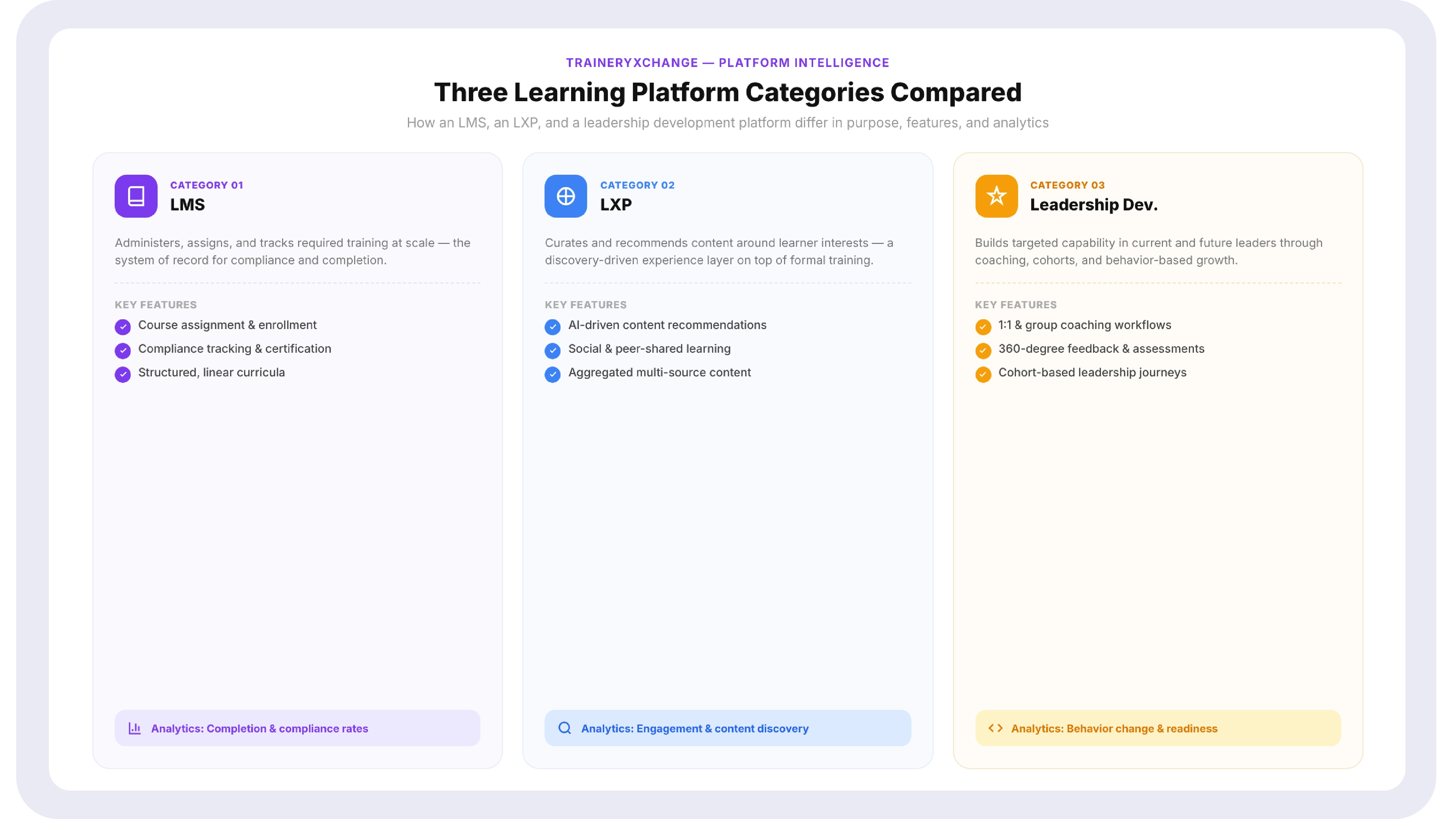
Dimension LMS Learning Experience Platform (LXP) Leadership Development Platform
Primary Purpose Manages, delivers, and tracks formal training, certifications, and compliance programs. Personalizes and curates learning experiences across multiple internal and external content sources. Builds leadership capability through structured development programs, coaching, mentoring, and assessments.
Content Approach Organization-created or uploaded courses with limited marketplace integration. Aggregates learning from internal libraries and external providers with strong search, recommendations, and discovery. Curated leadership content combined with competency assessments, coaching, and mentoring infrastructure.
Leadership-Specific Features Minimal. Typically requires third-party leadership content and custom configuration. Some leadership capabilities depending on the platform and content partnerships. Built specifically around leadership competency frameworks, 360-degree feedback, coaching, mentoring, and succession readiness.
Analytics Depth Training completion, pass/fail scores, certifications, and compliance reporting. Engagement analytics, skills gap insights, personalized learning recommendations, and learning path completion. Leadership effectiveness scores, promotion readiness, succession pipeline visibility, and manager capability analytics.
Best For Compliance-heavy organizations, onboarding programs, and certification management. Organizations prioritizing employee-driven, continuous learning and skill development. Organizations investing in leadership pipelines, succession planning, and executive development.

Many enterprise organizations ultimately need elements of all three. An enterprise learning platform that combines LXP flexibility, LMS administrative control, and leadership-specific features, backed by an online training marketplace, provides more strategic flexibility than any single-category tool.

See How Trainery Combines LMS, LXP, and Leadership Development in One Platform

Trainery’s enterprise learning platform gives L&D teams the infrastructure to manage compliance training, personalize leadership learning paths, and measure leadership capability development, all from a single solution with an integrated content marketplace.

Book a Demo
Side-by-side comparison diagram showing the differences between an LMS, a learning experience platform, and a leadership development platform across purpose, features, and analytics

Must-Have Features in a Leadership Development Platform

The feature set that matters for corporate leadership development has expanded significantly. Below are the capabilities that should appear in any platform evaluated for enterprise use in 2026.

AI-Powered Learning Recommendations

Effective leadership development is not linear. Managers at different career stages, in different functions, and with different assessed competency gaps need differentiated learning experiences. AI recommendation engines that analyze role data, assessment outcomes, and learning behavior to surface the most relevant content dramatically reduce the manual configuration burden on L&D teams while improving learner engagement and completion.

Skills Assessments and Competency Mapping

A platform that cannot tell you what leadership gaps exist in your organization before training begins, and measure whether those gaps have closed afterward, is not a development platform. It is a content delivery system. Look for platforms that include multi-rater (360-degree) assessments, self-assessments, and manager-validated competency mapping that connects directly to your leadership framework.

Mentoring and Coaching Infrastructure

Leadership development research consistently identifies mentoring as one of the highest-impact interventions for developing managers and building succession pipelines. A platform that supports structured mentoring program design, mentor-mentee matching, session tracking, and outcome measurement allows organizations to scale mentoring beyond informal relationships.

Curated Leadership Content Library

Building custom leadership content from scratch is expensive, slow, and typically yields lower production quality than expert-developed off-the-shelf alternatives. A platform with access to an e-learning content library or online training marketplace allows L&D teams to launch leadership programs quickly with vetted, current curriculum, while preserving the option to develop organization-specific content over time.

Leadership Analytics and Pipeline Dashboards

The analytics layer separates platforms built for compliance reporting from platforms built for strategic workforce development. Look for dashboards that provide visibility into leadership pipeline depth by level and function, promotion readiness scores, manager effectiveness ratings correlated with team performance, and longitudinal skill development trends.

Integrations with HRIS, Performance Management, and Communication Tools

A leadership development platform that operates as a standalone technology silo reduces adoption and creates data fragmentation. Native or API-based integrations with your HRIS, performance management system, and communication tools (such as Slack or Microsoft Teams) allow learning to be embedded in existing workflows rather than requiring employees to navigate a separate platform for development activities.

Best Leadership Development Platforms by Company Size

No single platform is the optimal choice for every organization. Company size shapes the complexity of deployment requirements, budget constraints, administrative capacity, and the sophistication of analytics needed to demonstrate ROI.

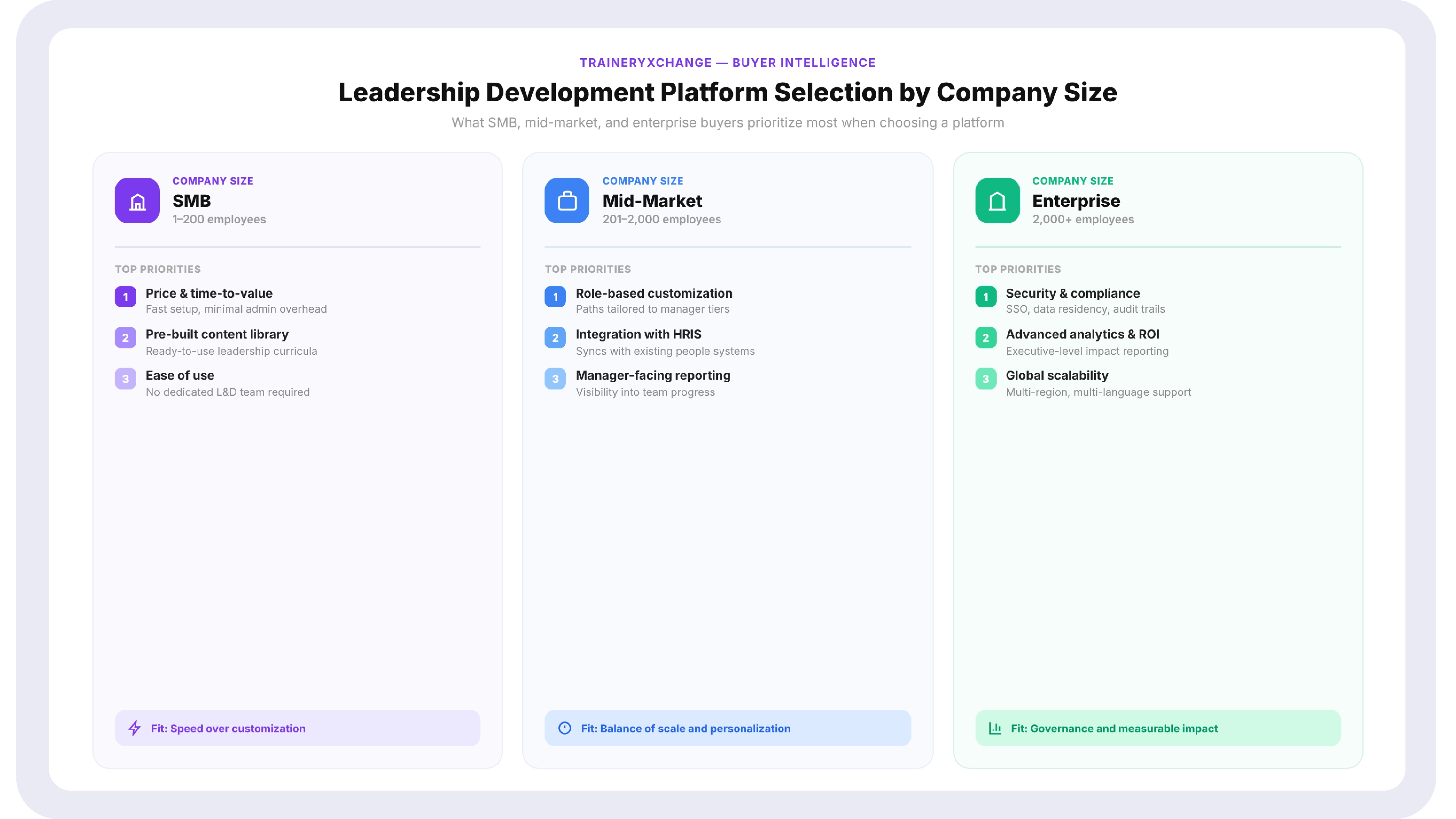
SMB (50 to 500 Employees)

Small and mid-sized organizations typically need a platform that is quick to deploy, does not require a dedicated LMS administrator, offers access to a strong off-the-shelf content library (since custom content development is rarely feasible at this scale), and provides enough analytics to track progress without requiring a data team to interpret the output.

Key priorities for SMBs: ease of setup, content marketplace access, affordable per-seat pricing, and basic mentoring or coaching tools. Avoid platforms built primarily for enterprise-scale implementation complexity.

Mid-Market (500 to 5,000 Employees)

Mid-market organizations face a distinct set of challenges: they are large enough to have meaningful leadership pipeline complexity, diverse enough to require role-based learning paths, but often under-resourced relative to enterprise L&D functions. They need a platform with genuine customization capability, solid integration support, and analytics that can demonstrate ROI to a leadership team that is increasingly sophisticated in its expectations of L&D.

Key priorities for mid-market: configurable learning paths, multi-department administration, competency framework customization, HRIS integration, and a content library broad enough to cover multiple leadership levels from emerging managers to senior leaders.

Enterprise (5,000+ Employees)

Enterprise organizations require the full capability stack: advanced skills assessment and competency mapping, AI-powered recommendation at scale, enterprise-grade security and compliance, multi-language support for global workforces, sophisticated reporting and analytics, dedicated customer success and implementation support, and the administrative infrastructure to manage thousands of active learners across multiple business units simultaneously.

For enterprise buyers, the platform is only part of the evaluation. The vendor's implementation methodology, change management support, and long-term product roadmap are equally important selection criteria.

Built for Enterprise Scale, Accessible for Growing Teams

Trainery’s enterprise learning platform scales from mid-market to global enterprise without requiring a platform migration as you grow. One solution, configured to your needs, backed by a content marketplace with thousands of leadership development courses.

Book a Demo
Three-column visual showing SMB, mid-market, and enterprise priority features for leadership development platform selection

Why Off-the-Shelf Leadership Content Matters

One of the most frequently underestimated components of a leadership development platform is the quality and breadth of its content library. Organizations often assume they need to build custom leadership content to make training relevant. In practice, the most effective implementations combine a strong off-the-shelf foundation with targeted customization for organization-specific frameworks, terminology, and case studies.

An online training marketplace that aggregates leadership content from multiple expert providers gives L&D teams three significant advantages:

  • Speed to deployment: Programs can be launched in days or weeks rather than the months required to produce high-quality custom content.
  • Content quality benchmarking: Courses from established providers have been developed by subject-matter experts and refined through wide-scale learner feedback. The average in-house custom course does not match this standard.
  • Breadth across leadership levels: A marketplace with thousands of courses can cover everything from first-time manager fundamentals through executive-level strategic leadership and change management, without requiring separate vendor relationships for each topic area.

When evaluating a platform's content library, assess the following: recency of course updates, diversity of leadership topics covered (emotional intelligence, inclusive leadership, strategic thinking, communication, coaching skills), available formats (video, microlearning, scenario-based, assessments), and whether the library includes content localized for global teams.

The ROI of Leadership Development Programs

L&D leaders face increasing pressure to quantify the business impact of their investments. Leadership development is no exception. The good news is that the connection between effective leadership development and measurable business outcomes is well established in the research literature. The challenge is capturing the right data and connecting it to the right metrics.

The Four Measurable Returns of Corporate Leadership Development

1. Retention of High-Potential Employees

Research from Gallup and McKinsey consistently identifies manager quality as the primary driver of employee retention. Organizations that invest in structured leadership development reduce voluntary turnover among high-potential employees, who disproportionately leave when they lack confidence in their manager's capability to develop them. A retention improvement of even 5% among this population typically delivers an ROI that exceeds the annual cost of a leadership development platform.

2. Reduction in External Leadership Hiring Costs

The average cost of externally hiring a senior manager or director ranges from 50% to 150% of annual salary when recruitment fees, onboarding time, and productivity ramp are included. Organizations with structured succession pipelines and measurable promotion readiness data consistently fill a higher percentage of leadership roles internally, reducing dependency on costly external search.

3. Improvement in Manager Effectiveness Scores

When manager effectiveness is tracked through 360-degree assessments or team engagement surveys before and after a leadership development program, organizations consistently see measurable improvement. Even modest gains in manager effectiveness scores correlate with meaningful improvements in team productivity, engagement, and output quality.

4. Acceleration of Leadership Pipeline Velocity

Organizations with structured leadership development programs promote ready leaders faster. Faster promotion cycles reduce the cost and risk of leadership vacancies, particularly at the senior manager and director levels where extended leadership gaps create measurable disruption to team performance and business continuity.

ROI Measurement Framework

  • Establish baseline metrics before program launch: voluntary turnover rate, internal promotion rate, manager NPS or effectiveness scores, and average time-to-promotion for high-potential employees.
  • Track program participation, completion, and assessment score progression through your learning platform analytics.
  • Conduct a 6-month and 12-month post-program measurement of each baseline metric.
  • Calculate avoided cost from reduced external hiring (use fully loaded cost per hire for senior individual roles).
  • Connect team performance data (productivity, engagement scores, attrition rates) to leadership cohort participation to demonstrate downstream business impact.

Common Mistakes When Selecting Leadership Training Software

The platform selection process is where organizations consistently make avoidable errors that undermine program effectiveness before the first learner logs in.

  1. Selecting on price without defining outcomes. The cheapest platform is always the wrong starting point. Define the specific leadership capability gaps you are trying to close and the business outcomes you expect to generate before evaluating any vendor.
  2. Evaluating features rather than use cases. A feature checklist comparison across vendors tells you very little about which platform will actually work for your specific organization, workforce, and L&D team capacity. Evaluate platforms against concrete use cases: 'How would this platform help us develop 50 first-time managers in six months?'
  3. Ignoring content library quality and recency. A platform with weak content forces you to build everything from scratch or manage additional vendor relationships. Evaluate content library depth, topic coverage, format diversity, and update frequency before selecting a platform.
  4. Underweighting integration requirements. A leadership development platform that does not integrate with your HRIS, performance management system, or communication tools will be used inconsistently. Integration friction is the leading cause of low adoption in otherwise well-designed programs.
  5. Failing to secure manager participation in the selection process. Leadership development platforms serve managers. Selecting a platform without input from the people who will use it most produces misalignment between product capability and actual user workflow.
  6. Treating platform selection as a one-time decision. Leadership development is a continuous organizational capability, not a project. Evaluate vendors on their product roadmap, support model, and commitment to content library updates, not just current-state features.

Why an Enterprise Learning Platform Outperforms a Standalone Leadership Tool

Purpose-built leadership development applications solve a narrow set of problems well. They are optimized for leadership content delivery, competency assessment, and mentoring program management. But they create a fragmented technology ecosystem when they exist alongside a separate LMS for compliance training, a separate onboarding platform, and separate performance management software.

An enterprise learning platform that functions as a unified learning infrastructure, combining LMS capability, LXP personalization, and leadership-specific features, backed by an integrated online training marketplace, provides several advantages a standalone tool cannot match:

  • Single learner record: All development activity, from onboarding through compliance training through leadership development, lives in one system, giving L&D and HR leadership a complete picture of each employee's growth trajectory.
  • Cross-program analytics: Correlating leadership program participation with broader performance, retention, and engagement data is straightforward when all data exists in the same platform.
  • Content marketplace flexibility: Access to an e-learning content library with thousands of courses from multiple providers means your leadership content never becomes stale, and you can respond to emerging skill gaps without waiting for custom content development cycles.
  • Consolidated vendor relationship: One platform, one contract, one support relationship, and one integration footprint simplifies the administrative overhead that fragments L&D team capacity across multiple point solutions.
  • Scalability without platform migration: Organizations that grow from 500 to 5,000 employees do not need to re-platform. An enterprise learning platform that scales with the organization protects the curriculum investment and user data accumulated over time.

Selecting a leadership development platform is one of the highest-leverage decisions an L&D leader makes. The right platform structures how your organization identifies, develops, and promotes the leaders who will define your culture, retain your talent, and drive your performance over the next decade.

The organizations that get this decision right share a common approach: they define outcomes before evaluating features, they insist on a platform with genuine analytics capability rather than activity tracking disguised as insight, they prioritize content library depth alongside delivery infrastructure, and they select vendors with the implementation support and product roadmap to serve as long-term partners rather than transactional software providers.

Whether you are building your first structured leadership development program or scaling an existing one, the framework in this guide gives you the structure to evaluate, compare, and select with confidence.

Enterprise Leadership Development

Ready to Build a Scalable Leadership Development Program?

Trainery’s enterprise learning platform combines a curated leadership content library, skills assessments, mentoring tools, and business-impact analytics in one solution. Schedule a demo and see how leading organizations design leadership programs that produce measurable results.

Book a Demo

Key Takeaways

  • A leadership development platform is not the same as an LMS or a general learning experience platform. Understanding these distinctions is the first step toward selecting the right solution.
  • The best platform for your organization depends on company size, existing HR technology, content requirements, and whether you need off-the-shelf courses, custom content, or both.
  • Must-have features in 2026 include AI-powered learning recommendations, skills assessments, mentoring and coaching tools, analytics dashboards, and integration with your HRIS.
  • Off-the-shelf leadership content from an online training marketplace reduces time-to-training dramatically and provides expert-vetted curriculum without the cost of custom development.
  • The measurable ROI of leadership development programs goes well beyond course completion. Retention, promotion readiness, manager effectiveness scores, and business-unit performance are the metrics that justify investment.

Leadership capability is the most consequential variable in organizational performance. Study after study confirms that the quality of management directly determines employee engagement, retention, and ultimately the productivity of every team in a business. Yet despite widespread recognition of this reality, most organizations still struggle to translate that understanding into structured, scalable, and measurable leadership development.

The leadership development platform market has matured significantly in the past three years. Organizations now have access to purpose-built software that goes far beyond the traditional LMS, combining skills assessments, mentoring infrastructure, AI-driven learning recommendations, coaching tools, and content libraries into unified platforms designed specifically for developing leaders at every level.

This buyer's guide is for HR leaders, L&D directors, and People Operations executives who need to evaluate, select, and implement a leadership development platform for their corporate teams in 2026. It covers what to look for, how to compare platform categories, how to match solutions to company size, and how to measure the ROI of the investment.

What Is a Leadership Development Platform?

A leadership development platform is a software solution designed to build leadership capability across an organization through structured learning programs, skills assessments, mentoring and coaching tools, and progress analytics. Unlike a general learning management system, which manages and delivers training content broadly, a leadership development platform focuses specifically on the competencies, behaviors, and career pathways required to develop effective managers and executives. Modern platforms include AI-powered learning recommendations, content libraries with off-the-shelf leadership courses, 360-degree feedback tools, and integrations with HRIS and performance management systems.

Leadership Development Platform vs. LMS vs. Learning Experience Platform

One of the most common and costly mistakes in the platform selection process is conflating three distinct product categories. Each serves a related but fundamentally different organizational need.

Dimension LMS Learning Experience Platform (LXP) Leadership Development Platform
Primary Purpose Manages, delivers, and tracks formal training, certifications, and compliance programs. Personalizes and curates learning experiences across multiple internal and external content sources. Builds leadership capability through structured development programs, coaching, mentoring, and assessments.
Content Approach Organization-created or uploaded courses with limited marketplace integration. Aggregates learning from internal libraries and external providers with strong search, recommendations, and discovery. Curated leadership content combined with competency assessments, coaching, and mentoring infrastructure.
Leadership-Specific Features Minimal. Typically requires third-party leadership content and custom configuration. Some leadership capabilities depending on the platform and content partnerships. Built specifically around leadership competency frameworks, 360-degree feedback, coaching, mentoring, and succession readiness.
Analytics Depth Training completion, pass/fail scores, certifications, and compliance reporting. Engagement analytics, skills gap insights, personalized learning recommendations, and learning path completion. Leadership effectiveness scores, promotion readiness, succession pipeline visibility, and manager capability analytics.
Best For Compliance-heavy organizations, onboarding programs, and certification management. Organizations prioritizing employee-driven, continuous learning and skill development. Organizations investing in leadership pipelines, succession planning, and executive development.

Many enterprise organizations ultimately need elements of all three. An enterprise learning platform that combines LXP flexibility, LMS administrative control, and leadership-specific features, backed by an online training marketplace, provides more strategic flexibility than any single-category tool.

See How Trainery Combines LMS, LXP, and Leadership Development in One Platform

Trainery’s enterprise learning platform gives L&D teams the infrastructure to manage compliance training, personalize leadership learning paths, and measure leadership capability development, all from a single solution with an integrated content marketplace.

Book a Demo
Side-by-side comparison diagram showing the differences between an LMS, a learning experience platform, and a leadership development platform across purpose, features, and analytics

Must-Have Features in a Leadership Development Platform

The feature set that matters for corporate leadership development has expanded significantly. Below are the capabilities that should appear in any platform evaluated for enterprise use in 2026.

AI-Powered Learning Recommendations

Effective leadership development is not linear. Managers at different career stages, in different functions, and with different assessed competency gaps need differentiated learning experiences. AI recommendation engines that analyze role data, assessment outcomes, and learning behavior to surface the most relevant content dramatically reduce the manual configuration burden on L&D teams while improving learner engagement and completion.

Skills Assessments and Competency Mapping

A platform that cannot tell you what leadership gaps exist in your organization before training begins, and measure whether those gaps have closed afterward, is not a development platform. It is a content delivery system. Look for platforms that include multi-rater (360-degree) assessments, self-assessments, and manager-validated competency mapping that connects directly to your leadership framework.

Mentoring and Coaching Infrastructure

Leadership development research consistently identifies mentoring as one of the highest-impact interventions for developing managers and building succession pipelines. A platform that supports structured mentoring program design, mentor-mentee matching, session tracking, and outcome measurement allows organizations to scale mentoring beyond informal relationships.

Curated Leadership Content Library

Building custom leadership content from scratch is expensive, slow, and typically yields lower production quality than expert-developed off-the-shelf alternatives. A platform with access to an e-learning content library or online training marketplace allows L&D teams to launch leadership programs quickly with vetted, current curriculum, while preserving the option to develop organization-specific content over time.

Leadership Analytics and Pipeline Dashboards

The analytics layer separates platforms built for compliance reporting from platforms built for strategic workforce development. Look for dashboards that provide visibility into leadership pipeline depth by level and function, promotion readiness scores, manager effectiveness ratings correlated with team performance, and longitudinal skill development trends.

Integrations with HRIS, Performance Management, and Communication Tools

A leadership development platform that operates as a standalone technology silo reduces adoption and creates data fragmentation. Native or API-based integrations with your HRIS, performance management system, and communication tools (such as Slack or Microsoft Teams) allow learning to be embedded in existing workflows rather than requiring employees to navigate a separate platform for development activities.

Best Leadership Development Platforms by Company Size

No single platform is the optimal choice for every organization. Company size shapes the complexity of deployment requirements, budget constraints, administrative capacity, and the sophistication of analytics needed to demonstrate ROI.

SMB (50 to 500 Employees)

Small and mid-sized organizations typically need a platform that is quick to deploy, does not require a dedicated LMS administrator, offers access to a strong off-the-shelf content library (since custom content development is rarely feasible at this scale), and provides enough analytics to track progress without requiring a data team to interpret the output.

Key priorities for SMBs: ease of setup, content marketplace access, affordable per-seat pricing, and basic mentoring or coaching tools. Avoid platforms built primarily for enterprise-scale implementation complexity.

Mid-Market (500 to 5,000 Employees)

Mid-market organizations face a distinct set of challenges: they are large enough to have meaningful leadership pipeline complexity, diverse enough to require role-based learning paths, but often under-resourced relative to enterprise L&D functions. They need a platform with genuine customization capability, solid integration support, and analytics that can demonstrate ROI to a leadership team that is increasingly sophisticated in its expectations of L&D.

Key priorities for mid-market: configurable learning paths, multi-department administration, competency framework customization, HRIS integration, and a content library broad enough to cover multiple leadership levels from emerging managers to senior leaders.

Enterprise (5,000+ Employees)

Enterprise organizations require the full capability stack: advanced skills assessment and competency mapping, AI-powered recommendation at scale, enterprise-grade security and compliance, multi-language support for global workforces, sophisticated reporting and analytics, dedicated customer success and implementation support, and the administrative infrastructure to manage thousands of active learners across multiple business units simultaneously.

For enterprise buyers, the platform is only part of the evaluation. The vendor's implementation methodology, change management support, and long-term product roadmap are equally important selection criteria.

Built for Enterprise Scale, Accessible for Growing Teams

Trainery’s enterprise learning platform scales from mid-market to global enterprise without requiring a platform migration as you grow. One solution, configured to your needs, backed by a content marketplace with thousands of leadership development courses.

Book a Demo
Three-column visual showing SMB, mid-market, and enterprise priority features for leadership development platform selection

Why Off-the-Shelf Leadership Content Matters

One of the most frequently underestimated components of a leadership development platform is the quality and breadth of its content library. Organizations often assume they need to build custom leadership content to make training relevant. In practice, the most effective implementations combine a strong off-the-shelf foundation with targeted customization for organization-specific frameworks, terminology, and case studies.

An online training marketplace that aggregates leadership content from multiple expert providers gives L&D teams three significant advantages:

  • Speed to deployment: Programs can be launched in days or weeks rather than the months required to produce high-quality custom content.
  • Content quality benchmarking: Courses from established providers have been developed by subject-matter experts and refined through wide-scale learner feedback. The average in-house custom course does not match this standard.
  • Breadth across leadership levels: A marketplace with thousands of courses can cover everything from first-time manager fundamentals through executive-level strategic leadership and change management, without requiring separate vendor relationships for each topic area.

When evaluating a platform's content library, assess the following: recency of course updates, diversity of leadership topics covered (emotional intelligence, inclusive leadership, strategic thinking, communication, coaching skills), available formats (video, microlearning, scenario-based, assessments), and whether the library includes content localized for global teams.

The ROI of Leadership Development Programs

L&D leaders face increasing pressure to quantify the business impact of their investments. Leadership development is no exception. The good news is that the connection between effective leadership development and measurable business outcomes is well established in the research literature. The challenge is capturing the right data and connecting it to the right metrics.

The Four Measurable Returns of Corporate Leadership Development

1. Retention of High-Potential Employees

Research from Gallup and McKinsey consistently identifies manager quality as the primary driver of employee retention. Organizations that invest in structured leadership development reduce voluntary turnover among high-potential employees, who disproportionately leave when they lack confidence in their manager's capability to develop them. A retention improvement of even 5% among this population typically delivers an ROI that exceeds the annual cost of a leadership development platform.

2. Reduction in External Leadership Hiring Costs

The average cost of externally hiring a senior manager or director ranges from 50% to 150% of annual salary when recruitment fees, onboarding time, and productivity ramp are included. Organizations with structured succession pipelines and measurable promotion readiness data consistently fill a higher percentage of leadership roles internally, reducing dependency on costly external search.

3. Improvement in Manager Effectiveness Scores

When manager effectiveness is tracked through 360-degree assessments or team engagement surveys before and after a leadership development program, organizations consistently see measurable improvement. Even modest gains in manager effectiveness scores correlate with meaningful improvements in team productivity, engagement, and output quality.

4. Acceleration of Leadership Pipeline Velocity

Organizations with structured leadership development programs promote ready leaders faster. Faster promotion cycles reduce the cost and risk of leadership vacancies, particularly at the senior manager and director levels where extended leadership gaps create measurable disruption to team performance and business continuity.

ROI Measurement Framework

  • Establish baseline metrics before program launch: voluntary turnover rate, internal promotion rate, manager NPS or effectiveness scores, and average time-to-promotion for high-potential employees.
  • Track program participation, completion, and assessment score progression through your learning platform analytics.
  • Conduct a 6-month and 12-month post-program measurement of each baseline metric.
  • Calculate avoided cost from reduced external hiring (use fully loaded cost per hire for senior individual roles).
  • Connect team performance data (productivity, engagement scores, attrition rates) to leadership cohort participation to demonstrate downstream business impact.

Common Mistakes When Selecting Leadership Training Software

The platform selection process is where organizations consistently make avoidable errors that undermine program effectiveness before the first learner logs in.

  1. Selecting on price without defining outcomes. The cheapest platform is always the wrong starting point. Define the specific leadership capability gaps you are trying to close and the business outcomes you expect to generate before evaluating any vendor.
  2. Evaluating features rather than use cases. A feature checklist comparison across vendors tells you very little about which platform will actually work for your specific organization, workforce, and L&D team capacity. Evaluate platforms against concrete use cases: 'How would this platform help us develop 50 first-time managers in six months?'
  3. Ignoring content library quality and recency. A platform with weak content forces you to build everything from scratch or manage additional vendor relationships. Evaluate content library depth, topic coverage, format diversity, and update frequency before selecting a platform.
  4. Underweighting integration requirements. A leadership development platform that does not integrate with your HRIS, performance management system, or communication tools will be used inconsistently. Integration friction is the leading cause of low adoption in otherwise well-designed programs.
  5. Failing to secure manager participation in the selection process. Leadership development platforms serve managers. Selecting a platform without input from the people who will use it most produces misalignment between product capability and actual user workflow.
  6. Treating platform selection as a one-time decision. Leadership development is a continuous organizational capability, not a project. Evaluate vendors on their product roadmap, support model, and commitment to content library updates, not just current-state features.

Why an Enterprise Learning Platform Outperforms a Standalone Leadership Tool

Purpose-built leadership development applications solve a narrow set of problems well. They are optimized for leadership content delivery, competency assessment, and mentoring program management. But they create a fragmented technology ecosystem when they exist alongside a separate LMS for compliance training, a separate onboarding platform, and separate performance management software.

An enterprise learning platform that functions as a unified learning infrastructure, combining LMS capability, LXP personalization, and leadership-specific features, backed by an integrated online training marketplace, provides several advantages a standalone tool cannot match:

  • Single learner record: All development activity, from onboarding through compliance training through leadership development, lives in one system, giving L&D and HR leadership a complete picture of each employee's growth trajectory.
  • Cross-program analytics: Correlating leadership program participation with broader performance, retention, and engagement data is straightforward when all data exists in the same platform.
  • Content marketplace flexibility: Access to an e-learning content library with thousands of courses from multiple providers means your leadership content never becomes stale, and you can respond to emerging skill gaps without waiting for custom content development cycles.
  • Consolidated vendor relationship: One platform, one contract, one support relationship, and one integration footprint simplifies the administrative overhead that fragments L&D team capacity across multiple point solutions.
  • Scalability without platform migration: Organizations that grow from 500 to 5,000 employees do not need to re-platform. An enterprise learning platform that scales with the organization protects the curriculum investment and user data accumulated over time.

Selecting a leadership development platform is one of the highest-leverage decisions an L&D leader makes. The right platform structures how your organization identifies, develops, and promotes the leaders who will define your culture, retain your talent, and drive your performance over the next decade.

The organizations that get this decision right share a common approach: they define outcomes before evaluating features, they insist on a platform with genuine analytics capability rather than activity tracking disguised as insight, they prioritize content library depth alongside delivery infrastructure, and they select vendors with the implementation support and product roadmap to serve as long-term partners rather than transactional software providers.

Whether you are building your first structured leadership development program or scaling an existing one, the framework in this guide gives you the structure to evaluate, compare, and select with confidence.

Enterprise Leadership Development

Ready to Build a Scalable Leadership Development Program?

Trainery’s enterprise learning platform combines a curated leadership content library, skills assessments, mentoring tools, and business-impact analytics in one solution. Schedule a demo and see how leading organizations design leadership programs that produce measurable results.

Book a Demo

Frequently Asked Questions

What are the most common mistakes organizations make when selecting a leadership development platform?
Why is an off-the-shelf leadership content library better than building custom courses?
How should we measure the ROI of our leadership development program?
What features are non-negotiable in a leadership development platform in 2026?
How do I know which leadership development platform is right for my company's size?
What is the difference between a leadership development platform and an LMS?