
How to Evaluate Training Marketplace Content Quality

A practical buyer checklist for evaluating training marketplace content quality, regulatory scope, technical compatibility, accessibility, and update governance.

Updated On:
February 18, 2026

Mahesh Kumar

Founder, TraineryHCM.com
Training Marketplace Quality Assurance

Table of Contents

How to Evaluate Training Marketplace Content Quality

A large training catalog can improve choice, but catalog size alone does not establish course quality. L&D and compliance teams still need a repeatable way to evaluate whether a course fits the audience, learning objective, technical environment, and applicable requirements.

This guide provides a practical quality-assurance checklist for evaluating courses from a training content marketplace. The goal is not to assume that every marketplace follows the same vetting process. It is to identify the evidence a buyer should request before deploying content.

1. Review Instructional Fit

Start with the learning objective and audience rather than a preferred duration or format. A short microlearning module can work well for reinforcement, while a longer course, scenario, demonstration, or practice activity may be appropriate for a more complex skill.

  • Objective: Is the expected learner outcome clearly stated?
  • Audience: Does the content match the learner’s role, experience, and context?
  • Practice: Are scenarios, questions, demonstrations, or activities appropriate for the objective?
  • Assessment: Does the assessment measure the stated objective rather than simply recall?

2. Verify Subject-Matter Review

Do not infer expertise from a course title alone. Ask who developed or reviewed the content, what qualifications are relevant to the topic, when the material was reviewed, and whether sources are identified where appropriate.

Credentials can be useful evidence, but no single certification should be treated as a universal requirement for every cybersecurity, leadership, safety, or compliance course.

3. Check Regulatory Scope Carefully

Compliance content requires additional diligence. A course should not be treated as legally sufficient simply because it mentions a law or regulation.

  • Governing source: Identify the law, regulation, policy, contract, or internal standard driving the training requirement.
  • Jurisdiction: Confirm whether the course is intended for federal, state, local, industry-specific, or international use.
  • Audience and role: Verify that the course addresses the workers or roles covered by the requirement.
  • Currentness: Confirm the publisher’s review date and process for evaluating relevant changes.
  • Legal review: When legal sufficiency matters, use qualified legal or compliance counsel rather than relying on marketplace labels alone.

For a broader planning framework, see our compliance training priorities guide.

4. Test Technical Compatibility

Technical compatibility should be verified in the buyer’s actual environment. SCORM, xAPI, AICC, and LTI describe different standards and workflows, and support can vary by course, publisher, LMS, and implementation.

  • Confirm the file or delivery format for the specific course.
  • Test launch, navigation, completion, score, bookmarking, and reporting behavior where those functions are required.
  • Test representative desktop and mobile experiences rather than assuming universal device compatibility.
  • For existing-LMS delivery, confirm the supported integration method and required configuration.

See the LMS delivery and LTI guide for architecture considerations.

5. Verify Accessibility and Language Requirements

Ask for course-level evidence about captions, transcripts, keyboard access, screen-reader behavior, visual contrast, language availability, and other accessibility features relevant to the learner population. Do not assume every course in a marketplace has identical accessibility or translation coverage.

6. Validate Credentials and Continuing-Education Credit

Professional-development credit should be confirmed at the individual course level. SHRM, HRCI, PMI, and other organizations have their own provider, program, and recertification rules. OSHA Outreach training is a separate program and should not be described as professional accreditation or a generic continuing-education credential.

Before promoting a course as eligible for credit, verify the current provider status, course eligibility, credit amount, learner requirements, and documentation with the relevant credentialing organization.

7. Ask About Versioning and Content Updates

Content does not remain current automatically. Buyers should understand how each publisher monitors relevant changes and how the marketplace handles revised or retired courses.

  • Monitoring: Who watches for changes that may affect the course?
  • Review: What triggers a content review, and who approves revisions?
  • Notification: How are customers informed when a version changes?
  • Delivery: Does a revised course require a new assignment, package, link, or configuration?
  • Records: How are historical completions and prior versions retained?

There is no safe basis for assuming that a legal change automatically retires a course or swaps a new version into every customer LMS. Update behavior depends on the publisher, licensing model, delivery method, and customer configuration.

8. Use Ratings as One Signal, Not the QA Standard

Learner ratings can reveal usability or relevance problems, but popularity does not establish legal accuracy or learning effectiveness. Combine learner feedback with completion data, assessment results, support issues, manager observations, and other evidence that fits the training objective.

Questions to Ask a Training Marketplace

  • What quality criteria are documented for publishers and courses?
  • Which checks are performed by the marketplace, and which remain the publisher’s responsibility?
  • How is regulatory scope represented and reviewed?
  • What technical formats and delivery methods are available for this specific course?
  • What accessibility and language information is available at course level?
  • How are revisions, retirements, and customer notifications handled?
  • Which credentials or continuing-education credits are verified for this course?

Where TraineryXchange Fits

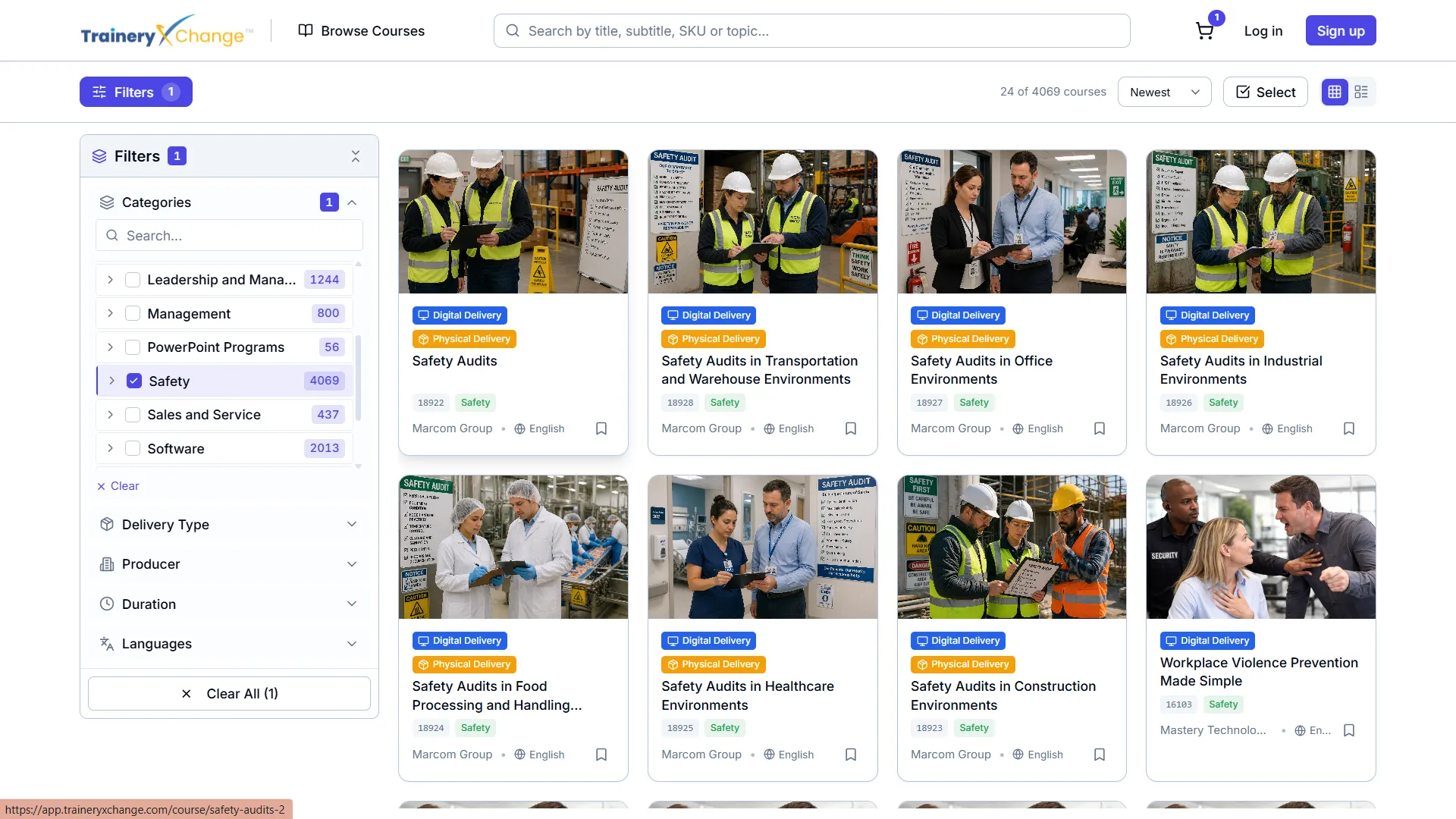
TraineryXchange provides access to 18,000+ training content options across its marketplace. Buyers can evaluate content alongside their delivery requirements, including TraineryLMS and supported existing-LMS workflows. Course availability, licensing, technical format, language, accessibility features, credentials, and update processes should be confirmed for the specific content being considered.

For organizations comparing content sourcing models, see our marketplace vs. in-house content guide. To discuss catalog fit and delivery requirements, book a demo.

Conclusion

Training marketplace quality assurance is strongest when it is evidence based. Define the requirement, verify the course and publisher, test the technical workflow, confirm regulatory and credential scope, and document how updates are governed. That approach is more defensible than relying on catalog size, star ratings, accreditation labels, or claims that content stays current automatically.

Key Takeaways:

  • Verify the publisher’s documented review process instead of assuming marketplace content is legally accurate.
  • Match compliance courses to the applicable jurisdiction, role, and governing requirement.
  • Test course files and completion data in the actual LMS configuration before broad deployment.
  • Confirm accessibility, language, credential, and continuing-education details at the individual course level.
  • Ask how publishers review, version, communicate, and retire content when requirements change.

How to Evaluate Training Marketplace Content Quality

A large training catalog can improve choice, but catalog size alone does not establish course quality. L&D and compliance teams still need a repeatable way to evaluate whether a course fits the audience, learning objective, technical environment, and applicable requirements.

This guide provides a practical quality-assurance checklist for evaluating courses from a training content marketplace. The goal is not to assume that every marketplace follows the same vetting process. It is to identify the evidence a buyer should request before deploying content.

1. Review Instructional Fit

Start with the learning objective and audience rather than a preferred duration or format. A short microlearning module can work well for reinforcement, while a longer course, scenario, demonstration, or practice activity may be appropriate for a more complex skill.

  • Objective: Is the expected learner outcome clearly stated?
  • Audience: Does the content match the learner’s role, experience, and context?
  • Practice: Are scenarios, questions, demonstrations, or activities appropriate for the objective?
  • Assessment: Does the assessment measure the stated objective rather than simply recall?

2. Verify Subject-Matter Review

Do not infer expertise from a course title alone. Ask who developed or reviewed the content, what qualifications are relevant to the topic, when the material was reviewed, and whether sources are identified where appropriate.

Credentials can be useful evidence, but no single certification should be treated as a universal requirement for every cybersecurity, leadership, safety, or compliance course.

3. Check Regulatory Scope Carefully

Compliance content requires additional diligence. A course should not be treated as legally sufficient simply because it mentions a law or regulation.

  • Governing source: Identify the law, regulation, policy, contract, or internal standard driving the training requirement.
  • Jurisdiction: Confirm whether the course is intended for federal, state, local, industry-specific, or international use.
  • Audience and role: Verify that the course addresses the workers or roles covered by the requirement.
  • Currentness: Confirm the publisher’s review date and process for evaluating relevant changes.
  • Legal review: When legal sufficiency matters, use qualified legal or compliance counsel rather than relying on marketplace labels alone.

For a broader planning framework, see our compliance training priorities guide.

4. Test Technical Compatibility

Technical compatibility should be verified in the buyer’s actual environment. SCORM, xAPI, AICC, and LTI describe different standards and workflows, and support can vary by course, publisher, LMS, and implementation.

  • Confirm the file or delivery format for the specific course.
  • Test launch, navigation, completion, score, bookmarking, and reporting behavior where those functions are required.
  • Test representative desktop and mobile experiences rather than assuming universal device compatibility.
  • For existing-LMS delivery, confirm the supported integration method and required configuration.

See the LMS delivery and LTI guide for architecture considerations.

5. Verify Accessibility and Language Requirements

Ask for course-level evidence about captions, transcripts, keyboard access, screen-reader behavior, visual contrast, language availability, and other accessibility features relevant to the learner population. Do not assume every course in a marketplace has identical accessibility or translation coverage.

6. Validate Credentials and Continuing-Education Credit

Professional-development credit should be confirmed at the individual course level. SHRM, HRCI, PMI, and other organizations have their own provider, program, and recertification rules. OSHA Outreach training is a separate program and should not be described as professional accreditation or a generic continuing-education credential.

Before promoting a course as eligible for credit, verify the current provider status, course eligibility, credit amount, learner requirements, and documentation with the relevant credentialing organization.

7. Ask About Versioning and Content Updates

Content does not remain current automatically. Buyers should understand how each publisher monitors relevant changes and how the marketplace handles revised or retired courses.

  • Monitoring: Who watches for changes that may affect the course?
  • Review: What triggers a content review, and who approves revisions?
  • Notification: How are customers informed when a version changes?
  • Delivery: Does a revised course require a new assignment, package, link, or configuration?
  • Records: How are historical completions and prior versions retained?

There is no safe basis for assuming that a legal change automatically retires a course or swaps a new version into every customer LMS. Update behavior depends on the publisher, licensing model, delivery method, and customer configuration.

8. Use Ratings as One Signal, Not the QA Standard

Learner ratings can reveal usability or relevance problems, but popularity does not establish legal accuracy or learning effectiveness. Combine learner feedback with completion data, assessment results, support issues, manager observations, and other evidence that fits the training objective.

Questions to Ask a Training Marketplace

  • What quality criteria are documented for publishers and courses?
  • Which checks are performed by the marketplace, and which remain the publisher’s responsibility?
  • How is regulatory scope represented and reviewed?
  • What technical formats and delivery methods are available for this specific course?
  • What accessibility and language information is available at course level?
  • How are revisions, retirements, and customer notifications handled?
  • Which credentials or continuing-education credits are verified for this course?

Where TraineryXchange Fits

TraineryXchange provides access to 18,000+ training content options across its marketplace. Buyers can evaluate content alongside their delivery requirements, including TraineryLMS and supported existing-LMS workflows. Course availability, licensing, technical format, language, accessibility features, credentials, and update processes should be confirmed for the specific content being considered.

For organizations comparing content sourcing models, see our marketplace vs. in-house content guide. To discuss catalog fit and delivery requirements, book a demo.

Conclusion

Training marketplace quality assurance is strongest when it is evidence based. Define the requirement, verify the course and publisher, test the technical workflow, confirm regulatory and credential scope, and document how updates are governed. That approach is more defensible than relying on catalog size, star ratings, accreditation labels, or claims that content stays current automatically.
Frequently Asked Questions

Can I see the vetting scorecard?
How does this compare to open content libraries like YouTube?
Do you vet for Accessibility (ADA/508)?
What happens if a course we bought is retired?
Can we add our own vetting criteria?
How often are courses reviewed?