
%201.svg)
Enterprise learning becomes difficult when the organization has many courses, systems, vendors, and reporting requirements but no shared rule for deciding what should be taught, who needs it, how it should be delivered, and what evidence will show that the program is useful. A large catalog or a sophisticated LMS does not solve that coordination problem by itself.
Quick answer: An enterprise learning strategy is a structured plan for how an organization develops workforce capability in support of business priorities. It typically covers needs assessment, content strategy, delivery infrastructure, governance, and measurement. The strategy should guide decisions about what to build, what to source, which audiences to prioritize, how learning data is managed, and how programs will be reviewed over time.
This guide is designed for HR and L&D teams responsible for multi-role, multi-location, or higher-volume training. It complements the broader learning and development, enterprise training, and training operations use cases on TraineryXchange.
What an Enterprise Learning Strategy Should Cover
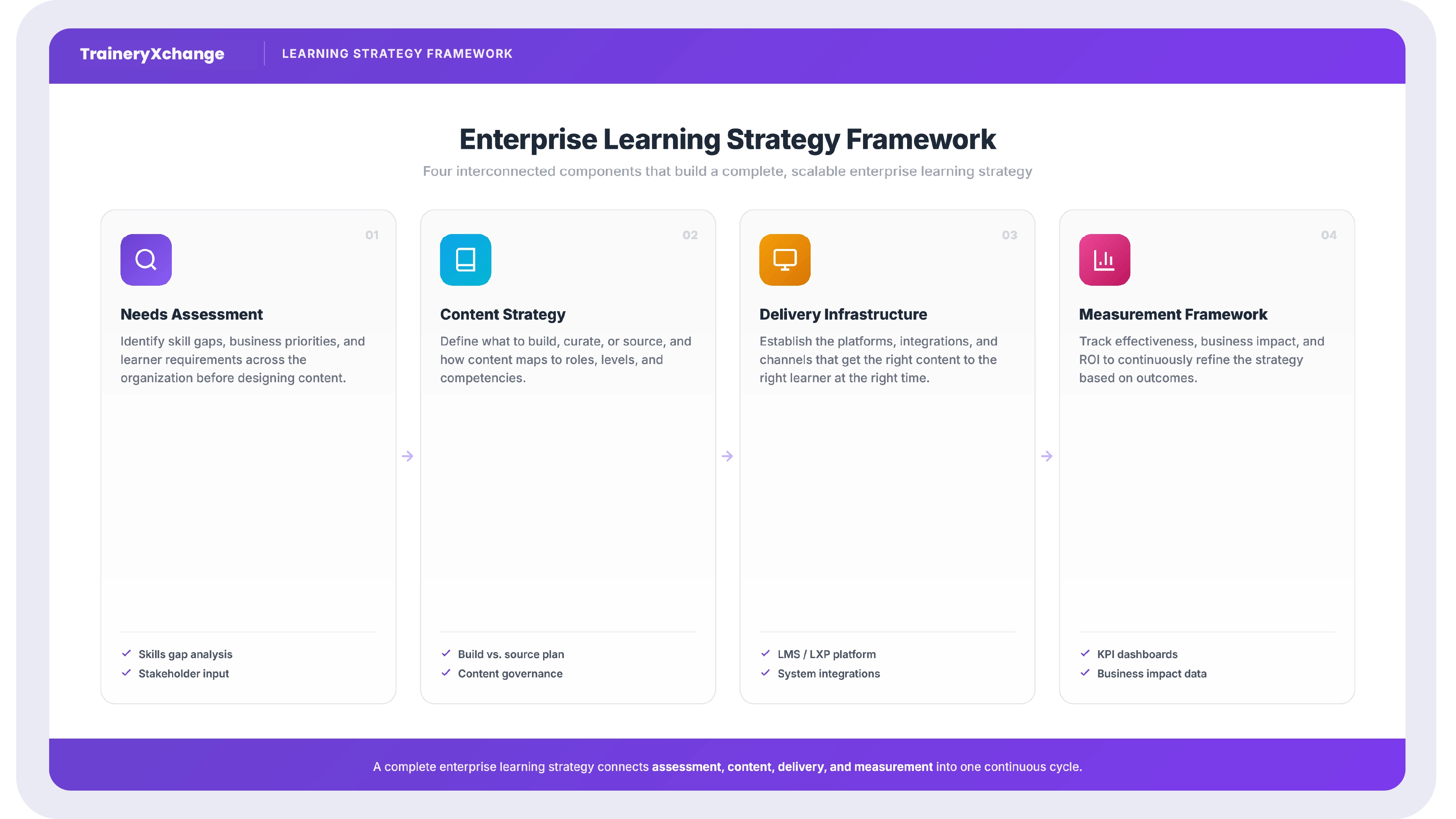
1. Business and capability priorities
Start with the work the organization needs to perform, the risks it must manage, and the capabilities that could limit execution. That may include regulatory obligations, new-hire readiness, manager capability, product knowledge, customer service, safety, technical skills, or future-role development.
A useful strategy translates broad goals into specific workforce questions. Instead of “improve leadership,” define which manager populations need support, which behaviors matter, and what evidence would show that a change occurred. Instead of “upskill for AI,” identify the actual tools, workflows, responsibilities, and governance requirements that affect each role.
2. Content strategy
Content strategy determines what should be built internally, licensed externally, curated from existing resources, or delivered through another format such as coaching, practice, documentation, or manager-led instruction. The right answer varies by topic.
Organization-specific products, systems, policies, procedures, culture, and operating models often require internal content. Common topics may be candidates for licensed content when the publisher, learning objectives, jurisdiction, accessibility, format, and maintenance model fit the organization’s requirements. TraineryXchange’s corporate training content marketplace and training content curation pages describe content-sourcing options without assuming one model fits every program.
3. Delivery infrastructure
Delivery infrastructure includes the LMS or learning platform, identity and provisioning, integrations, content-delivery methods, assignment workflows, learner access, reporting, support, and data ownership. Requirements should be based on real workflows rather than a generic feature list.
Organizations with an existing LMS may prioritize compatibility and data flow. Others may evaluate TraineryLMS or another platform as the primary learning system. Where LTI, SCORM, xAPI, hosted delivery, or other standards are relevant, verify the exact version, services, content, and LMS configuration rather than assuming universal behavior. See the LTI integration and integration pages for related implementation considerations.
4. Governance and measurement
Governance defines who can assign training, who approves content, how regulated or high-risk material is reviewed, where learner data is stored, how long records are retained, and what happens when content changes. Measurement defines the evidence used to review learning activity, capability, behavior, and relevant business outcomes.
Four Enterprise Learning Categories to Plan Separately
Enterprise strategies are easier to operate when different learning categories are not forced into the same model.
| Category | Typical Requirement | Content Approach | Measurement Focus |
|---|---|---|---|
| Compliance and required training | Documented assignment, due dates, completion records, jurisdiction or role relevance | Internal or licensed content depending on obligation, authority, maintenance, and legal review | Assignment, completion, overdue status, assessment where appropriate, record retention |
| Onboarding | Role readiness, policies, systems, culture, manager support | Usually a blend of common and organization-specific content | Completion plus role-relevant evidence such as knowledge checks, manager sign-off, or time-to-proficiency indicators |
| Leadership and professional development | Practice, reflection, feedback, coaching, manager application | Licensed, custom, facilitated, coaching, or blended depending on program design | Participation, capability evidence, observed behavior, employee or manager feedback |
| Reskilling and future capability | Emerging tools, workflows, role transitions, strategic skills | Frequently updated content plus practice and work-based evidence | Skill evidence, adoption, quality of application, mobility or staffing signals where appropriate |
For onboarding-specific planning, see the employee onboarding page. For required learning, review compliance training. For leadership-related content and operations, the training teams and L&D pages provide related workflows.
Build, Source, or Blend? A Practical Decision Matrix
| Question | Build Internally When: | Source Externally When: | Use a Blend When: |
|---|---|---|---|
| Is the topic organization-specific? | The content depends on internal products, systems, policies, procedures, terminology, or examples. | The topic is broadly applicable and a qualified provider offers suitable material. | External foundations need internal policy, workflow, or case-study layers. |
| How often can the topic change? | The organization owns the authoritative source and can maintain updates reliably. | A specialist publisher is better positioned to maintain the topic. | The external core changes while internal job aids or policy notes remain organization-owned. |
| What evidence is required? | The organization needs custom practice, workflow evidence, or internal sign-off. | Standardized knowledge, awareness, or skill objectives are suitable. | A sourced course is followed by internal practice, coaching, or observation. |
| What delivery constraints apply? | Internal systems or sensitive information prevent external delivery. | The licensed format works with the organization’s LMS and learner environment. | Different audiences or systems require multiple delivery methods. |
There is no reliable universal percentage for how much enterprise training should be sourced versus built. The mix depends on business specificity, subject-matter ownership, risk, audience, update frequency, internal capacity, licensing, and the actual quality of available content.
Review Content Before Building from Scratch
TraineryXchange can help L&D teams review curated course options, licensing, delivery, and TraineryLMS workflows before committing internal production resources.
How to Build an Enterprise Learning Strategy: Six Steps
Step 1: Define the business decisions learning must support
List the business priorities, workforce risks, and role changes that could create a capability requirement. Then convert those priorities into specific learning or performance questions. Some problems will not be training problems; missing tools, unclear processes, incentives, workload, staffing, or access may require another intervention.
Step 2: Audit existing content and programs
Inventory required learning, onboarding, manager development, role training, professional development, and other active programs. Review each item for owner, audience, objective, last review date, usage, duplication, accessibility, and whether it still reflects current policy or work.
Do not retire content solely because usage is low. First determine whether the issue is discoverability, relevance, assignment logic, audience mismatch, or content quality. Likewise, high completion does not prove a course is effective if it is mandatory.
Step 3: Decide build, source, retire, or redesign
Use the decision matrix above. For externally sourced content, inspect the actual course, not only the catalog description. Review learning objectives, subject-matter expertise, update practices, accessibility, languages, assessment, licensing, and compatibility.
For high-risk or regulated topics, confirm who is responsible for legal or compliance interpretation. Training content can support an obligation, but it should not be treated as a substitute for legal advice or organization-specific policy review.
Step 4: Design delivery and administration around real workflows
Map how users enter the system, how roles or groups are created, who assigns training, how managers view status, how records are exported, and who handles support. If content will be delivered into another LMS, test the selected integration or delivery method with representative courses and reporting requirements.
Step 5: Define measurement before launch
Separate four levels of evidence:
- Activity: enrollment, attendance, completion, time, attempts.
- Learning: knowledge checks, assessments, demonstrations, simulations.
- Application: manager observation, work samples, process adherence, quality checks.
- Business outcomes: retention, productivity, sales, safety, compliance incidents, quality, customer measures, or another relevant metric.
Business outcomes are influenced by many factors. If a metric changes after a program, report the association and methodology rather than automatically claiming training caused the result. Where ROI is calculated, document program costs, the benefit assumptions, the comparison period, and other plausible influences.
Step 6: Create a review cycle
Enterprise learning should be reviewed when business priorities, regulation, policy, technology, roles, products, or workforce conditions change. Different programs can use different review triggers; a fast-changing technical course may need more frequent review than a stable manager-development program.
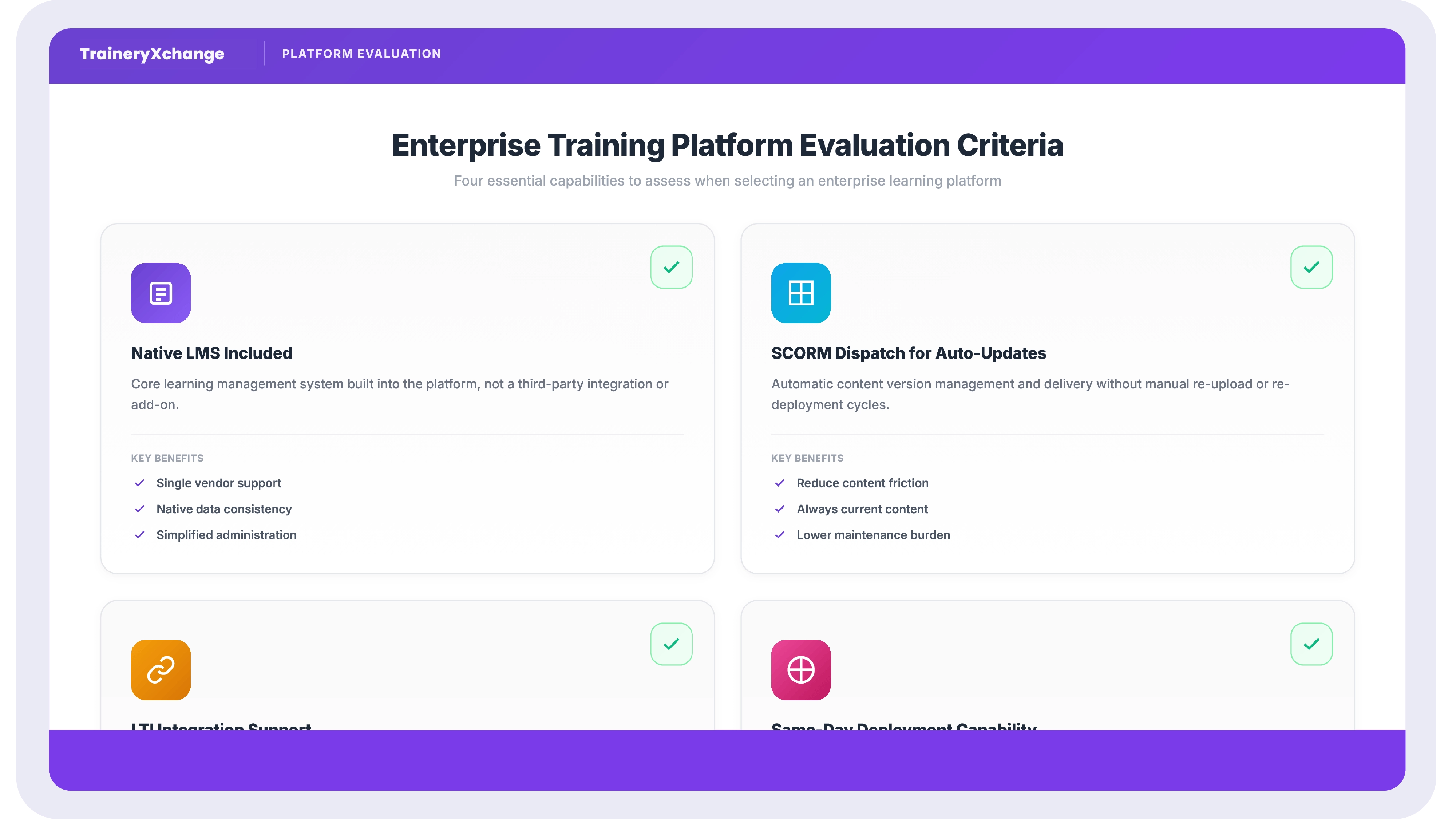
Enterprise Learning Platform Evaluation Checklist
- Which audiences, locations, roles, and business units must be supported?
- Which content is internal, licensed, or delivered through partners?
- Which LMS, HRIS, identity, communication, or reporting integrations are required?
- Which content standards or delivery methods are required for the selected courses?
- How are users provisioned and removed?
- How are groups, assignments, reminders, and manager views administered?
- Which learning records can be exported, and who owns the data?
- How are content updates communicated or delivered?
- What security, privacy, accessibility, retention, and localization requirements apply?
- What implementation, administrator training, and support are included?
- What will be measured directly in the learning system versus another business system?
- What are the renewal, licensing, data-export, and termination terms?
Public pricing, trials, bundled content, native LMS capability, SCORM Dispatch, LTI, and other features can be useful evaluation factors, but availability should be verified for the exact vendor, plan, content, and configuration. Avoid using fixed implementation-time or cost benchmarks as if they apply to every organization.
Common Enterprise Learning Strategy Mistakes
| Mistake | Why It Creates Risk | Better Approach |
|---|---|---|
| Treating the LMS as the strategy | Technology is selected before business needs and workflows are defined. | Define use cases, evidence, governance, and content requirements first. |
| Assuming all common topics should be sourced | External content may not fit the organization’s policy, jurisdiction, audience, or learning objective. | Review course-level fit and ownership requirements. |
| Assuming all content updates automatically | Update behavior depends on publisher, license, delivery method, LMS, and configuration. | Document the update workflow for each important content category. |
| Measuring only completion | Completion shows participation, not necessarily learning, application, or business impact. | Select evidence that matches the program objective. |
| Claiming ROI without a method | Business outcomes are multi-causal, so simple before-and-after comparisons can mislead. | Define baselines, assumptions, comparison windows, and limitations. |
Practical Next Steps
- Choose three business or workforce priorities that learning may need to support.
- Map the audiences, capabilities, and evidence required for each priority.
- Audit existing content before buying or building more.
- Classify each requirement as build, source, blend, retire, or non-training intervention.
- Test delivery and reporting workflows with representative users and courses.
- Define measurement and review triggers before launch.
A strong enterprise learning strategy does not promise that every program will create a measurable business outcome. It creates a disciplined way to decide where learning is appropriate, what evidence matters, how content and systems should be managed, and when the organization should change course.
Review Enterprise Learning Content and Delivery Options
Discuss curated content, licensing, TraineryLMS, supported delivery methods, and implementation requirements for the learning priorities already defined in your strategy.
Book a Demo




%5B1%5D.svg)
